
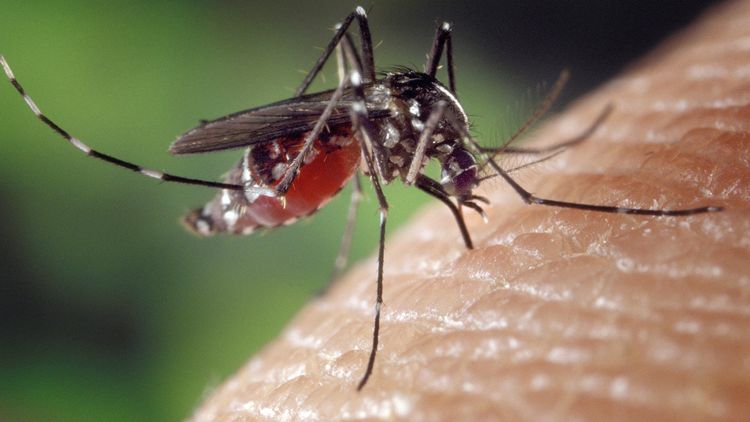

Different mosquitoes - different characteristics. Young scientists Felix Sauer and Tobias Lauermann are investigating the differences in the ecological requirements of mosquitoes.
Mosquitoes have a bad image - yet Felix Sauer and Tobias Lauermann from the Aquatic Ecology and Nature Conservation working group at the Institute of Biology and Environmental Sciences are passionate about researching these pests. "There are still so many unanswered questions about mosquitoes - especially their ecology. I find that exciting," says Sauer. First and foremost, he wants to find out how likely it is that mosquitoes in this country will also become carriers of life-threatening pathogens. Tobias Lauermann's research is all about midges - extremely small bloodsuckers that are often found on farms. "We know next to nothing about midges, even though they live in our immediate environment and also transmit diseases. I want to change that," says Lauermann.
Each mosquito species has its own preferences and the doctoral candidates, led by Prof Dr Ellen Kiel, are researching these ecological requirements. To this end, they also take samples from dung heaps or use a kind of hoover to systematically record the midges and mosquitoes in the bushes. "The common mosquito, for example, likes to hang out near human dwellings, while other species live mainly in wetlands," explains Sauer. Many midges, on the other hand, are particularly focussed on livestock and therefore nest near stables. However, they all have one thing in common: in order to produce enough eggs, the females need blood, which they obtain from humans or animals.
In warmer parts of the world, mosquitoes transmit pathogens that can cause life-threatening diseases. In recent years, two mosquito species have appeared in southern Germany that were previously not native to the region: The tiger mosquito, which can transmit the Zika and dengue viruses, among others, and the bush mosquito, which is considered a carrier of the West Nile virus, among others. However, despite these invaders, it is currently unlikely to become seriously ill in this country after a mosquito bite, says Sauer. "These pathogens do not yet play a role here. However, climate change and global trade could perhaps change this - questions that form the background to our research projects," says the doctoral candidate. As part of a federal project, his dissertation is intended to contribute to a mosquito risk assessment for Germany.
The risk that midges - the mini bloodsuckers from farms - pose to Europe has been known since 2006 at the latest. At that time, bluetongue broke out in Germany. As the midges spread the virus en masse, it caused millions in damage throughout Europe. For Sauer and Lauermann, there is much to suggest that 2018 will be an intense year for mosquitoes. There was enough moisture in autumn and winter for eggs and larvae to thrive. If you want to protect yourself, you should either empty or cover standing water around the house - for example in rain barrels. However, the assumption that light attracts mosquitoes is just as false as the myth of sweet blood. "Whether I get bitten depends primarily on
body odour," says Sauer. The ultimate attractant for mosquitoes is the CO2 that humans emit with the air they breathe. "However, stopping breathing because of this is not a solution," says Lauermann with a wink. Better to put a mosquito net in front of the window.