
Without grammar, there is no language - otherwise there would be no structure. This also applies to Sater Frisian. Anyone wishing to learn it can now refer to an up-to-date reference work. An Oldenburg student has also contributed to this.
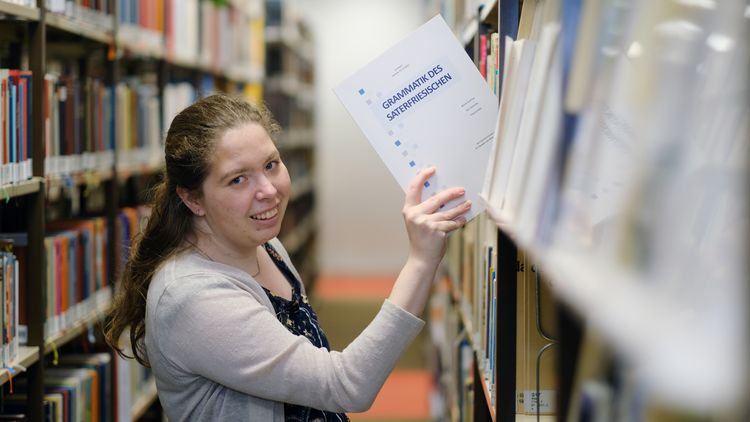
Träi Monljude and tjo Wieuwljude - three men and three women. Sater Frisian has a masculine and a feminine word for the number three. These and other linguistic peculiarities are revealed in the new grammar of Sater Frisian, which was published by a team from the Fryske Akademy in Leeuwarden (Netherlands) in December last year. Dr Eric Hoekstra and Bouke Slofstra, two linguists from the research centre, have worked together with Oldenburg student Tessa Leppers to create a comprehensive reference work that is primarily intended for learners. "The grammar is generally understandable, so that not only a scientific audience, but anyone interested can use it," explains Leppers, who completed a five-month internship at the Frisian Academy.
Born in the Netherlands, she studied "European Languages and Cultures" at the University of Groningen and then decided to do a master's degree programme in German Studies in Oldenburg. She had already spent a semester abroad here during her bachelor's degree. "I liked the university and the city so much that I really wanted to do my Master's in Oldenburg," says the 27-year-old. However, the coronavirus pandemic made it difficult for Leppers to travel to Germany. She therefore decided to complete an internship in her home country. At the Frisian Academy, she finally gained deep insights into the language of the Sater Frisians - a recognised minority in Germany.
Important milestone for the minority language
"Sater Frisian is spoken in what is now the joint municipality of Saterland in the district of Cloppenburg by a small language community," explains Heike Schoormann, who researches Sater Frisian at the Institute for German Studies in Oldenburg. Sater Frisian is a remnant of Old East Frisian, which was spoken in the former East Frisian language area along the North Sea coast until the end of the Middle Ages. After that, Low German prevailed - except in a few places that were remote at the time, such as Saterland. The Frisian language family also includes West Frisian, spoken in the Dutch province of Friesland, and North Frisian in Schleswig-Holstein.
The new 117-page reference work not only summarises grammar rules and examples for the minority language "Seeltersk", but also takes spelling and pronunciation into account. One special feature, for example, is that there is no genitive in Sater Frisian; instead, constructions with "von" are used: do Ponnen fon dät Huus sunt rood - the roof tiles of the house are red. Tessa Leppers was mainly involved in the chapter on verbs and the final correction. "Of course, Sater Frisian is a very small area in linguistics, only around 2,250 people speak it. But that doesn't make it any less interesting for me," says Leppers. In fact, the language is now threatened with extinction - it is being used less and less. "Grammar makes an important contribution to preserving the language and I'm delighted to be able to play a part in this," says Leppers. The fact that she doesn't speak Sater Frisian herself is not a problem, on the contrary: "I notice certain aspects better, I notice different things than native speakers."
A new grammar was long overdue, as the previous version "Kute Seelter Sproakleere" by Pyt Kramer dates back to 1961 and is long out of print. It served as the basis for the new version. The authors also looked at academic literature on Sater Frisian and literary works in Sater Frisian as well as language recordings of Kramer from the 20th century.
Second edition in progress
A milestone has been reached with the current grammar: together with the dictionary by Dr Marron C. Fort, the former head of the "Low German and Sater Frisian" department at the University of Oldenburg who died in 2019, there is now a comprehensive overview of the Sater Frisian language - which is available for further work. And this is already in full swing: Leppers and her colleagues are already working on a second version, which will be much more detailed and aimed primarily at an academic audience. "We want to go into even more detail on individual topics, such as irregular verbs," explains Leppers, who was also involved in the second version as part of her internship. The student is already looking forward to holding it in her hands in the near future.