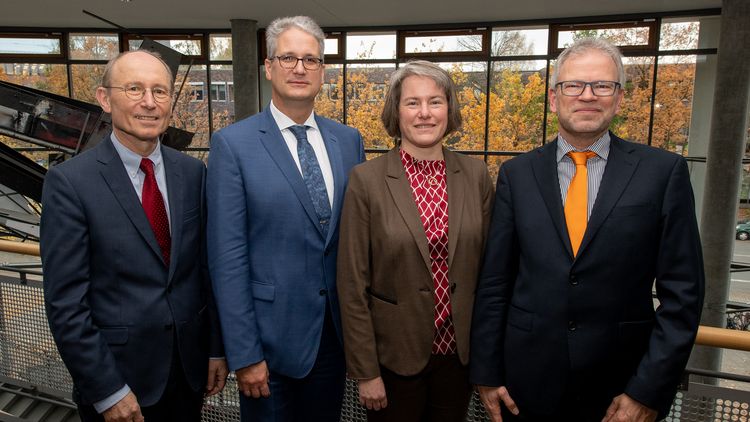

The University Senate today set the course for the leadership of the university from 2020. It confirmed chemistry didactician Verena Pietzner and Computing Science expert Martin Fränzle as new Vice Presidents and voted in favour of a second term of office for Jörg Stahlmann.
Following a proposal by President Prof. Dr Dr Hans Michael Piper, the University Senate confirmed Prof. Dr Verena Pietzner as Vice President for Studies, Teaching and Internationalisation and Prof. Dr Martin Fränzle as Vice President for Research, Transfer and Digitalisation. The University Senate's vote will be submitted to the Lower Saxony Ministry of Science (MWK) for a decision together with the opinion of the University Council, which will meet next week. The two-year term of office of the part-time members of the Executive Board is expected to begin on 1 January 2020.
The University Senate also voted today in favour of appointing the full-time Vice President for Administration and Finance, Jörg Stahlmann, for a second, now eight-year term of office ahead of schedule and without advertising. This vote will also be submitted to the MWK for a decision shortly together with the University Council's statement. Stahlmann has been in office since 2015, having previously served as an interim representative.
University President Piper explained that he is looking forward to continuing to advance the "university, which has been developing very dynamically for years" in proven cooperation with Stahlmann, an administrative and financial expert, and once again with two proven personalities from research and teaching. "I would already like to thank the outgoing Vice Presidents for their highly committed work," said Piper. The term of office of the current Presidential Board will last until the end of the year. Pietzner will then succeed the Germanist Prof Dr Sabine Kyora, who was in office for four years, while Fränzle will take over from the biologist Prof Dr Meinhard Simon. The successor to linguist Prof Dr Esther Ruigendijk - who has also been Vice President for four years - has not yet been decided.
In her speech to the University Senate, Pietzner emphasised that her main task over the next two years will be the introduction of so-called system accreditation. "This will enable the university to review the quality of degree programmes under its own responsibility and to continuously adapt them to scientific and social developments." Digitalisation will also play an important role in the further development of study and teaching processes between the Schools and central units. Pietzner sees the new departmental structure, which combines studies and teaching as well as internationalisation, as an opportunity for closer integration - for example to anchor "mobility windows" in the degree programmes: "The aim is to pave the way for our students to go abroad and remove previous hurdles in the management of studies." In order to minimise language barriers, she is also focusing on additional courses in English.
Fränzle emphasised the importance of scientific knowledge for our society, its development and change. This forces us to view research and transfer as a unit. One example of this is the "Digitalisation" department, which has been explicitly named for the first time at a university in Lower Saxony, with its many facets. Digitalisation is not only a technical tool in teaching, research and administration, but also a transdisciplinary field of research with technical, ethical, legal and democratic dimensions and consequences for individuals and society as a whole. The university's future digitalisation strategy, which needs to be developed "in a broad interdisciplinary dialogue", must take all of this into account. In order to promote all future fields of the university, he will systematically support new research and transfer projects.
In his speech, Stahlmann emphasised the challenges posed by the university's constant growth in terms of student numbers, professorships, research projects and the number of employees. In order to secure research, studies, teaching, but also service and administration, the necessary infrastructure is essential - whether it is energy-efficient buildings, new space or computer capacity and IT security. Stahlmann also named the further successful expansion of the School of Medicine, which urgently needs a centralised research and teaching building, as a goal for the coming years. Within the university, but also with partners such as the cooperating hospitals of university medicine, transparent administrative structures are also indispensable. He also attaches importance to new quality management and further digitalisation. Stahlmann emphasised that the people who make up the university and a culture of cooperation are at the centre of all of this.