


A revolution in the energy market - nothing more and nothing less is the goal of the "Empower Generations" project. Oldenburg business IT specialists are developing a technology that enables small electricity producers to sell their surpluses directly
Electricity trading is a complicated business. German energy suppliers buy and sell quotas on the EEX electricity exchange in Leipzig. Prices fluctuate greatly, sometimes by a factor of two within a few hours. Homeowners with a photovoltaic system on their roof have not yet been able to benefit from high prices at times of high demand: They have to feed their surpluses into the grid at the relatively low fixed price of just under twelve cents per kilowatt hour.
But what if owners of photovoltaic systems, wind turbines or biogas plants could sell the electricity they produce directly - preferably to neighbours or businesses in the area? "You would no longer need an energy supplier as a middleman and everyone involved would save money," says Stefan Wunderlich.
Direct energy trading in a mini model village
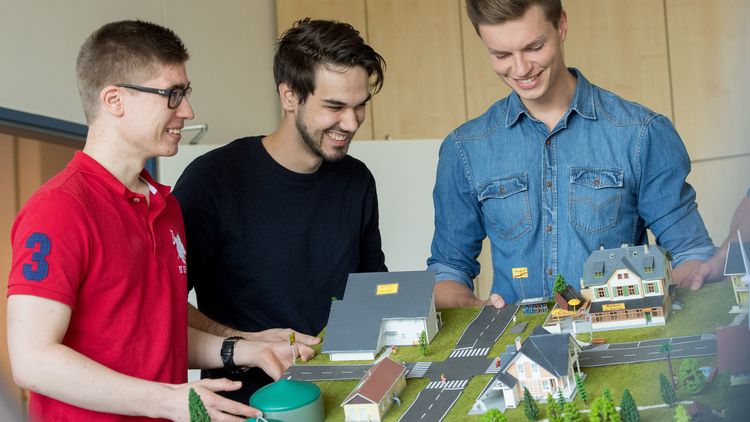
The business informatics specialist is leading the Empower Generations project, which is running until the end of the year at the university in the Department of Business Informatics (Very Large Business Applications), headed by Prof Dr Jorge Marx Gómez. In a feasibility study, twelve students and developers from the Oldenburg software company the peak lab are investigating what infrastructure would be needed to realise direct energy trading.
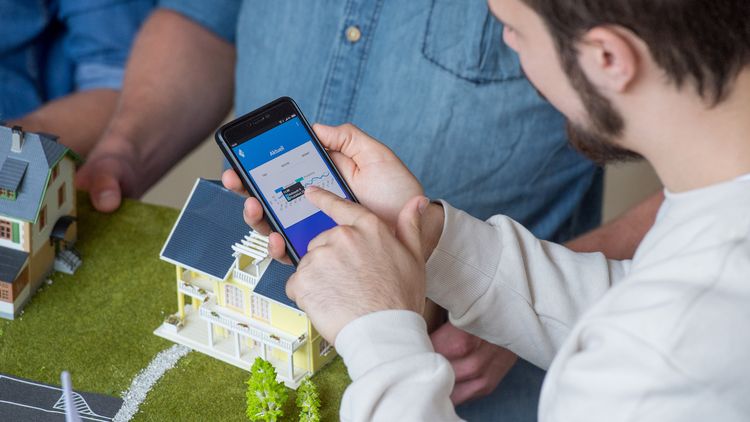
The team has built a model on a plate measuring around 80 centimetres by one metre in order to test the concept on a small scale. In this mini model village, there are various electricity generators, such as residential buildings with photovoltaic systems, a biogas plant and wind turbines. The consumers are mainly owner-occupied homes. The idea behind it: In future, similar networks of consumers and producers could form island power grids within which the electricity generated from renewable sources could be traded. The Oldenburg business IT specialists have already developed software that records consumption and production and stores all transactions in a decentralised database. The programme also calculates the electricity price and allocates quotas to consumers.
Blockchain technology for transparency and legal certainty
To make this work, small single-board computers with the software are located under each building in the model village and are networked with each other. In reality, each house would also have to be equipped with a smart electricity meter that can send and receive data. It is also important to have a database in which generated and consumed, bought and sold electricity quantities are stored together with the time and the price realised - in a transparent and legally secure manner. "We need blockchain technology for this," explains Marx Gómez.
The buzzword "blockchain", which has become known through the online currency Bitcoin, is based on an ingenious principle: databases that are structured according to this principle can be accessed by numerous users, yet the data is stored there in a tamper-proof manner. Such databases consist of so-called blocks that are strung together like a chain - for example, a new block is added every quarter of an hour. This contains a data record that contains all transactions that have taken place within the quarter of an hour. The special thing about this is that a cryptographic process is used to generate a characteristic checksum from all the data in a block, which is mathematically uniquely dependent on the data. This number in turn flows into the data of the next block and into its checksum. In this way, the data of all blocks is linked together. If someone changes even just one number in an older data record, the system sounds an alarm, as the checksum then no longer matches the subsequent blocks. Because the calculation rules are highly complex, it is virtually impossible to manipulate data. "The structure of the blockchain ensures that nothing can be changed retrospectively," emphasises Wunderlich.
Network limited to a few hundred participants
Of course, there is one limitation: the complexity of the mathematical operations increases dramatically the more data there is. "Our programme can therefore not be scaled up indefinitely," says Wunderlich. For Empower Generations, this means that the island networks within which electricity can be traded are limited to a few hundred participants. According to the team, however, this is not a problem: "Many experts assume that the electricity grid of the future will be divided into numerous sub-grids, which in turn will be connected to a central grid.
The Oldenburg team presented the model and the current status of the project at the CEBIT digital trade fair in Hanover in mid-June. "We have a prototype that is well developed at hardware and software level," says Wunderlich, describing the status quo. The interaction between smart electricity meters, mini-computers and the software is already working well. The team has also developed a mobile app that allows homeowners, for example, to keep an eye on the electricity production of their solar system, consumption and current price. "This app is especially designed for users who want to keep a close eye on their energy consumption," says Wunderlich.
He and his colleagues are now working on expanding the model - and simulating charging stations for electric cars, for example. On the other hand, the aim is to improve the forecasting algorithm. "Our software currently plans the supply one day in advance every quarter of an hour," reports Wunderlich. Strictly speaking, this requires two forecasts: one for generation and one for consumption.
Good weather forecast required
In order to determine how much electricity the existing generators will produce in the coming day, a good weather forecast is particularly important for renewable energies such as wind and solar power. Forecasts of consumption can best be determined by algorithms using existing data. The Empower Generations team is currently using a freely available data set from Ireland to train the programme, but hopes to receive data from several hundred households in the local region in the near future - anonymised, of course. "In order to obtain a high quality forecast, you need precise and detailed data, which is something we are still lacking at the moment," says Wunderlich.
The response at CEBIT was so good that the project group is looking to the future with confidence and intends to acquire further third-party funding at the end of the project. Stefan Wunderlich is certain: "In 15 to 20 years, everyone will be using renewable energies at home. The only question is what the market will look like then." If he has his way, every solar system owner will then be able to automatically sell a few kilowatt hours to their neighbour on sunny days - at the optimum price.