Do I want to go to university? And if so, what will I study? Some school leavers explored these and similar questions during a Voluntary Academic Year (FWJ) at the University of Oldenburg. A group of six volunteers presented their final projects, all with a focus on the World Cup.
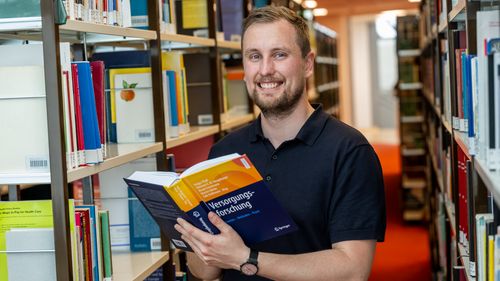
There’s a flurry of activity in Building 16A on the Wechloy campus: six FWJ graduates are about to present their final projects, giving those in charge a chance to look back on the course of their Voluntary Academic Year. The volunteers are currently wrapping up their educational period in science and research at the university. ‘The volunteers’ include Alaa Akar, Johanna Cordes and Friederike Hasselmann from the Department for Human Medicine; Finjas Künnemann from the Department of Health Services Research; and Rieke Wahlen from the Institute of Biology and Environmental Sciences. The group also includes Saeed Alsabbagh from the Department of Economics and Law. Saeed and Alaa are both graduates of the orientation year for refugees.
Getting to know academia
Since 2015, the University of Oldenburg has offered the opportunity to complete a <link fwj/>Voluntary Academic Year (FWJ)</link> as part of the Federal Voluntary Service. The FWJ is primarily aimed at A-level graduates who wish to gain an insight into research and academia. Volunteers typically spend twelve months familiarising themselves with academic subject areas and carry out support tasks in research and administration. Another component of the FWJ is the so-called compulsory training days: these are designed to familiarise participants with topics relating to academic work and research practice, to attend lectures and seminars, to make use of the academic advisory services, and to get to know various areas of the university. The university provides a monthly allowance of 400 euros during the FWJ, and each volunteer also receives a reference at the end of the programme.
Positive conclusion
For the closing event, the six FWJ graduates were given a specific task. In the spirit of the Football World Cup, they were asked to reflect on their time in the FWJ as if it were a football match. This involved questions such as: Who played in my team? Did I have opponents? Which goals did I score and/or concede? What strategy did I follow? Who was cheering me on from the sidelines? The results varied, but showed once again that, unlike with German football, participants are generally very satisfied with the FWJ programme. The volunteers gained an in-depth insight into research projects in healthcare research, the work of university hospitals, the fields of economics and law, and environmental sciences. Rieke Wahlen, for example, was part of Prof. Dr Victoria Burke’s four-person junior research group, which investigates the degradation and transport behaviour of various veterinary medicines in soil and groundwater. Rieke particularly enjoyed the practical work: “I was allowed to help out in the lab, carry out rapid tests or take samples at the lysimeter – a facility near the university that we used to sample soil leachate,” explains Rieke.
Rieke and the other FWJ participants presented their work through talks and scientific posters. Also present were: Prof. Dr Hans Gerd Nothwang, Dean of School V - School of Medicine and Health Sciences, Nina Löchte, Head of the Young Talent Development Programme, colleagues from the research groups, and Michael Kuck from the AWO, who, alongside Nadine Brandt – the university’s FWJ coordinator – provided educational support for the volunteers. It quickly became clear to the guests that the six had visibly gained experience and confidence during their time at the university.
With their sights set on their goals
All six are now certain that they want to study and are currently awaiting confirmation of their university places. Whether it’s environmental sciences, veterinary medicine, agricultural sciences or medicine – the FWJ has been a valuable guide for them all, making their choice easier. Perhaps this will turn out to be a very personal ‘summer fairy tale’ for them in 2018 at the University of Oldenburg.