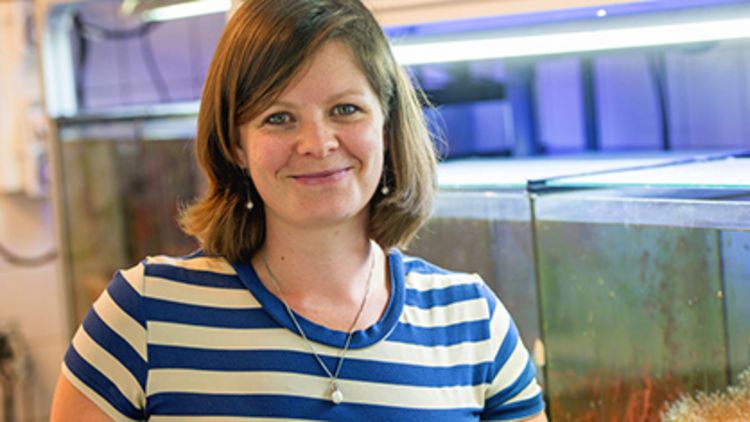

She wants to know how different animal species adapt to their environment and at what cost: Australian Dr Gabrielle Miller is conducting research as an Alexander von Humboldt Fellow at the Institute of Biology and Environmental Sciences.
The blackfin anemonefish actually seems quite peaceful. Dr Gabrielle Miller holds her finger in the aquarium and moves it back and forth a little. Within seconds, the black and red female shoots up and attacks the finger. The uninitiated spectator jumps back a step in horror - Gabrielle Miller smiles happily to herself: "Yes, yes, the ladies can get quite aggressive." The 31-year-old knows what she is talking about: she has spent years studying Amphiprion melanopus, the Latin name for the fish, on the Great Barrier Reef in Australia, a hotspot that is not only the dream of almost every marine biologist, but also of many other people.
The world's largest coral reef network stretches over an area of 350,000 square kilometres along Australia's east coast. That is roughly the size of Germany. And it is here, in northern Europe, that the Alexander von Humboldt scholarship holder has been living since last October: grey autumn, rainy winter, cold spring instead of sunshine. "Yes, I did miss the daylight at first," admits the coral reef researcher, who has been conducting research in the Biodiversity and Evolution of Animals working group at the Institute of Biology and Environmental Sciences (IBU) under the direction of Prof Dr Gabriele Gerlach since March following a four-month language course. She was constantly tired: "It was dark, I didn't understand the language and I didn't know anyone."
This inevitably raises the question: why would someone voluntarily swap such a "dream job" for the grey German reality? "The conditions for postdocs in Germany are actually better than in Australia," she says. Since the change of government Down Under, the situation for postdoctoral researchers who are still at the beginning of their careers has become even more difficult. "And the air is particularly thin in the field of coral reef research: little funding, but strong competition," the young woman summarises. She had already worked with her new boss in Oldenburg at James Cook University in Townsville - "a very trusting collaboration," says Miller.
However, the decisive reason why the scientist turned her back on her home country is yet another: she wanted to focus not only on coral reef research, but also on interdisciplinary issues. And that is exactly what she can do in Oldenburg. There are freshwater and saltwater aquariums in the working group's laboratories. Fish, crabs, shrimps and cnidarians live there under different light, water and feeding conditions.
Gabrielle Miller wants to know how these different model animal species adapt to their environment and what they have to pay for it, so to speak: ecologically, evolutionarily and reproductively. "I'm still at the beginning of my research, after all I've only been involved since 1 March," she says. But the researcher already feels completely at ease, the initial homesickness has been overcome - and her colleague Dr Sebastian Schmidt-Roach, with whom she shares an office and with whom she has already worked in Townsville, has also contributed to this. For the biologist, there is already no question that she would like to continue her research in Germany after the scholarship: "I can't achieve much in two years," she says.
And that somehow doesn't fit in with the young woman's CV. It reads like a picture-book scientific career: In addition to six publications as a doctoral student, various presentations and posters at international conferences, she has already received awards and scholarships and raised funding. For example, the "Science for Management Award", which the Great Barrier Reef Marine Park Authority presents to particularly dedicated reef researchers. Or the Australian Postgraduate Award. "We were constantly encouraged by our supervisors to raise funds and prizes," she says - obviously with success. Miller works as an invited reviewer for renowned journals such as Nature Climate Change, Marine Biology, Marine Ecology Progress Series, ICES Journal of Marine Science and Ecology and Evolution.
This young woman obviously always wanted to become a coral reef researcher - as determinedly as she has pursued her career. "But it wasn't like that at first," she says and laughs again. Because she has another dormant talent: singing. And so for a while she toyed with the idea of becoming an opera singer and even worked as a singer. "But that's completely over, I only sing in the shower," she confesses. Once the Australian has decided on a path, there's no turning back. "Of course the reef is beautiful, and of course I miss my family," she says.
Nevertheless, she looks forward to every new day in Oldenburg: "It's a little fairytale town with a fantastic university. And the Christmas market was a highlight for me." What the researcher particularly appreciates about the lab work is the constant conditions and the lack of blood-sucking "sandflies", which sometimes spoilt her enjoyment of the fresh air. "And I really wouldn't be happy as a field researcher in the reef in the long term, because I can't stand the intense sun," she reveals. So Oldenburg is exactly the right place.