
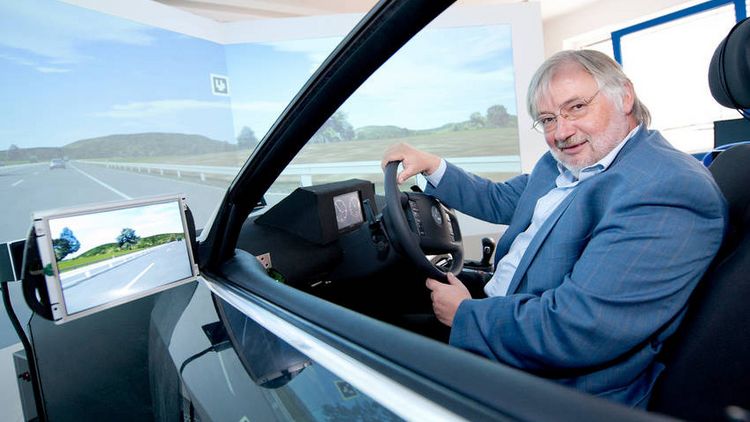

The university is to establish a new interdisciplinary research centre in the field of safety-critical systems. There, researchers will develop and test socio-technical systems for cars, aeroplanes, ships and trains. The aim: safe and environmentally sustainable mobility.
The researchers’ proposal, entitled ‘Interdisciplinary Research Centre on Critical Systems Engineering for Socio-Technical Systems’, was successful in the call for proposals jointly launched by the Lower Saxony Ministry of Science and the Volkswagen Foundation to ‘strengthen the competitiveness of higher education institutions in Lower Saxony’. A total of 19.5 million euros is available for this purpose from the “Niedersächsisches Vorab” funding programme. Five million euros of this will go to the Oldenburg Research Centre for Safety-Critical Socio-Technical Systems. Alongside the University of Oldenburg, the OFFIS Institute of Computing Science, the German Aerospace Centre (DLR) and the SafeTRANS Competence Cluster are involved in the research centre. The spokesperson is the Oldenburg-based computer scientist Prof. Dr Werner Damm.
“The new research centre builds seamlessly on both the long-standing DFG Collaborative Research Centre on Safety-Critical Systems and the university’s key research focuses in Neurosensory Science, Marine Technology and Medicine,” explains University President Prof. Dr Babette Simon.
Safety-critical systems are highly complex computer-based systems used in the automotive industry, aerospace, marine engineering, automation technology, energy supply and the healthcare sector. For example, they control the engine in vehicles, assist with navigation, lane-keeping and accident avoidance, and, as autopilot and collision-avoidance systems in aircraft and ships, contribute to safe air and maritime transport. The increasing interconnectedness of these systems and the incorporation of human behaviour give rise to so-called socio-technical systems, in which people and technical devices work together to solve tasks such as ensuring safe, environmentally sustainable mobility whilst providing comfort and efficiency for users. To ensure compliance with the required safety standards in the development of such systems, new, interdisciplinary approaches are needed that go far beyond those of traditional engineering disciplines such as Computing Science, electrical engineering or mechanical engineering.
It is of central importance to understand the interaction between the people acting within the overall system, their assistance systems and their technical and natural environment. This is where the Oldenburg Research Centre comes in. The scientists test and develop socio-technical systems, particularly in the transport sector – that is, for cars, aeroplanes, ships and trains. Their aim: safe and environmentally sustainable mobility. “Aeroplanes, ships and trains – they all operate using safety-critical systems. When developing these highly complex systems, we must take ‘human factors’ – that is, human influences – into account. This requires highly precise investigations and an interdisciplinary research approach,” emphasises Damm.
The reliability of safety-critical systems cannot be adequately tested in the laboratory alone. Large-scale simulations are necessary for this, which require close co-operation with industry. The collaborative partners – OFFIS, the DLR with its ‘Intelligent Mobility Application Platform’ (AIM) and SafeTRANS, with its network of industry partners – ensure that safety-critical systems can be tested under real-world conditions. “We see the research centre as a think tank where experts from academia and industry work together to advance research into safety-critical systems at the highest level,” said Damm. An integrated college is also dedicated to training early-career researchers.