


Antarctic krill cover vast distances during their migrations in the Southern Ocean. Researchers from the NaviSense Cluster of Excellence are setting up camp on the South Shetland Islands to investigate how these crustaceans navigate on these long journeys.
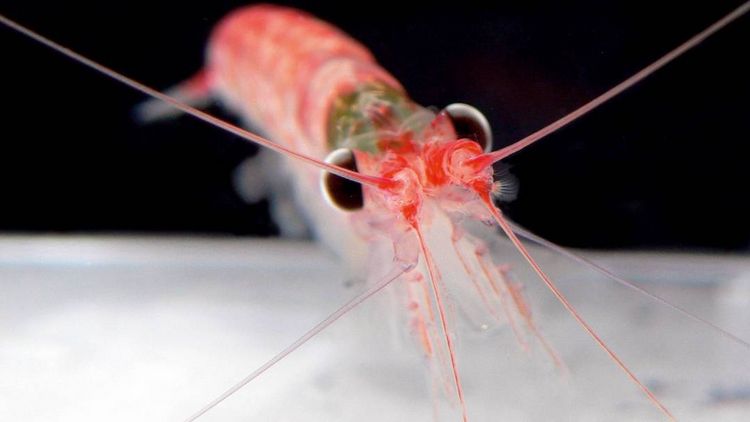
One of the largest animal migrations on this planet takes place for the most part unobserved. Off the coast of Antarctica, vast shoals of finger-sized, shrimp-like crustaceans move around beneath the water’s surface. Antarctic krill represent one of the most abundant wild animal biomasses on Earth, estimated at somewhere between 300 and 500 million tonnes. At certain times of the year, billions of these fragile creatures migrate hundreds of kilometres from one location to another, presumably above all for the purpose of reproduction.
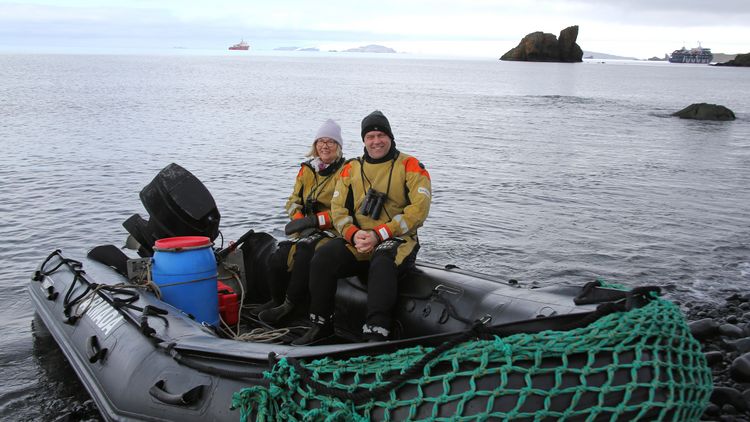
Yet how they find their way across such large distances remains for the most part a mystery. “Given the importance of this species for the Southern Ocean, it is astonishing that nobody knows how they navigate, what mechanisms govern their seasonal migrations, or whether they use the Earth’s magnetic field in this process,” explains Professor Dr Bettina Meyer, a biologist and head scientist in the NaviSense Cluster of Excellence, within which she hopes this mystery can be solved. She and NaviSense spokesperson and animal navigation expert Prof. Dr Henrik Mouritsen are currently on King George Island, situated north of the Antarctica Peninsula in waters which are particularly rich in krill. “‘When is the krill where?’ is a fundamental question that we are investigating in NaviSense,” says the scientist, who holds a joint professorship at the University of Oldenburg and the Alfred Wegener Institute in Bremerhaven.
Krill fishing is an important economic factor
With its research on Antarctic krill (Euphausia superba), the Cluster of Excellence is focusing on a key species in the Southern Ocean’s food web: these crustaceans feed on tiny algae, smaller crustaceans and the remains of other organisms. At the same time, they themselves are a vital food source for important species such as penguins, petrels, seals and baleen whales. According to a study published in 2024, their excrement and carcasses, which sink to the seabed, store around 20 million tonnes of carbon per year – an amount roughly equivalent to Romania’s total annual emissions. Accordingly, krill accounts for almost one percent of carbon storage in the ocean. In addition, krill fishing is an important economic factor. “Krill navigation has a significant impact on the Antarctic ecosystem, the carbon cycle and fisheries management in the Southern Ocean,” explains Meyer.
Long-term studies suggest that rather than simply drifting passively with the currents, krill swarms actively swim – there is no other way to explain their migrations across large distances. But whether krill belong to the select group of animals that can sense the Earth’s magnetic field remains unclear. Initial experiments carried out by a team led by Meyer in 2021 with a closely related species, Norwegian krill, suggest that this may well be the case. However, Meyer notes that there are also clear indications that these long-distance migrations, as well as the daily migration of krill from deep water layers to the surface, are regulated by an internal clock.
The NaviSense team now plans to take a closer look at which environmental cues the animals use for navigation, and in particular whether the Earth’s magnetic field or the position of the sun play a role. To this end, the researchers have developed an innovative experimental device that can generate an artificial magnetic field. “We want to test how individual krill and groups of krill respond to different navigational cues,” Meyer explains.
When you conduct field research in Antarctica at regular intervals, the consequences of climate change cannot be overlooked.
Bettina Meyer, biologist
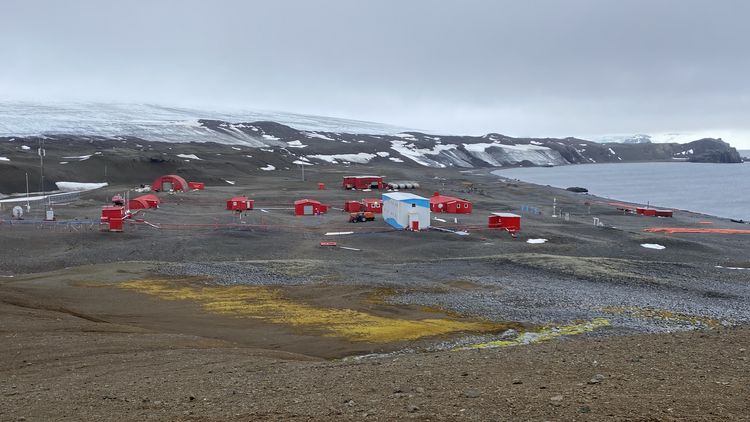
Meyer made the long journey to Antarctica with Mouritsen to assess what equipment and supplies will be needed to carry out experiments in the waters off King George Island during the Antarctic summers of 2027/28 and 2028/29. One objective was to find a suitable location, take stock of the available equipment and plan how to transport the remaining equipment to the research site as well as how to catch krill for the experiments. “King George Island is the unofficial capital of Antarctica, with a high concentration of research stations,” reports Meyer, who has travelled to Antarctica on numerous occasions. Most of these stations are located along a largely ice-free bay in the south-west, which can be reached by plane from Chile.
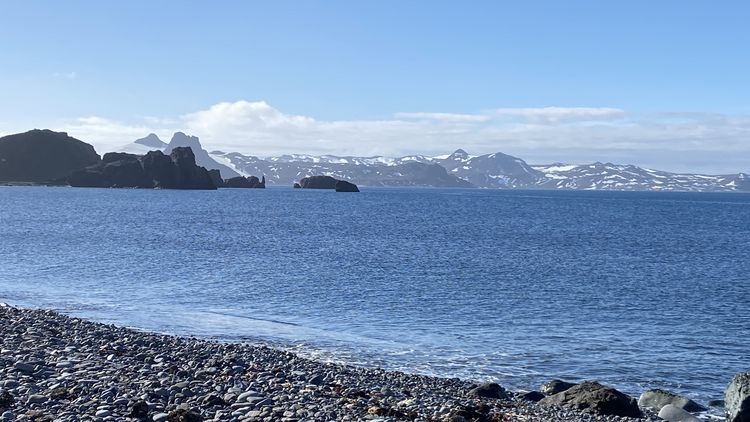
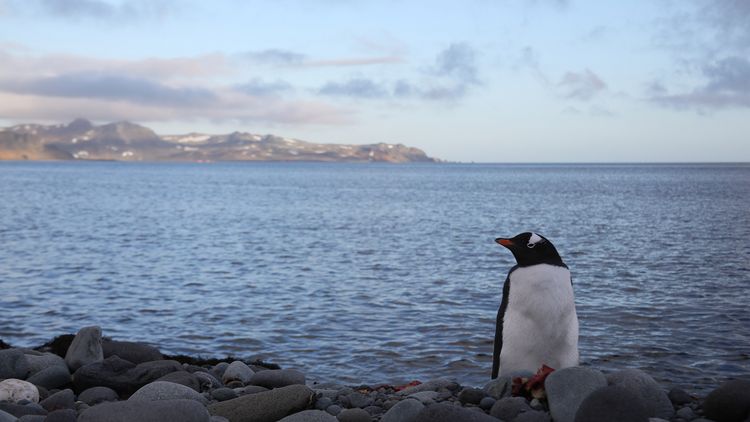
Thanks to the abundance of krill in its waters, the island is home to numerous penguin colonies and various species of seal, including Weddell seals, leopard seals and elephant seals. “This is my first time in Antarctica, and I find the landscapes, with their rugged beauty, very impressive,” says Mouritsen. Meyer is also fascinated by the unique natural environment every time she comes. But at the same time, she notices changes: “When you conduct field research in Antarctica at regular intervals, the consequences of climate change cannot be overlooked.” Krill are also affected: rising water temperatures are pushing their habitat further and further south towards the mainland. In addition, the marine ice that provides shelter and food for the larvae is disappearing. “Environmental changes are impacting the physiology, behaviour and presumably also the migratory movements of krill – and consequently the entire Antarctic ecosystem,” Meyer stresses.