

Strengthening the bond between people and nature – that is the aim of a German-Dutch EU project involving Oldenburg. The reasoning behind this is that people who feel they are part of the environment are more likely to campaign for its preservation.
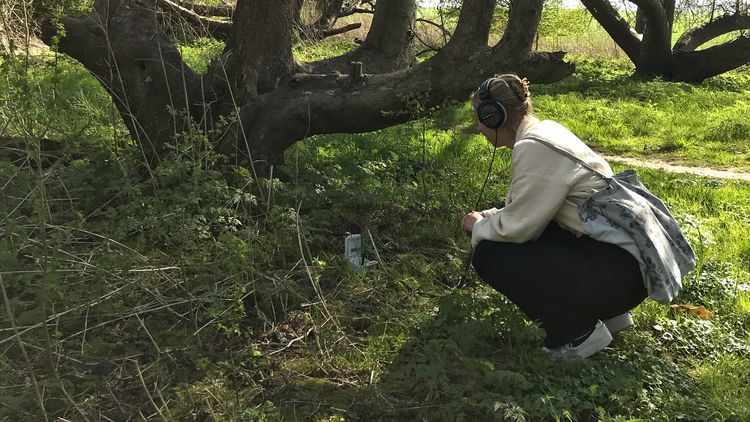
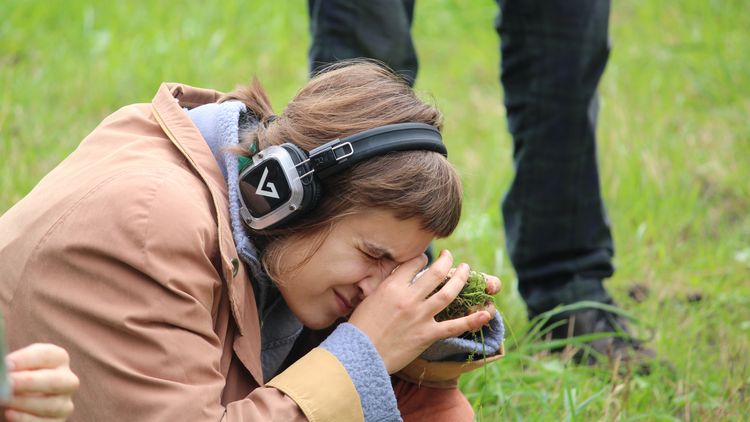
There are clacking and ticking sounds, creaking and thumping. Sometimes steady, sometimes random, sometimes fast, sometimes slow: at the Botanical Garden’s open day in June, visitors were able to hear for themselves what the ground beneath their feet sounds like. A sensitive microphone, inserted about 30 centimetres into the ground, revealed an astonishing wealth of sounds. “For many visitors, this was a real eye-opener and ear-opener – the realisation that the soil is alive, moves and even makes sounds,” explains Prof. Dr Dirk Albach, Director of the Botanical Garden.
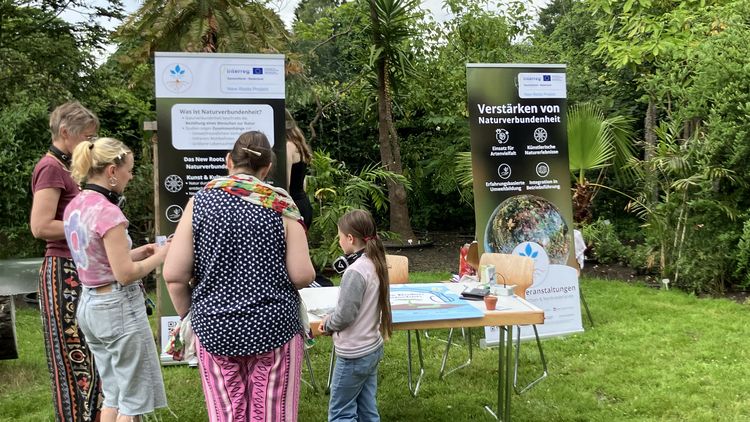
Researchers from the Science Engagement Centre at the University of Groningen had brought the ‘Living Soil’ installation to the open day. The idea behind it was that this direct sensory experience would help to strengthen people’s connection with nature. The initiative was part of the ‘New Roots for Lasting Change’ project, in which both the University of Oldenburg and the University of Groningen are involved. The project, which is funded under the EU’s Interreg Germany-Netherlands programme until 2029, is led by the provincial government of Fryslân in the Netherlands; with other partners including the Park der Gärten in Bad Zwischenahn, Ökowerk Emden and Van Hall Laarenstein University of Applied Sciences in Leeuwarden, the Netherlands.
The project team has placed the sense of connection to nature at the centre of the project, as it has become apparent that people are generally having fewer and fewer experiences of nature and are therefore less interested in protecting it. “Studies show that people who feel a stronger emotional connection to nature are more likely to take action to protect the environment, but are also happier,” emphasises Albach, for whom “New Roots” is already the third German-Dutch Interreg project on nature conservation and environmental education.
People who feel more connected to nature act in a more environmentally conscious manner
The scientific concept of ‘nature connectedness’ describes the extent to which people see themselves as part of nature, whether they feel a close emotional bond with the living and non-living environment, or whether they perceive themselves as separate from it. “There is a relatively large body of research showing that a stronger connection to nature goes hand in hand with better health, well-being and happiness,” reports Albach. It is also known that people who feel more connected to nature are more likely to campaign for its conservation and generally act in a more environmentally conscious manner.
What is less well known, however, is how this connection with nature can be strengthened. This is precisely what the “New Roots” project team now aims to find out. “In previous projects, we have already conducted a great deal of research into how to raise public awareness of issues such as insect decline. We have shared a great deal of knowledge, but evaluations have repeatedly shown that this does not increase people’s connection to nature,” reports Albach.
The researchers are now focusing on making nature an experience for all the senses – as with the Living Soil installation at the Botanical Garden’s open day. The project’s activities include discovery tours for school groups in the Park of Gardens, workshops at festivals, forest walks for adults, artistic and cultural events, and a collaboration with businesses and public authorities aimed at promoting sustainable corporate management. Rather than simply receiving information about nature, participants in the events are encouraged, for example, to identify leaves by touch, smell herbs, experience landscape art through touch, or work together to create mandalas from natural materials.
Providing children with more immersive experiences of nature
The Oldenburg branch of the project supports initiatives by businesses and public authorities aimed at strengthening their employees’ connection with nature. These can range from joint planting activities to a staff outing to the Botanical Garden. “There are companies that, for example, create wildflower meadows, build a bee hotel or even redesign the entire company grounds together,” reports Albach. Environmental psychologist Maresa Pallasch is involved; she evaluates the various initiatives and assesses their success from a scientific perspective.
Albach hopes this will provide new inspiration for the Botanical Garden, whose colourful programme of events is aimed at people of all ages. For example, insights into how activities can best be organised in future to strengthen participants’ love of nature. “We’re investigating, for instance, the influence of a group’s age mix, or how important it is for people to interact directly with plants,” he explains.
He is particularly keen to provide children with more immersive experiences of nature. “Many girls and boys now rarely come into contact with nature; some even feel uncomfortable in a forest or find insects disgusting,” Albach has observed. The best way to prevent such alienation is through direct sensory experiences. The researcher’s hope is: “We want to encourage people of all ages to build a vibrant, emotional relationship with nature – just as they would with a good friend.”