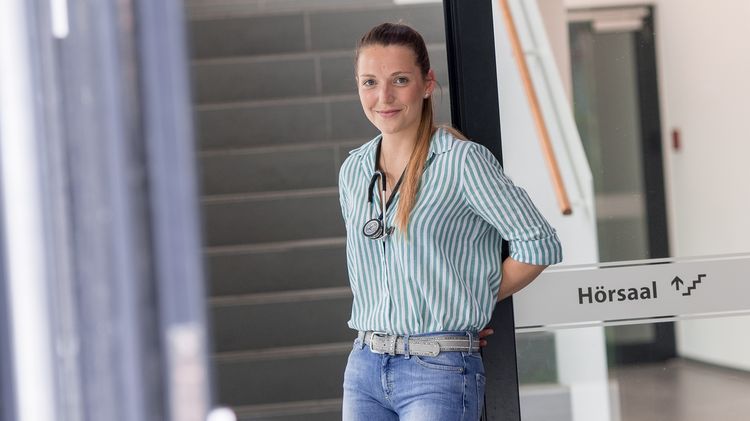

Finding your feet in a new city and switching from working life to student life: medical student Mirjam Philippi explains how she’s managed it.
Mirjam Philippi knew as early as the age of 15 that she wanted to become a doctor. After completing her Abitur and spending five years working in the ambulance service, she was finally accepted onto a medical degree programme in Oldenburg. “I hadn’t really had the city on my radar,” admits Mirjam, who is originally from the Südharz region. But the focus of the medical programme there won her over. Through personal contacts, the 24-year-old quickly found a flat. “I was really lucky; I know from fellow students that it’s not at all easy to find a suitable shared flat.”
Mirjam’s start in her new city and on her degree course turned out to be relatively relaxed after all. During orientation week, her student body – as is customary in other departments too – organised a varied welcome programme for the new students, including a campus and city treasure hunt. “That was absolutely lovely,” recalls Mirjam, who is now in her second semester. “The older students involved us straight away, offering places to stay to fellow students who hadn’t found a flat yet and giving tips on where to go at the weekend.” As the classes of medical students are relatively small, with around 40 students, the atmosphere quickly became very friendly.
Staying on the ball is key
Whilst other student bodies were still introducing their first-year students to the art of timetable planning, Mirjam and her fellow students were already attending their first lectures: “For medical students, the semester starts as early as the end of September,” she explains. She was well aware that the course wouldn’t be a walk in the park. “I’d still imagined it would be a bit less time-consuming,” she admits. Although she’s used to long, tightly scheduled days from her professional life, it’s still challenging to stay focused and follow the lecturers at all times. “After three hours of biochemistry, you’ve had enough.” Mirjam benefits greatly from her previous training – first as a paramedic, then as a senior paramedic and finally as a senior emergency paramedic: she’s got the vocabulary down pat and already has a solid grounding in how the body works.
The biggest adjustment for the student is that there’s no such thing as ‘finishing for the day’ when you’re studying. “There’s always work waiting,” she says. Whether it’s preparing for a placement or following up on a lecture. “It’s not as if you always understand everything straight away.” Staying on the ball is the be-all and end-all for successfully navigating everyday student life. However, there’s no magic formula: everyone has to work out for themselves how they learn best – whether in the library, at home or in a group. “I set up a study group fairly quickly. It helps me a lot personally. We quiz each other, which keeps things moving. And, of course, it’s a huge source of motivation, especially when preparing for exams.”
Looking after yourself
The student also makes time for social engagement. As a member of the Student council, she plays an active role in shaping her degree programme. “There are plenty of opportunities to get involved – in committees or working groups. A great example is the Teddy Bear Hospital, where children can have their ‘sick’ cuddly toys treated by medical students and so learn about hospital procedures in a playful way,” she explains. “Getting involved is worthwhile, it’s fun and it’s a great opportunity to meet new people.”
Despite all this drive, it’s still important to treat yourself to regular breaks. “You have to make sure you don’t run out of steam,” says Mirjam. Her tip: set aside one evening a week to do some sport or play music. “In the summer, it’s also brilliant to meet up at the Dobbenwiesen or head to one of the nearby lakes,” she enthuses. She’s also a huge fan of Oldenburg, the “green city”. “The city and the uni simply have so much to offer.”