
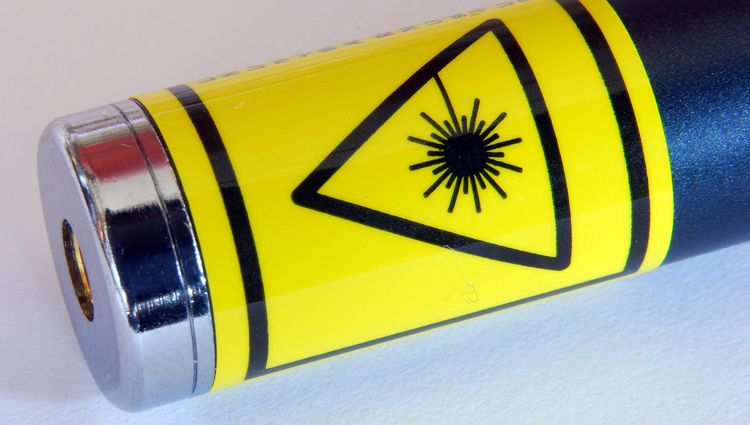

Be careful when buying and using laser pointers: the beam power of commercially available devices can exceed the admission value many times over. And the specified values cannot always be relied upon. Holger Koch, Laser Safety Officer at the University of Oldenburg, points this out.
The most recent test of such an optical pointer in the Department of Energy and Semiconductor Research revealed a value 30 times higher than the permitted beam power of up to one milliwatt (mW). "What sounds positive at first - more power for less money, so to speak - poses a great danger and can lead to blindness," warns Koch.
Even with legal laser pointers with an output of less than 1 mW, the eye is only safe if the eyelid closes reflexively in a fraction of a second. However, anyone who gets laser beams like those of the tested device in the eye is at risk of irreversible and inoperable blindness. Particularly treacherous for users: according to the packaging, the test device should have complied with the admission limit.
In addition, the physicists discovered another danger during their measurements, namely a proportion of infrared radiation (IR) with a strength of 10 mW. "This radiation poses particularly incalculable risks because it is invisible and can therefore cause eye damage without warning," explains engineer Koch. IR radiation is needed for a laser pointer with a green beam, but would then have to be filtered out again.
If you are unsure about the safety of a laser pointer you have already purchased, he recommends putting it to the test: if a laser beam melts or discolours chocolate within seconds, it is likely to have a beam power of at least 20 mW, which is often excessive and therefore highly risky. Only an extremely powerful laser pointer with an output of around 150 mW or more is capable of igniting a match. Visibility of the light spot at a distance of more than one kilometre should also be ruled out with an admission pointer.
Koch also recommends checking both the information on the packaging and on the device. These should not differ and should always be less than one milliwatt.
Further information on this topic
Department of Energy and Semiconductor ResearchContact details
Holger Koch
Institute of Physics – Department of Energy and Semiconductor Research
Tel: 0441-798/3930