
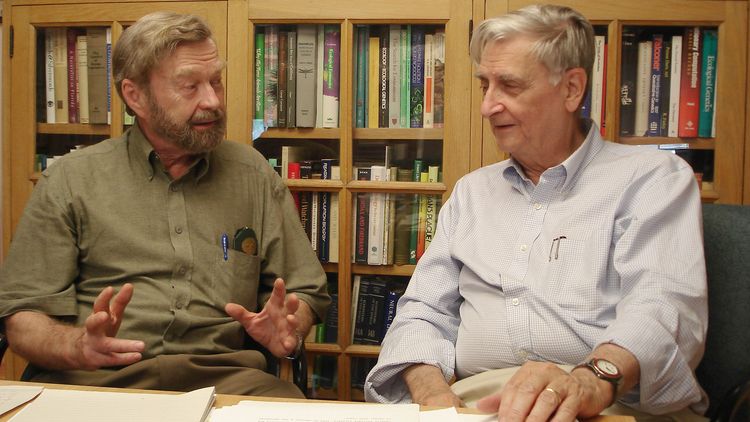

Biodiversity, sociobiology, nature and species conservation - three fields of research that the American biologist and evolutionary theorist Prof Dr Edward O. Wilson has significantly influenced. One day after his 85th birthday, the University awarded him an honorary doctorate.
"Edward O. Wilson is one of the greatest living biologists. He has set new impulses with his research on evolution and biodiversity. He is rightly referred to as the 'father of biodiversity', which for him is the 'key to preserving the world as we know it'," explained Prof. Dr Meinhard Simon, Dean of School V - School of Mathematics and Science, on the occasion of the award ceremony on 11 June. For three years now, the School has honoured Wilson's research with the annual E.O. Wilson Lecture, at which scientists from all over the world present current developments in biodiversity research. It was therefore only logical - especially in view of Oldenburg's research focus on biodiversity - to award Wilson an honorary doctorate, said Simon.
Wilson, who celebrated his 85th birthday the day before the award ceremony, did not attend the ceremony in person. The German behavioural scientist and long-time companion of Wilson, Prof. Dr Bert Hölldobler, accepted the honorary doctorate on his behalf and gave the keynote speech "The superorganism: communication, co-operation and conflict in ant colonies". Hölldobler has spent many years researching ants and social insects together with Wilson. Together they wrote "The Ants", for which they received the Pulitzer Prize in the non-fiction category in 1990.
Wilson's pioneering research on ants gave rise to sociobiology and enabled ground-breaking developments in the field of biodiversity research. In 1996, the US news magazine TIME listed the two-time Pulitzer Prize winner as one of the 25 most influential people in America. During his studies at the University of Alabama, he already focussed on social insects - ants, social bees, wasps and termites. In his biography "The Naturalist", Wilson confesses: "Most children have a bug period, I never grew out of mine. (Most children have a bug period, I never grew out of mine."
In 1955, Wilson completed his doctorate at Harvard University, where he still conducts research today. Together with the US ecologist Robert H. MacArthur, the zoologist developed a theory on "biogeography" in 1963, which describes the natural balance of species in nature. They analysed the immigration and extinction of species, the determining factors for biodiversity, on the basis of geographical, ecological and demographic characteristics - a novelty in science. In 1967, the book "The Theory of Island Biogeography" was published, a standard work of biology that had a significant influence on research into ecology and environmental protection.
In 1975, after providing a comprehensive overview of social insects in "The Insect Societies", Wilson published the book "Sociobiology". It is regarded as the inspiration and namesake for a new field of scientific research. The "International Animal Behavior Society" describes Wilson's "Sociobiology" as "the most important book on animal behaviour" ever written. Wilson's theories on sociobiology, which he later also applied to humans and human culture, have been the subject of extremely critical debate over the years.
As early as the 1970s, Wilson began to focus on environmental protection and biodiversity - two fields of research that were far removed from scientific trends at the time and received little attention. In 1988, he published the anthology "Biodiversity", thereby establishing the term "biodiversity". The anthology is a milestone for modern research on biodiversity. In recent years, the zoologist has been particularly involved in the online project "Encyclopedia of Life".
Wilson has received numerous scientific awards - including the Crafoord Prize from the Royal Swedish Academy Of Sciences.