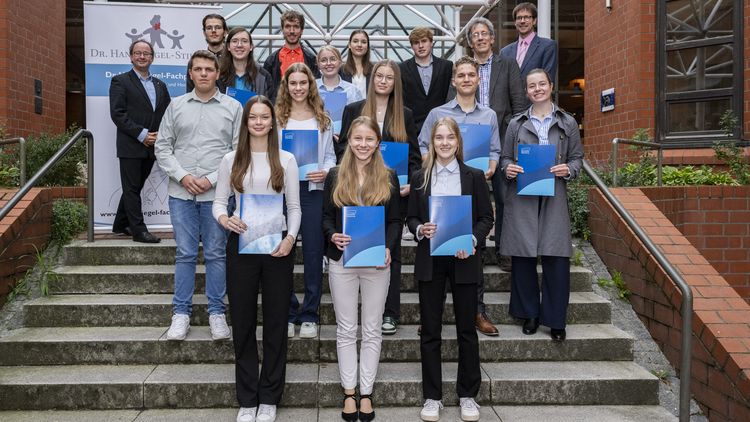

They dealt with the ozone layer, the lotus effect or sugar-reduced foods: 14 pupils from the region have been honoured at the university for their outstanding research papers. For the 13th time, the university and the Dr Hans Riegel Foundation jointly awarded prizes in the subjects of Biology, Chemistry, Computing Science, Mathematics and Physics.
At the Dr Hans Riegel subject prizes ceremony on the Wechloy campus, Physics didactics expert Prof. Dr Michael Komorek paid tribute to this year's submissions on behalf of School V - School of Mathematics and Science. "From everyday phenomena to questions of energy supply and climate change to the current topic of artificial intelligence, the range of topics was surprisingly broad," emphasised Komorek. "We hope that at least some of the award winners will pursue a career in the STEM field. But even if not, we are delighted when STEM interest and STEM education are broadly anchored in the population. The prize makes a significant contribution to this."
STEM describes the range of subjects in mathematics, Computing Science, Natural Sciences and Technology. In line with this focus, 45 student projects were submitted in the subjects of maths, Computing Science, biology, chemistry, geography and physics. A university jury assessed the work according to scientific criteria, with particularly creative topics and a clearly recognisable practical element - for example in the form of experiments - being important factors in the award.
The Dr Hans Riegel prizes are endowed with 600 euros for first place, 400 euros for second place and 200 euros for third place in each subject. The schools in first place also receive a non-cash prize of around 250 euros. The winners at a glance:
Biology
1st prize: Lynn Heddinga (Marienhafe-Moorhusen Integrated Comprehensive School): "Collecting behaviour of the ant species Acromyrmex octospinosus - an experiment"
2nd prize: Katharina Luisa Mork (Liebfrauenschule Oldenburg): "Age-related hearing loss as a limit to communication - approaches to changing communication"
3rd prize: Marie Harder (Gymnasium Graf-Anton-Günther-Schule Oldenburg, GAG): "Methods of bionics using the example of the lotus effect - an investigation into the feasibility of technical solutions based on biological models"
Chemistry
1st prize: Johanna Niers (Gymnasium Marianum Meppen): "The ozone layer - its change and its significance for life on earth"
2nd prize: Helle Ritscher (Halepaghen-Schule Buxtehude): "Do sugar-reduced foods keep their promise?"
Computing Science
1st prize: Sönke Wessels (Gymnasium Eversten Oldenburg): "AI as a zoon politikon?"
2nd prize: Leon-Patrick Hammerich (Herbartgymnasium Oldenburg, HGO): "Investigating the security of elliptic curve cryptography against quantum computers"
Mathematics
1st prize: Kristian Riedel (GAG): "Order in Randomness - An Investigation of Selected Random Experiments"
2nd prize: Fiene Hofer (Altes Gymnasium Oldenburg): "Infinity in mathematics - the discoveries of Georg Cantor"
3rd prize: Arne Koenen (Ubbo-Emmius-Gymnasium Leer): "Investigation of fractal sets and fractal curves"
Physics
1st prize: Aike Nerger and Tobias Nitschke (Gymnasium Ritterhude): "Assessment of original and recognised insulating materials in (house) construction"
2nd prize: Angelina Sawodoswkie (HGO): "Cepheids as a means of astronomical distance determination using the example of IY Tau"
3rd prize: Lea-Sophie Eiselt (GAG): "Physical phenomena in table tennis - an investigation of selected aspects"