



Carbon instead of silicon: the next revolution in electronics could be based on so-called organic semiconductors. Physicist Manuela Schiek is working on a group of these materials that react very specifically to light.
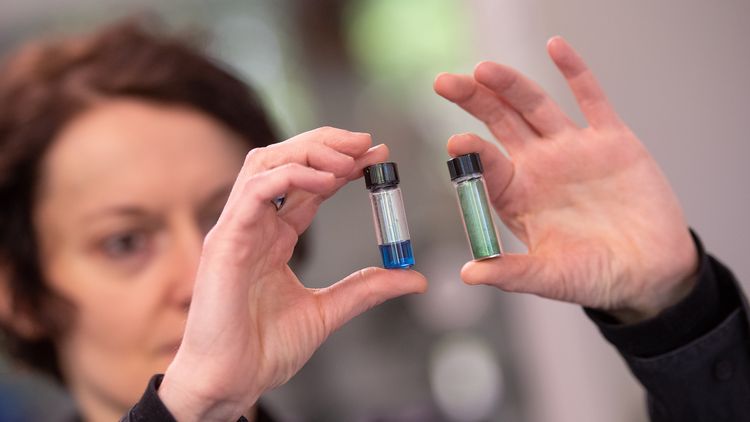
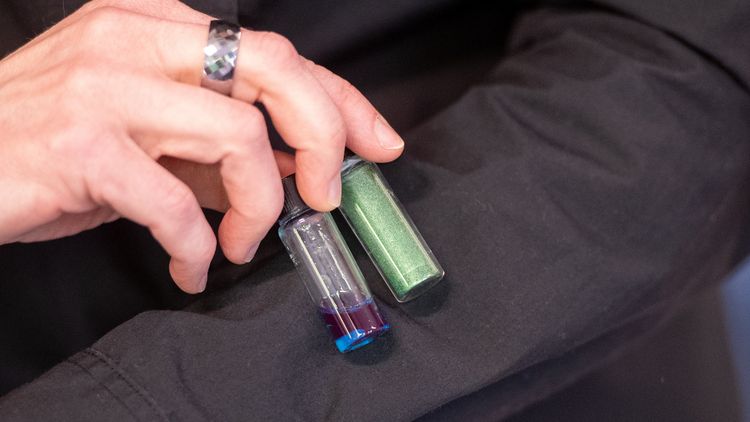
It could be a tube of ink that Prof Dr Manuela Schiek is holding in her hand. The liquid in it has an intense azure blue colour. But when the physicist holds the small glass container up to the light, the contents reveal their secret: the liquid begins to glow a soft blood-red colour. "This effect is more of a gimmick, but it shows how strongly these substances interact with light," says Schiek, junior professor and head of the Optoelectronic Organics working group at the University of Oldenburg.
The liquid in the glass is a solution of a dye from the group known as squaraine. This class of organic substances gets its name from an otherwise very rare square of four carbon atoms located in the centre of the molecule. Squaraine is one of the so-called organic semiconductors - molecules based on the element carbon that contain mobile electrons. Some of these substances can be made to conduct electricity by light, while others are excited to glow by electricity. These are useful properties for so-called optoelectronic components, which make it possible to convert electronically generated data into light emissions and vice versa. "Another advantage over inorganic semiconductors such as silicon is that they are better tolerated by biological tissue and are therefore suitable as a seamless interface to neuronal tissue, for example," says Schiek.
Organic semiconductors with special symmetry
In addition, thin layers of organic semiconductors are usually flexible, can be produced cheaply using printing or spraying techniques and their material properties can be designed relatively easily as required. As there are numerous interesting potential applications, many experts believe that these materials could revolutionise information technology in the coming years, for example in screens or sensors.
Among other things, Manuela Schiek is investigating compounds that have a particular symmetry: Those that exist in two almost identical, mirror-image variants. These so-called chiral compounds relate to each other like right and left hands: "No matter how you twist and turn them, they can't be brought into alignment," explains Schiek. This principle is widely used in biology: The genetic material DNA, amino acids and many sugars have a chiral structure, with life only utilising one of the two variants at a time.
Due to their asymmetrical structure, chiral compounds also have special optoelectronic properties: they show different reactions to so-called circularly polarised light, which also occurs in two directions - left and right circularly polarised. This property of light is used in 3D cinema, for example, so that the right and left eye see different images. Some materials - such as spirally structured substances or biological tissue - reflect right-hand circularly polarised light differently than its counterpart, left-hand circularly polarised light. This also applies to chiral compounds: "They absorb right- and left-circularly polarised light to different degrees," reports Schiek. This difference in absorption is called circular dichroism.
Amazing interactions with light
The effect is usually relatively weak and is used in research to characterise organic molecules, for example. Schiek has tested various squaraine produced by colleagues at the University of Bonn and discovered a special substance: in this compound, the difference in absorption is around one hundred times greater than in other organic substances. In 2018, she and other colleagues from Oldenburg, Spain and Denmark published a study in the journal Nature Communications, in which the team describes the material and its optical properties in detail. "No one had ever observed anything similar before, so we had to prove very precisely that the effect was real. That was a milestone," says the researcher.
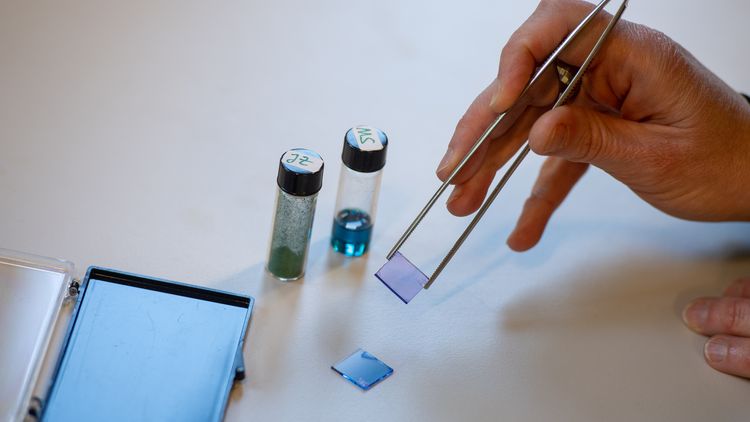
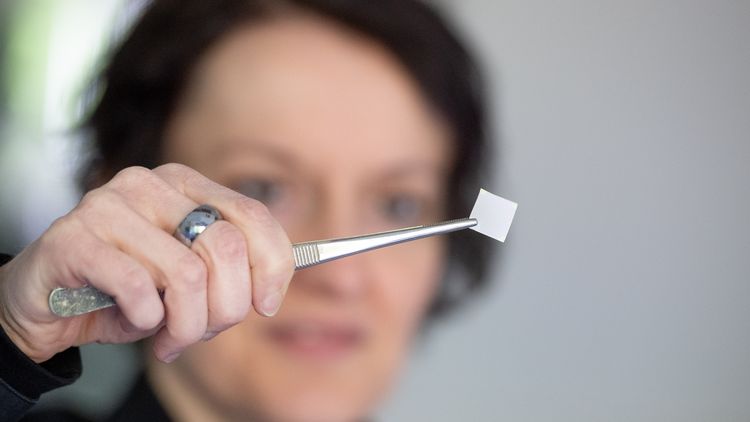
For her investigations, Schiek first applies her colourful organic semiconductor materials in extremely thin layers to small glass plates and then heats them. This causes the molecules to rearrange, change colour and also develop a strong interaction with light. Schiek uses a special device known as an ellipsometer to measure how pronounced the circular dichroism is. She discovered the unusually strong difference in one of the squaraine she examined. "The effect is so great that it can be utilised technologically," reports the physicist.
A detector for polarised light
In a second study published in February 2019 in the journal Advanced Functional Materials, a team led by Schiek describes a potential application: The researchers produced a photodiode from the material - in other words, a component that generates electricity when light falls on it. This component could serve as a detector for circularly polarised light. The special thing about it is that it does not require any additional optical components, as would be necessary for a conventional photodiode. Schiek and his colleagues were able to show that the strength of the current generated depends on the direction of polarisation. The diode can therefore recognise this property of light - an ability that could be used in miniature circuits, for example. "In this way, more data could be transmitted in optical fibres, for example, because the polarisation direction of the light is additional information," explains Schiek.
The researcher is also on the trail of further secrets in the interaction of light and matter. For example, she is investigating the extent to which the spin of electrons - a quantum mechanical property - in organic semiconductors can be influenced by circularly polarised light. "This is heading in the direction of quantum computers," she reveals. Instead of magnets, polarised light could possibly be used in the future to store or transmit information - which could simplify or accelerate many processes.