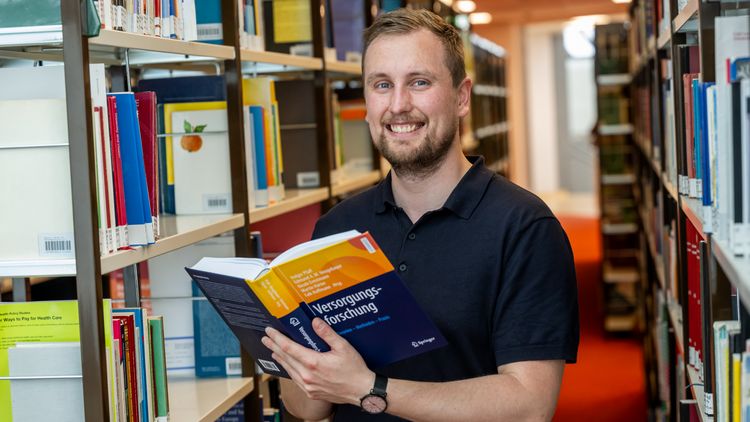

A minor operation ten years ago, carried out on a pool table in the basement of a rural school camp on the island of Wangerooge, had a profound impact on Jannik Ohmes. It was one of the reasons why the 29-year-old went on to train as a paramedic from 2016 onwards. At the same time, it also played a part in his decision, after two years in the profession, to swap the ambulance for the lecture theatre; he is now on the verge of graduating from university as a healthcare systems researcher.
Jannik Ohmes was already fascinated by the emergency services whilst still at school: “I had, so to speak, the most classic of all career aspirations: to become a firefighter,” he recalls with a laugh. After a few years with the volunteer fire brigade in Ofen, he decided to do a voluntary social year at the Wangerooge ambulance station. “It’s really fascinating to see how the emergency response chains are organised on an island,” he explains. “You can’t just drive the patient to hospital. In emergencies, the rescue helicopter is deployed instead, or in bad weather conditions, the sea rescue service is called in.”
On the island, Ohmes completes the two-month training programme to become a paramedic, drives the ambulance, and assists the paramedic as well as the island’s doctor, who is called in when needed. One thing in particular fascinates him: how flexibly the emergency personnel respond to different emergencies. In winter, there is less going on, but challenging weather conditions are more common, especially when serious emergencies such as heart attacks or strokes require rapid transport to hospital. In summer, the ambulance crew mainly deal with the typical emergencies affecting the many tourists – from circulatory collapse on the beach to cycling accidents.
One such call-out involved a heavily bleeding laceration to the knee sustained by a schoolboy during a school trip after falling down some stairs. It needed stitches. “Taking him to hospital on the mainland for this would have meant the end of the school trip for him,” recalls Ohmes. To avoid this, the doctor and the ambulance team stitch up and dress the wound on the pool table in the basement of the school camp, and the boy is able to continue enjoying the school trip.
“It was through experiences like these that I realised: being able to really help people is what I enjoy,” says Ohmes. After completing his voluntary social year (FSJ), he therefore began the then-new training programme to become a paramedic in the Oldenburg district and quickly realised that the ambulance service had long since replaced his dream job of becoming a firefighter. In 2019, he completed his training and, highly motivated, began his career with the Ammerland Ambulance Service. “It was great to put everything I’d learnt into practice and to work with a high degree of personal responsibility.” As a paramedic, he holds the highest non-medical qualification and leads call-outs that do not require an emergency doctor.
Soon, however, he also begins to notice a trend that paramedics are increasingly complaining about: many call-outs are not genuine emergencies. Rather than life-threatening situations, they often involve colds, chronic back pain or elderly people who can no longer cope on their own. Highly trained and equipped for exceptional situations, he and his colleagues find themselves faced with people who need support – yet are unable to help them. “The ambulance service isn’t designed for call-outs like this, and we aren’t trained for them. In these situations, all we can do is take the people to hospital,” he says. These moments could not be further removed from the knee laceration that was stitched up on the spot, where the emergency and rescue resources were perfectly matched.
That is why Jannik Ohmes has made a decision: he is going to the University of Osnabrück to study ‘Vocational Education: Health Sciences’. His idea: as a vocational college teacher, to help ensure that trainee paramedics receive more realistic training – so that they can provide assistance, or at least advice, not only in medical emergencies but also in social emergencies.
However, teaching isn’t his thing. During his degree, he is far more interested in health services research – the field that examines the structures and processes of the healthcare system under everyday conditions. An internship at OFFIS brings him closer to the University of Oldenburg, where, after graduating from Osnabrück, he eventually enrols on the fledgling Master’s programme in Health Services Research.
“Here, I feel as though I can look behind the scenes of the healthcare system and finally understand the underlying factors that determine how things work in practice – or, at times, why they don’t,” he says. How admissions to practise as a panel doctor are allocated, how the ever-increasing number of doctors working part-time affects healthcare provision, and how and for what emergency services are actually paid are just a few of the topics on which Ohmes now has a different, scientific perspective. “Despite its scientific approach, health services research considers healthcare from a practical standpoint. I like that. It’s always about the question of how to provide the right care for what is needed,” he explains.
After graduating, the 29-year-old therefore intends to embark on a research career himself and, together with health services researcher Prof. Dr Falk Hoffmann, investigate how staff are affected when emergency care is centralised due to hospital closures. “I could draw on my experience both as a paramedic and as a health services researcher, and perhaps actually make a difference to the system that used to frustrate me,” he says.