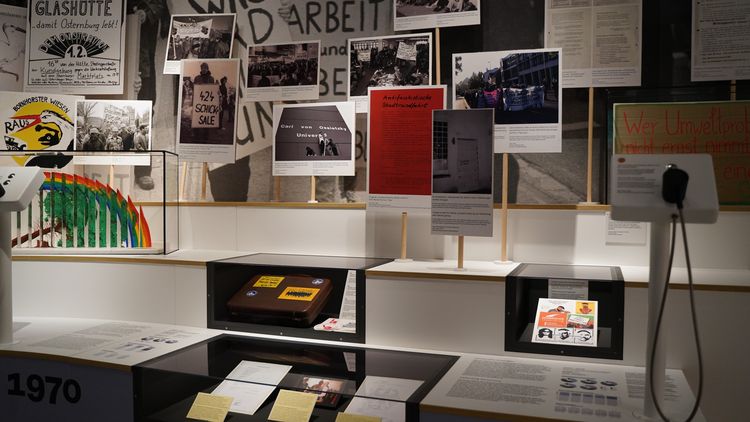
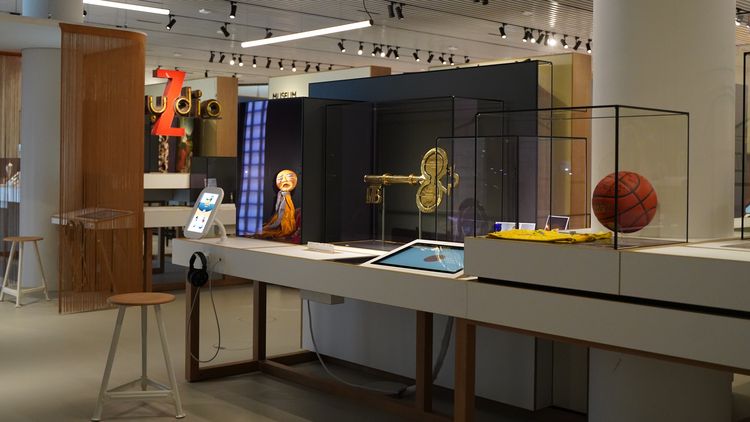


The university is part of Oldenburg’s city history – and, since this summer, two items from the university archives have been on display as part of the permanent exhibition at the newly opened City Museum. Here's what the golden key and the brown plastic suitcase are all about.
According to Dr Gunnar B. Zimmermann, head of the Oldenburg University Archives, it has “become iconic“: the dove of peace on a blue background, which makes the tallest building on the Haarentor campus a real eye-catcher. This motif also features on two blue stickers, which in turn adorn one of the two exhibits on the university’s history at the City Museum.
It is a brown plastic suitcase that belonged to one of Oldenburg University’s very first lecturers. Prof. Dr Klaus Brake took up his post at the university – which was only a few months old at the time – in 1974 and taught and conducted research here for 41 years on urban and regional development. The suitcase, which is likely to have been his constant companion at least throughout the 1970s and 1980s, was stored for a long time in the university archives and now stands as a testament to the university’s eventful history at the City Museum.
Zimmermann examined the archive item closely before it was sent to the City Museum on permanent loan: “Its very materiality alone can be interpreted as an anti-establishment statement,” said the archive director. The two blue stickers featuring a dove – which symbolised the concerns shared by many Oldenburg students about an arms race during the so-called Cold War – are not the only ones.
Another sticker commemorates the 1976 Oldenburg bicycle protest, during which around 1,100 members of the university community cycled to the state capital, Hanover, over four days in protest against the austerity measures of the then CDU state government. Last but not least, one sticker takes a stand in the dispute with the state government – which lasted until 1991 – over naming the university after Nobel Peace Prize laureate Carl von Ossietzky.
The suitcase can be found in the permanent exhibition at the recently reopened City Museum, alongside a 13-kilogram golden key. Zimmermann also has a story to tell about this special object from the university archives. According to him, the key was to be presented in 1984 – as a traditional symbol of the handover of a building to the client – at the official inauguration of the natural sciences campus in Wechloy.
However, due to student protests against the presence of Lower Saxony’s Minister for Science, Johann-Tönjes Cassens, this did not take place; the event was cut short. The key, however, remained at the university – and ended up in its archives.
In Zimmermann’s view, the key and the case have now found an “appealingly representative display” at the Oldenburg City Museum. There, both objects are presented “as what they actually are: outstanding artefacts from the early history of Oldenburg University, which epitomise various key developmental processes at the institution.”