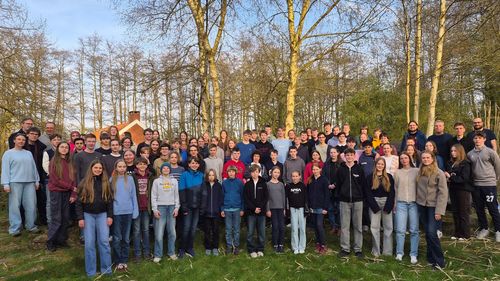


They dealt with caffeine in sport, household remedies for blocked drains or AI in medical diagnostics: 18 pupils from the region have been honoured at the university for their outstanding research papers. For the 14th time, the university, together with the Dr Hans Riegel Foundation, awarded prizes in the subjects of Biology, Chemistry, Computing Science, Mathematics and Physics.
At the presentation of the Dr Hans Riegel prizes on the Wechloy campus, the Dean of School V - School of Mathematics and Science, Prof. Dr Michael Wark, paid tribute to the theses submitted this year. "The enthusiasm of the young people and the high level of commitment with which they approached their self-chosen tasks is remarkable and gives me hope that we will be able to master the scientific challenges of our time," said the Professor of Technical Chemistry. "I hope that the prizes they have received will continue to motivate them to opt for a STEM degree programme and that their enthusiasm will be maintained throughout their studies."
STEM describes the range of subjects in mathematics, Computing Science, Natural Sciences and Technology. In line with this focus, 69 student projects were submitted in the subjects of maths, Computing Science, biology, chemistry, geography and physics. A university jury assessed the work according to scientific criteria, with particularly creative topics and a clearly recognisable practical element - for example in the form of experiments - being important factors in the award.
The Dr Hans Riegel prizes are endowed with 600 euros for first place, 400 euros for second place and 200 euros for third place in each subject. The schools in first place also receive a non-cash prize of around 250 euros. The winners at a glance:
Biology
1st prize: Vincent Baumbach (Lilienthal Grammar School): "Possible use of bone-like structures to reduce the weight of mechanically stressed components"
2nd prize: Lasse Lubienski (Gymnasium Eversten Oldenburg, GEO): "Caffeine in sport: more than just a placebo?"
3rd prize: Martha Stamerjohanns and Alina Stangneth (GEO): "Monograph of the ant species Acromyrmex octospinosus"
Chemistry
1st prize: Anna Röber (Gymnasium am Markt, Achim): "Are household remedies better than chemical drain cleaners? An analysis of chemical drain cleaners and their alternatives"
2nd prize: Anouk Waruschewski and Tomke Danckwerts (GEO): "Manipulation of (police) breathalysers using the example of peppermint"
3rd prize: Frauke Keuchel (Halepaghen School, Buxtehude): "Enamel damage caused by acid - How badly does acid damage our teeth?"
Computing Science
1st prize: Alexander Reimer (GEO): "Analysis of the optimisation methods of mechanical neural networks"
2nd prize: Hendrik Lind (Windthorst-Gymnasium Meppen): "Decentralised asymmetric encryption via Tor - The solution for secure messaging?"
3rd prize: Tammo Wriedt (Max-Planck-Gymnasium Delmenhorst): "The use of artificial intelligence to diagnose diseases such as Covid-19 in radiological torax images from 2020"
Mathematics
1st prize: Leonard Kottisch (Cäcilienschule Oldenburg): "The history of the axiomatic structure of geometry"
2nd prize: Carla Wengeler (Gymnasium Ursulaschule Osnabrück): "Development of the spruce bark beetle in the Teutoburg Forest in the context of climate change using a phenology model"
3rd prize: Sarah Humburg (Cäcilienschule): "The development of the content of maths lessons at upper secondary level since 1960"
Physics
1st prize: Jasper Fertig (Teletta-Groß-Gymnasium Leer): "The overtone series - study on the influence of overtones on sound"
2nd prize: Alina Prediger (Marienhafe-Moorhusen Integrated Comprehensive School): "Flight curves of balls - An experiment on the change in the flight curve of a table tennis ball in a headwind during an oblique upward throw"
3rd prize: Pascal Hasbach and Homa Ikei (GEO): "Influence of spoilers on the aerodynamics of cars"