
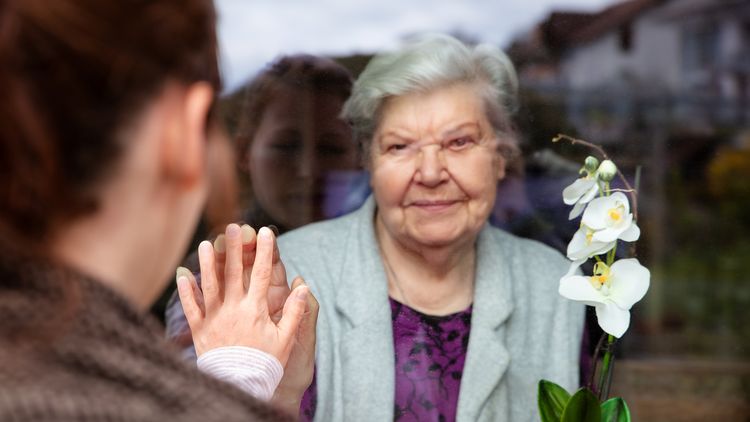

The pandemic has plunged societies around the world into a crisis - and thrown a spotlight on the relationship between the state and the population. Social scientist Gesa Lindemann explains what has changed and what has not.
Professor Lindemann, your book "The Order of Touch" looks at what the coronavirus crisis can teach us about modern societies. To what extent has the pandemic given rise to this?
Right at the beginning of the coronavirus crisis, media coverage shone a spotlight on a wide range of areas of society. We were really able to learn something about modern society.
What, for example?
It very quickly became clear that the coronavirus crisis hasn't changed anything structurally. We continue to live in a society that is differentiated into different contexts of action. The law, for example, functions differently from politics, and politics differently from the economy. The reporting showed that there are different logics of action in each case - that actors from the economy are concerned about something different than those who are involved in politics. And at the same time, an incredible amount has changed. Namely, what I call the order of contact.
What does that mean?
Touch is usually defined as one surface coming into physical contact with another surface. When two bodies touch, perhaps the hand touches the skin of another's shoulder. However, this is an abbreviated understanding of touch. People touch each other not only through surface contact, but also across distances. We can touch each other and be touched by others through gestures, looks and even words. There have been drastic changes for all of us during the coronavirus pandemic. We suddenly have to orientate ourselves on a purely physical measure of proximity and distance if we want to get close to each other. With the 1.5 metre rule, we always have to pay attention to where the nearest body is. This orientation changes how we can get closer to each other physically and emotionally.
What does it say about us as a society that the majority of us have stuck to these guidelines for over a year and a half?
It shows how much we all accept that we are subject to the power of the state. For many decades, it was completely unthinkable for the state to set direct guidelines on how we should get close to each other. We were trapped in the paradox of violence, so to speak.
What does that mean?
The paradox of violence means that there is a centralised state authority that ensures that there is no more private use of force. At least that is the demand: any private use of force is in principle illegitimate, and we trust that we can meet without violence. We take this so much for granted that we no longer realise that non-violence is based on the state's monopoly on the use of force.
And that has become clear once again in the coronavirus era?
Exactly. With the state regulations on how we should touch each other, it suddenly became clear how much we are subject to state violence. In the beginning, the police had to be deployed again and again to enforce this new order of contact.
In some cases, there was also strong resistance to the measures imposed.
The rule of law provides for various means by which citizens can deal with state violence: They have the option of suing to have it determined whether a form of state use of force was legitimate. They can form political parties to intervene in the legislative process. The third option is to come together at demonstrations to show that they do not agree with the state's actions. The coronavirus crisis was a good example of this: we saw all three reactions. In this respect, we can say that the rule of law and its principles are working well.
On the one hand, we are subject to the power of the state, but you also describe it as caring.
Exactly, the state cares about the bodies of individuals, about their lives and health, and not about preserving groups. When the issue of herd immunity was discussed at the beginning of the pandemic, this solution was seen as very cynical and something that Germany should not orientate itself towards.
During the coronavirus crisis, many so-called conspiracy narratives have suddenly spread. As a sociologist, how do you view this phenomenon?
Conspiracy narratives have a specific function. There are other orders in addition to our procedural order of violence bound by the rule of law. For example, the order of victimisation, as described by the French philosopher René Girard. In order to make it clear that certain norms apply, the weakest member of a group is selected and, for example, beaten or killed. Up until the 1950s, this order of victimisation was also a legitimate component of modern societies; it was virtually an integral part of official policy and media reporting. Whenever there were social grievances, groups that were unable to defend themselves were always blamed. For example, the Jews, homosexuals, Sinti and Roma. This changed in the 1960s. At that time, the status of victims of violence changed. Victims went from being suspects to recognised spokespersons. The term "conspiracy theories" also emerged in the 1960s. This term was used to describe knowledge that was considered questionable and false. This meant that the classic form of conspiracy narratives was no longer socially accepted.
What happened during the coronavirus crisis?
On the one hand, the current conspiracy narratives still have the same function as before. They are narratives that look for culprits. They are looking for those who have attacked "us" and against whom "we" must defend ourselves. But the narratives - including those of the lateral thinking movement - are no longer directed against the classic victim groups. That tends to be socially ostracised. I was really surprised that the procedural order of violence bound by the rule of law has apparently become so strongly established that the classic order of victimisation no longer seems to work well. It is not the foreigners or the Jews who are being blamed for corona. Rather, the lateral thinkers have identified with the Jews. Nevertheless, the lateral thinkers are looking for those who have done something to "us" and against whom "we" must defend ourselves. Only it is no longer the traditional victim groups, but rather social elites.
Are there still parallels?
It only resembles the order of victimisation insofar as no resistance is to be expected. You can say the scariest things about Angela Merkel and Bill Gates and not have to fear any counter-violence. The difference to the past is that conspiracy narratives were also told or supported by social elites. This is hardly the case today. Now, these narratives tend to channel a mistrust of the elites. The coronavirus crisis has politicised society enormously.
At the beginning, you said that our social order will not fundamentally change as a result of coronavirus. So you don't see any danger of something getting out of balance?
The way society has reacted to the pandemic offers no indication that the procedural order of violence is changing. There are indications of other phenomena that jeopardise this order, but that has nothing to do with the pandemic. I would include the process known as digitalisation and the politically desired uncontrollability of large corporations. I doubt whether this is compatible with a democratic and constitutional system of procedures in the long term.
Do you see any developments in the organisation of contact, i.e. at an individual level?
The way out of the pandemic that is emerging is characterised by two features. One is that the government has authorised how individuals emerge from the pandemic. I assume it will be a gradual process, with a lot of inconsistencies. But what will remain is the threat of highly infectious viruses. We must also continue to expect mutations in the coronaviruses. This means that we will in all likelihood not return to life as it was before the pandemic, but will become permanently accustomed to certain precautionary measures - especially when dealing with strangers.
Thank you for talking to us!
Interview: Ute Kehse


