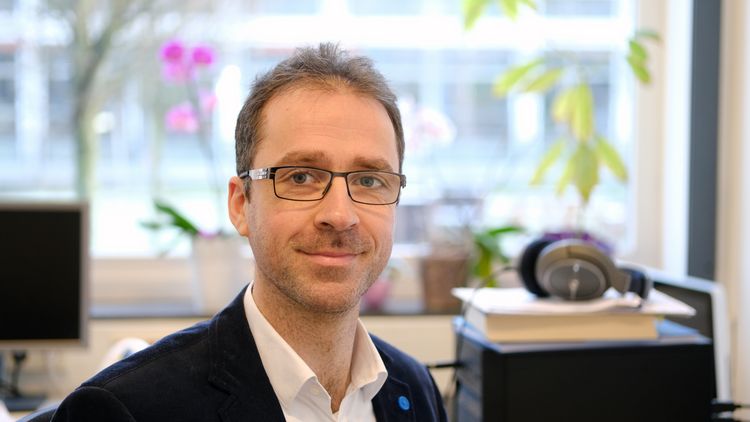


A new Emmy Noether junior research group led by neuroscientist Martin Bleichner is investigating how we perceive noise. To do this, the researchers want to measure brain signals in everyday life.
It is difficult to define what is noise and what is not. "Noise perception is a very subjective matter," explains Dr Martin Bleichner. A symphony orchestra can produce sounds that are louder than a chainsaw at a distance of one metre. Nevertheless, even extremely loud classical music is not perceived as noise by most people, whereas a screeching chainsaw is extremely annoying. "What we perceive as noise depends not only on the sound, but also on our interpretation of a situation," says Bleichner.
The neuroscientist wants to record precisely this individual perception - in order to be able to find out later, for example, whether there is a connection with secondary diseases such as sleep disorders, concentration problems or heart disease. So far, harmful noise levels have been defined purely in physical terms, but in principle any disturbing noise can cause stress, regardless of its volume.
Electrodes measure brain activity
Bleichner, a postdoc in Prof. Dr Stefan Debener's Department of Neuropsychology since 2013, was recently accepted into the prestigious Emmy Noether Programme of the German Research Foundation (DFG). His project is entitled "Transparent EEG for measuring noise perception in everyday situations" and is being funded with up to 1.3 million euros. Over the next six years, the neuroscientist and his four colleagues will be researching noise perception in everyday life - and creating the technical and methodological conditions for subjective noise measurements.
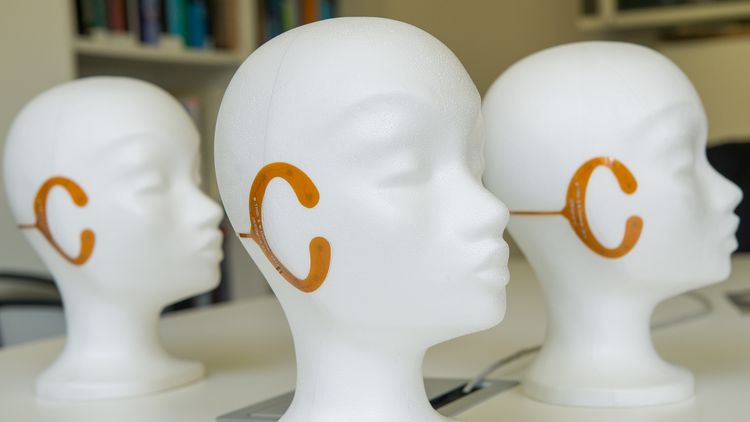
Mobile EEG devices and special measuring electrodes developed in the Department of Neuropsychology are central to his project. These electrodes, called cEEGrid, can record brain activity unobtrusively outside the laboratory. They replace the uncomfortable caps that test subjects previously had to wear to measure the electroencephalogram (EEG). Bleichner has already worked on the mobile measuring device as part of the Hearing4all cluster of excellence.
It consists of ten measuring sensors inside a transparent plastic film, which are arranged like the letter C. They are placed around the auricles. They are placed around the auricles and are barely visible. The measuring device includes an amplifier the size of a packet of cigarettes, which transmits the signals wirelessly to a smartphone for recording. The mobile phone simultaneously records the ambient noise. The test subjects can go about their normal daily routine during the measurements.
From the lab to everyday use
"Firstly, we want to clarify the question of how good the data quality is when we use the EEG in everyday situations and how much we lose compared to laboratory measurements," says Bleichner, describing one of the aims of his project. In studies, Oldenburg neuroscientists have already established that the small ear EEG reveals amazing things. For example, the signals can be used to determine which of two audiobooks a test subject is listening to or which piece of music they are listening to. "It's not that we can read their thoughts," explains Bleichner, "but the spikes in the EEG show, for example, whether the person has just heard four or five sounds, and from this we can then deduce the piece of music." If someone does not perceive a sound at all, completely blocks it out, so to speak, this can also be recognised in the EEG.
Initially, the researcher wants to record the brain signals of test subjects in the laboratory under controlled conditions in order to be able to correlate certain sound sequences and brain activity. Step by step, the measurements will then be transferred to real life: In further experiments, the test subjects will hear the same tone sequences in everyday situations as in the laboratory, for example when they are sitting at their desks. In the final step, normal everyday life will be mapped together with its natural soundscape.
How high is the noise pollution in the kindergarten?
The project promises interesting findings: For example, the results could be used to investigate how much teachers or kindergarten teachers are actually affected by high noise levels. The experiments could also record how noise stress increases over the course of a day and whether different people actually perceive the same noise differently.
"The mobile EEG gives you a more objective picture than if you ask people directly," says Bleichner. Thanks to the inconspicuous sensors behind the ear, the wearers forget that they are taking part in an experiment and the environment also behaves more naturally. Measuring noise perception is an initial application to better understand how the brain works in natural situations, says Bleichner: "In the long term, we are working on a neurophysiology of everyday life, so to speak."