

The locations around the world where mangroves thrive depend particularly on wave conditions. Researchers from Australia, the USA and the University of Oldenburg have determined this using computer modelling. The findings also provide insights into when and where young mangroves are most likely to take root worldwide and could help to protect these valuable coastal ecosystems in a more targeted manner in future. The study has been published in the journal *Nature*.
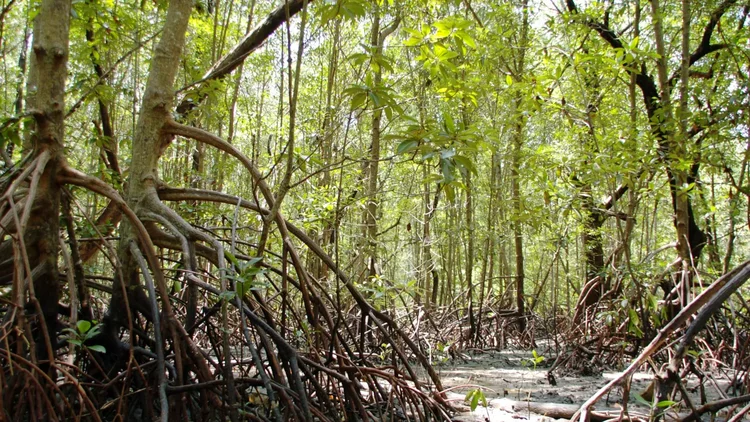
Mangrove forests, which are widespread along subtropical and tropical coasts, play a vital role in coastal protection, as they dampen the force of waves and storm surges. They also naturally store carbon in the soil and are home to a wide variety of living organisms. Large sums of money are being invested worldwide to protect and restore mangrove forests. However, these projects often fail because accompanying studies on optimal environmental conditions generally only take average values into account, explains Prof. Dr Will Glamore from the Water Research Laboratory at the University of New South Wales (UNSW) in Sydney, Australia.
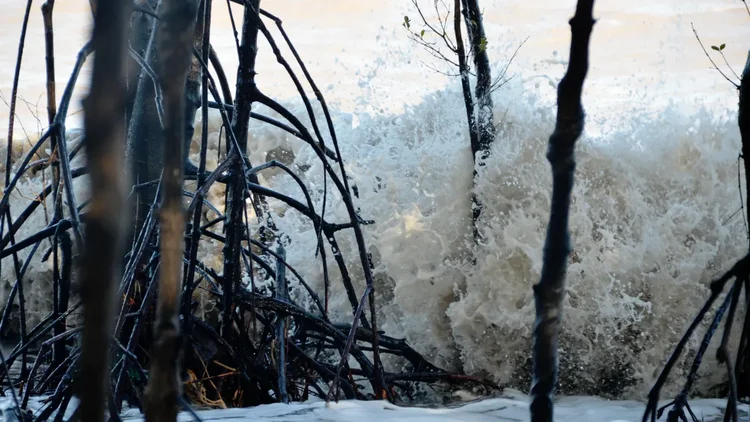
What is far more crucial for the trees to establish themselves, however, is that certain thresholds – for example, regarding wave action – are not exceeded. The study’s findings accordingly show “how short periods of ideal conditions can play a decisive role in enabling mangroves to establish themselves and develop”, says the environmental engineer.
Low wave energy is crucial
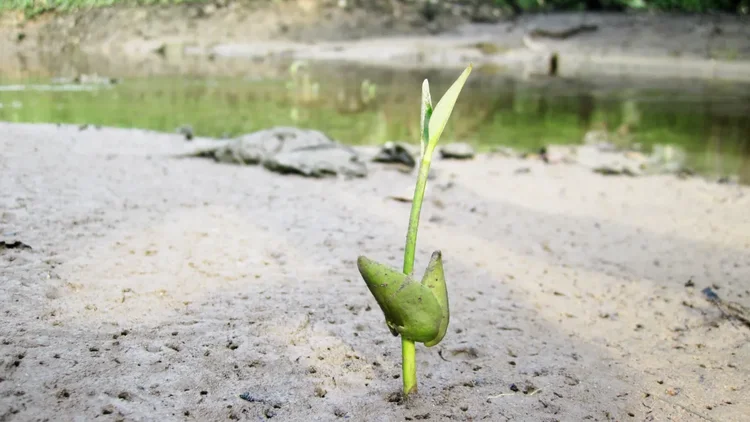
In earlier studies, Prof. Dr Thorsten Balke, a vegetation ecologist at the University of Oldenburg, together with researchers from Europe and South-East Asia, had found evidence of the conditions under which a mangrove seedling can begin to grow at all in shallow coastal areas influenced by tides and waves. “At the time, we defined a ‘favourable window of opportunity’,” explains Balke: only during a specific period are the conditions such that the seedling can take root and subsequently become firmly anchored. Otherwise, during the next high tide, waves, currents and sediment resuspension could uproot the young plant.
The international team has put this knowledge to use in the current study. They analysed 20 years’ worth of wave data from around 400 locations worldwide, half of which had mangroves and half of which did not. From this global data analysis, they developed a model of wave exposure and combined it with the concept of ‘windows of opportunity’ developed by Balke through experiments.
The team was thus able to correctly predict the presence or absence of mangroves at over 75 per cent of the sites studied. The results show that sites with mangroves experience longer periods of low wave energy more frequently than coasts without mangroves.
Windows of Opportunity
Previous research had already shown that young mangroves become more tolerant of stronger waves and sediment transport as they age. The steepest increase occurs in the first three months. For example, a one-day-old seedling can barely tolerate any waves, whilst a one-week-old seedling can already withstand certain waves, says Sarah Wells, a doctoral candidate at UNSW and lead author of the study. By combining this knowledge with local wave conditions in their model, the researchers can identify the time windows that are particularly favourable for establishment.
This is because mangroves are often planted to protect the coast from strong waves. This leads to a kind of paradox: the places where mangroves could offer the greatest protection against waves may also be among the places where it is most difficult for young mangroves to take root. The findings could help to improve the planning of reforestation schemes, for example by identifying favourable times and suitable locations.
Impacts of climate change
The findings also provide insights into how climate change might affect mangrove forests. Whilst global environmental changes do not cause waves to become stronger everywhere, However, in many subtropical and tropical regions, their direction could change. The researchers have taken this into account in their model. Their findings show that even slightly altered wave conditions determine whether a suitable establishment window exists at a given site. The angle of incidence plays a particular role in this. “As a result of climate change, the conditions for mangrove establishment could therefore change, even if the wave height remains the same,” emphasises Balke.
The consequence is that some current mangrove sites could become unsuitable for new seedlings in future, whilst sites that are currently unsuitable may become more favourable. However, the researchers stress that waves are only one factor influencing how mangroves will spread in future. Rising sea levels, tides, salinity, temperature and sedimentation also play a role.
The published study is part of the ‘Halo’ initiative, a joint research project between Australia and the Republic of Fiji. The aim is to restore degraded and urbanised coastlines using innovative, nature-based solutions. The project, which is funded by donations, encompasses social, economic, ecological and engineering research to support on-the-ground measures.