
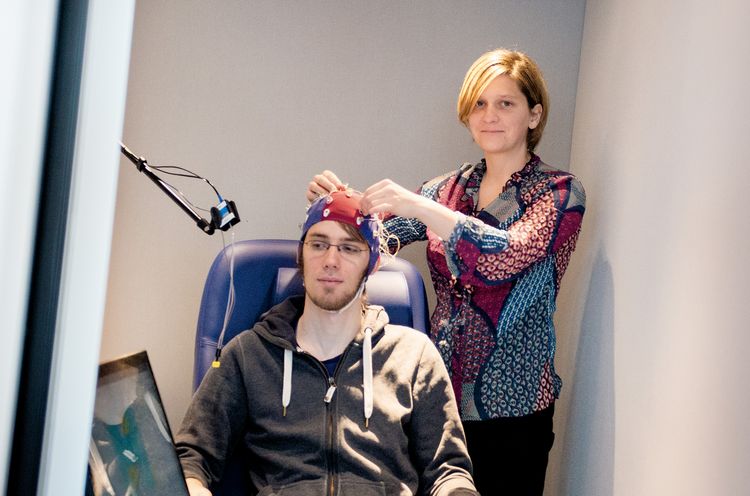

Top EU funding for a young hearing researcher from Oldenburg: Prof Dr Sarah Verhulst, junior professor in the "Hearing4all" cluster of excellence, has been awarded a 1.5 million euro "Starting Grant" from the European Research Council (ERC). Over the next five years, Verhulst wants to work with an expanded working group to develop a diagnosis and therapy for hearing damage caused by noise that is not recognised by existing hearing tests.
University President Prof Dr Dr Hans Michael Piper congratulated the 33-year-old: "An individual grant from the ERC is associated with the highest prestige for scientists in Europe - we are delighted with Sarah Verhulst about this recognition of her outstanding research." The Vice President for Research and Transfer, Prof Dr Katharina Al-Shamery, added: "Her pioneering work is also exemplary of the excellent interdisciplinary hearing research at the university."
Verhulst sees the interdisciplinary approach as "the key to the success" of her project. "The goal of my research is clear, but it is a complex project," says the Assistant Professor for Analysis and Modelling of the Auditory System. She is pleased "that the EU also recognises hearing impairment as an urgent medical and social problem for which we need a solution".
While hearing impairment is known to be widespread with increasing age, Verhulst expects a growing number of previously unrecognised hearing impairments in younger people due to increasingly noisy urban living and lifestyles. Researchers are talking about "hidden hearing loss": This is based on damaged synapses in the cochlea (cochlea) and has already been physiologically proven in animals. The aim of Verhulst's research project "RobSpear: Robust Speech Encoding in Impaired Hearing" (reliable speech understanding in impaired hearing). She will be able to recruit two doctoral students and two postdoctoral researchers for her working group.
Among other things, the project will focus on the so-called hair cells in the inner ear and the associated synapses of the auditory nerve. "There are around 3,000 inner hair cells in the human inner ear, and 30 synapses are connected to each of them - each of which encodes certain aspects of a sound," explains Verhulst. "Only the large number of coding channels, which independently transmit the same information to the brain, makes our hearing reliable even in a noisy environment." In cochlear neuropathy, on the other hand, the inner hair cells gradually lose some of the connected synapses. As a result, the speech comprehension of those affected is likely to decrease, especially in noisy environments - without this being able to be diagnosed yet, as the hair cells as such remain intact. People with the first signs of hearing problems could - unrecognised - have "cochlear neuropathy". According to Verhulst, this hearing loss is also likely to occur alongside regularly diagnosed hearing damage such as a loss of so-called outer hair cells and may be one of the reasons why a hearing aid cannot fully compensate for the hearing problem.
In order to enable a reliable diagnosis in future, Verhulst and her team want to use various methods to draw conclusions about the synapses of the auditory nerve from measured brainstem potentials, among other things. They want to combine this with the measurement of so-called otoacoustic emissions, i.e. sound waves emitted by the ear, and with computer modelling. "We have to find a way to change the sound so that patients can achieve the best possible individual hearing result with the remaining synapses," emphasises Verhulst. To this end, she wants to bring together expertise from engineering and neuroscience, signal processing and modelling in her future team.
Verhulst has been a junior professor at the School V - School of Medicine and Health Sciences and head of the "Psychoacoustics, Modelling and Evaluation" working group in the "Hearing4all" cluster of excellence for two years. She was previously a postdoctoral researcher at Boston University and a research fellow at Harvard Medical School. The Belgian-born scientist studied electrical engineering in Leuven, Belgium, and acoustic engineering at the Technical University of Denmark, where she also completed her doctorate.