






Dopamine, known in humans as the happiness hormone, also has an effect on tiny coral larvae: it encourages the little animals to settle on solid ground.
Stony corals are the master builders of the sometimes enormous reefs in the world's tropical oceans. However, their survival is threatened by climate change, ocean acidification, pollutants and dynamite fishing. Many details of the cnidarians' life cycle have hardly been studied to date. "Most corals only spawn once a year, which is why their reproduction is difficult to study," reports Prof Dr Peter Schupp, who heads the Environmental Biochemistry working group at the University of Oldenburg. Most stony coral species release eggs and sperm into the water, where the fertilised eggs develop into tiny oval or elongated larvae. These float in the sea for a few days or weeks. They then transform into a mostly flower-shaped polyp and settle in a suitable location.
The transition from free-swimming larvae to sedentary polyps is a crucial step in the life cycle of stony corals. Biologists Mareen Möller, Samuel Nietzer and Peter Schupp from the Institute of Chemistry and Biology of the Marine Environment (ICBM) in Wilhelmshaven have now discovered which messenger substances play a role in this process. In experiments, the three researchers identified three neurotransmitters that cause larvae of a coral species from the Pacific to settle on the substrate and transform into a coral polyp. The results could make it possible for the first time to rear young corals in aquaculture and thus contribute to the protection of endangered coral reefs, the team writes in the current issue of the journal Scientific Reports.
Larvae hatch every day
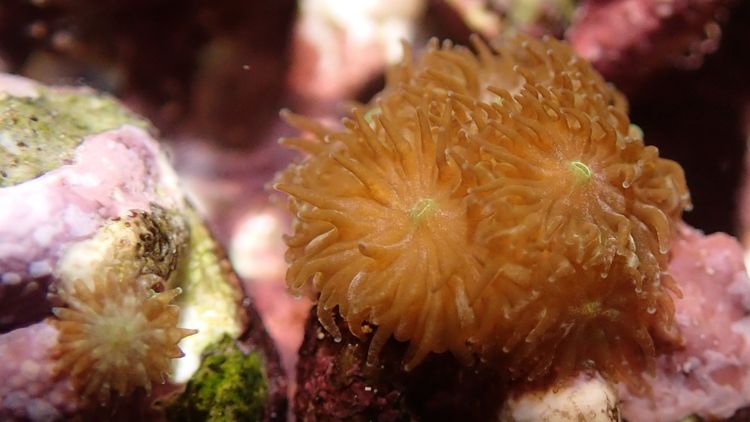
Until now, it was known that certain light conditions, the surface structure of a reef or chemical stimuli cause the larvae to transform into sedentary young animals and found a new colony. Möller, Nietzer and Schupp have now investigated which signalling chains and messenger substances play a role in this process. They conducted experiments with larvae of the large polyp stony coral (Leptastrea purpurea), a species that lives in the shallow waters off the coast of the island of Guam in the western Pacific. "This type of coral is excellent to work with," reports Mareen Möller. In the reddish-orange colonies of this species, the larvae do not develop in the open water, but in the tissue of the animals. "It is a so-called brooding coral," explains Möller. For the Wilhelmshaven researchers, the species is particularly interesting because the animals don't just release larvae once a year, but every day. "This makes it much easier to carry out experiments," says Möller.
In order to investigate the signalling chains that trigger the settlement process, the team exposed the larvae to different concentrations of the neurotransmitters serotonin, adrenaline, dopamine, L-dopa, glutamic acid and potassium. These neurotransmitters, which also play an important role in the human nervous system, were already known to induce larvae of sedentary marine animals such as mussels, barnacles or sea cucumbers to attach to the substrate. The researchers found that dopamine in particular, but also glutamic acid and adrenaline, stimulated the metamorphosis of the larvae into polyps and also their settlement. Serotonin, potassium and L-dopa, on the other hand, showed no effect. The experts emphasise that their study is a first step towards understanding the molecular basis of the coral life cycle: Further investigations could show how highly concentrated the individual substances need to be in order to induce as many coral larvae as possible to settle down, or whether combinations of several neurotransmitters are better suited for this purpose.
Juvenile corals for the aquarium trade
A more precise understanding of these processes could help to better protect the corals. The results could be used to settle corals in aquacultures and thus minimise the removal of wild coral colonies for the aquarium trade. For example, the messenger substances could be used to produce young corals for local reef restoration projects. "However, it must be emphasised that the large-scale coral extinction that we are seeing as a result of climate change cannot be stopped by such measures," emphasises Schupp. This is because the progression of climate change would have to be slowed down.