

Environmental Biochemistry

+++ News +++
Bachelor thesis in the field of ecotoxicology with a focus on method development and analytical chemistry.
-------------------------------------------------
Our website is currently under construction, therefore some content may be incomplete or inconsistent in its formatting. We apologise for this, but welcome you to our website! If you have any questions or comments about the homepage, please contact Dr Moritz Maxeiner.

Environmental Biochemistry
Research
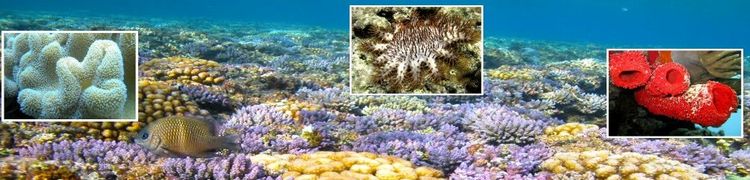
The overarching theme of the research group is the chemical ecology of marine organisms. We use chemical techniques to assess the role of marine natural products in their environment, while investigating the potential pharmacological effects of selected compounds. Much of the work focuses on tropical coral reefs, where chemical-ecological interactions between epibenthic organisms are particularly common in this highly competitive environment.
Sexual reproduction in stony corals
Coral reefs are biodiversity hotspots that are increasingly threatened by a variety of anthropogenic stressors such as overfishing, pollution, but especially climate change and the associated rise in sea surface temperatures.¹ Persistently higher water temperatures disrupt the symbiosis between corals and dinoflagellates, leading to bleaching and eventual coral death,² which can take on global proportions, as was observed during the fourth global mass bleaching event in 2023-24³. The survival of coral reefs largely depends on the recruitment of a new generation of coral individuals that are better adapted to a rapidly changing climate and other anthropogenic stressors (e.g. pollution, sedimentation). Therefore, a better understanding of the coral colonisation process, the substances involved and the key environmental factors that influence the success of colonisation is needed. In recent years, we have made some important progress by isolating bacteria associated with crustose algae that produce the colonisation signalling compound cycloprodigiosin (CYPRO). This compound induces the settlement of coral larvae4,5 and the conversion of recruits into healthy young polyps.⁶ We have shown that CYPRO induces settlement in several Pacific coral species that disperse their eggs and hatch their larvae, suggesting that it is a general signalling compound that could have great potential for coral reef restoration research and projects.
¹ Hughes et al. 2017, Nature 543, 373-377.
² Boilard et al. 2020, Microorganisms 8, 1682.
³ ICRI and NOAA 2024, https://icriforum.org/4gbe/
⁴ Petersen et al. 2021, Front. Mar. Sci. 8, 749070.
⁵ Petersen et al. 2021, Coral Reefs 40, 381-394.
⁶ Fiegel et al. 2023, Front. Mar. Sci. 10, 984656.
Ecotoxicological studies on birds and corals
Our group has been investigating the effects of various pollutants on birds for 15 years, continuing a 20-year time series. On the Wadden Sea coast of the North Sea, bird eggs are collected and analysed for heavy metals as well as persistent industrial and agrochemicals.
Another project focuses on the development of reliable test methods to assess the short- and long-term toxicity of chemicals to coral larvae and adult corals. This project is a collaboration with industry to establish standardised ecotoxicological methods for testing environmental samples, pollutants and personal care products such as UV filters for potential adverse effects on coral larvae and adult stony corals. As coral reefs are declining worldwide due to climate change, stress factors are also receiving increasing attention at the local level, including UV filters used in sunscreens. This has already led to bans of various organic UV filters in some regions, although the studies underlying these bans had significant flaws in experimental design.⁷ Our research aims to conduct sound chemical analyses with targeted ecological assessments of coral health to provide recommendations according to international guidelines for environmental and governmental agencies. Once such tests are established, they could enable the safe development and use of agrochemicals and personal care products.
⁷Miller et al. 2022, Toxics 10, 244.
Development of non-invasive monitoring methods for the assessment of temperate and tropical marine ecosystems
In a current project on Mafia Island in Tanzania, we aim to counteract the decline of coral reefs and biodiversity by using scalable and less labour-intensive monitoring techniques for sustainable management of coral reefs and marine protected areas. The project aims to promote a participatory approach to reef restoration by involving members of the community in the restoration process. To effectively monitor and guide these community attempts to restore the reefs, the study will utilise a combination of various state-of-the-art monitoring methods. These techniques include videogrammetry, Baited Remote Underwater Video Systems (BRUVs), line and belt transects, and traditional taxonomic surveys. Videogrammetry and BRUVs have already been successfully used to monitor marine protected areas and control sites in the North Sea. In addition, the project will validate data obtained from analysing environmental DNA (eDNA), a novel and promising approach to assess biodiversity in marine ecosystems. By integrating multiple methods, we aim to demonstrate the accuracy and reliability of eDNA in measuring biodiversity and monitoring changes in marine ecosystems. If successful, such an approach could serve as a template for monitoring programmes in temperate and tropical regions.
Understanding changes in the composition and function of benthic communities
Increasing anthropogenic stressors, most notably climate change, are likely to lead to changes in the composition and function of many benthic communities. Various benthic changes have been observed on coral reefs, including a shift towards communities that are not dominated by hard corals. The decline of reef-building species and the increase of alternative (i.e. non-reef-building) organisms have profound implications for the function of coral reefs and the services they provide, but this is still largely misunderstood, especially for alternative communities without algae.⁸ Current research and observational work around Manado (Indonesia) has already identified sites where parts of reefs have been converted to communities dominated by soft corals or ascidians. Our aim is to identify the driving forces and triggers (e.g. potential environmental factors), feedback mechanisms, changes in ecosystem functions and effects on ecosystem services. Aquarium experiments are used to investigate the role of allelopathic secondary metabolites of sponges and how these might influence their competitiveness against hard corals. Aquarium experiments are often combined with field experiments to validate the results in the field.
Changes in the benthic community have also been investigated in field and mesocosm experiments for the Wadden Sea. Mesocosm experiments are used to assess the effects of nutrient enrichment and spatial nutrient heterogeneity on microphytobenthos as well as cascading effects and interactions with macrofaunal consumers on tidal flats.
Microbial ecology
Our current microbiological research focuses on microbial communities in North Sea sediments and aims to decipher how environmental, biological and anthropogenic processes influence the benthic microbiota and microbial processes. Our results provide first insights into benthic microbial biogeographic patterns at large spatial scales and illustrate how anthropogenic activities such as bottom trawling can alter microbial distribution and abundance and potential metabolism at the ecosystem level.⁹ Marine Protected Areas (MPAs) have recently been established in the German North Sea, where fishing is partially or completely prohibited. This research project also monitors and investigates the changes in the benthic microbiota within the MPAs. To this end, we have set up a bioarchive with sediment samples from the German Bight, which is linked to a large data set on microbial communities.
Bioprospecting of marine bacteria and invertebrates
We have built up an extensive culture collection of marine bacteria and invertebrates from shallow and deep-sea areas in various locations. The organisms were mostly collected following ecological observations in the field, which often indicated superior competitiveness over other organisms. Often the production of bioactive compounds was the reason why these organisms were so successful in their specific habitats.