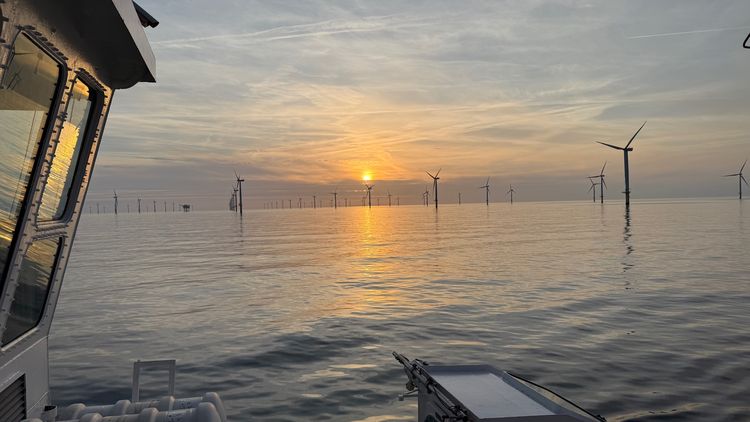


A special research expedition recently took a team from Oldenburg to a stretch of sea north of Heligoland. The researchers had to overcome some unusual challenges amongst the huge turbines of an offshore wind farm.
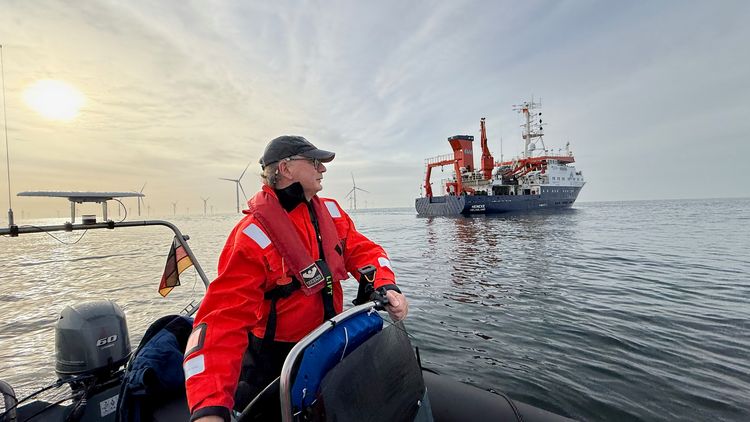
Dr Thomas Badewien knows the North Sea – and its German section in particular – quite well: on numerous research expeditions, the oceanographer from the Institute of Chemistry and Biology of the Sea (ICBM) has explored the waters, measured currents and taken water samples – often aboard the research vessel Heincke. In April this year, he was once again at sea north of Heligoland aboard the 54-metre-long vessel. But the voyage was by no means routine: it was the first time the researcher had been operating within an offshore wind farm. “Of course, I’ve often seen the large wind farms from a distance. But conducting research right in the middle of them is a completely different experience,” he explains. The immense size of the turbines, standing over a hundred metres tall, limited manoeuvring space and strong currents: “All of this was certainly a challenge for the ship and the crew – but the Heincke and the team handled it brilliantly,” he reports.
The two-week voyage, in which twelve researchers from Oldenburg and Hanover took part, was part of the major project “Reallabor 70 Gigawatt Offshore Wind”. The project, funded with 16.9 million euros by the state of Lower Saxony as part of the ‘TEN.efzn – Transformation of the Lower Saxony Energy System’ research programme, is investigating how the expansion of wind energy in the German North Sea, planned for completion by 2045, can be carried out as sustainably as possible. To date, the turbines there have a total capacity of 7.9 gigawatts (as at the end of 2025), with 70 gigawatts planned. By way of comparison, the total onshore wind power capacity installed in Germany, including in the North Sea and the Baltic Sea, stood at just under 78 gigawatts at the end of 2025.
In collaboration with the wind energy sector and other stakeholders, the project team – led by the Centre for Wind Energy Research (ForWind) – is developing action strategies for sustainable expansion by 2029. One of the project’s spokespersons is Prof. Dr Kerstin Avila, a physicist from Oldenburg. The work of the real-world laboratory is not just about technical issues, but about considering development as a whole and actively incorporating knowledge from outside the university into the research. The various sub-projects deal with spatial planning, environmental protection and economic development along the coast, and involve all key stakeholders.
In addition to scientists specialising in wind research, the project also involves researchers from the social sciences and marine sciences, as well as industry partners, including the energy group RWE, which operates offshore wind farms.
Measurement campaigns across all four seasons
It is this collaboration that enables Badewien’s team of marine researchers to carry out measurements within a wind farm in the first place. In their sub-project, they are investigating how the offshore turbines influence currents and waves, and how they affect the stratification of seawater and the transport of sediment. “We want to understand the impact that individual wind turbines, as well as larger wind farms, have on the environment and on adjacent nature reserves,” reports the researcher. Whilst there are already model calculations regarding possible hydrodynamic effects, there have been hardly any measurements to date. To change this, the Heincke set course last autumn and in April, for two weeks on each occasion, for an area north of Heligoland where several wind farms are in operation. Two further expeditions are planned for this year and next. “The idea is to carry out measurements across all four seasons to capture seasonal variations,” explains Badewien.
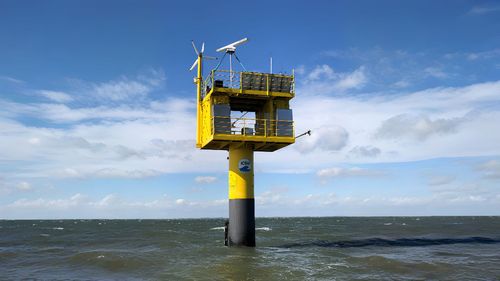
The ship-based expeditions form part of larger measurement campaigns: at the same time, a research aircraft is measuring wind currents over a wide area and collecting meteorological data, whilst permanently installed sensors monitor both local wind conditions and the status of the turbines. This makes it possible, for the first time, to observe interactions from the atmosphere right down to the seabed in a comprehensive manner. During the current voyage, the team on board the Heincke was tasked with determining water temperature, salinity, current velocity and wave height at various locations within and outside the wind farm. In addition, the researchers deployed several fixed measuring devices on the seabed, which provide continuous data.
Badewien particularly remembers two days at sea during which members of the research team circled one of the giant wind turbines in a dinghy for twelve hours at intervals of around 50 metres, taking measurements, whilst a second dinghy constantly travelled up and down on the leeward side. “It was a bit tedious, but it allowed us to study a complete tidal cycle and see how the current conditions around a turbine change with the ebb and flow of the tide,” reports the oceanographer. Fortunately, the weather cooperated: the researchers were able to carry out their measurements as planned for two weeks in sunshine and calm seas.
Plenty of seals among the wind turbines
Biological studies, such as an assessment of biodiversity, were not part of the research programme, but are taking place in parallel as part of projects run by the German Alliance for Marine Research. During the two weeks north of Heligoland, Badewien noticed many seals. He believes it is possible that wind farms could increase biodiversity – for example, because fishing is prohibited there and the structures act as artificial reefs, providing a suitable habitat for certain sedentary species.
However, disruptive effects are also conceivable: for example, increased turbidity of the seawater due to turbulence around the turbines, or a possible impact of the wind farms on the biologically highly productive interfaces between different water masses. The project results have yet to reveal exactly how these various effects interact.