
Since 2002, a permanent monitoring station run by the university has been continuously collecting key environmental data between Langeoog and Spiekeroog. This year, the unique research facility is going to be replaced. The plan is to upgrade the measurement and sensor technology and enhance the energy supply. In future, the data collected will be transmitted via fibre-optic cable to national and international observation networks.
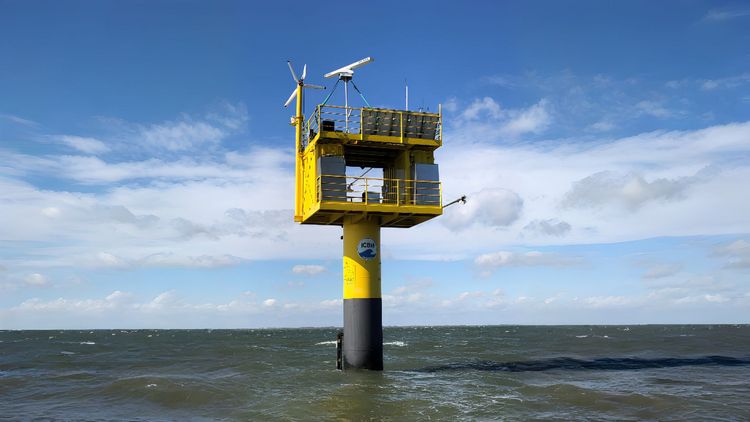
From the south-western tip of Spiekeroog, the approximately ten-metre-high black-and-yellow pole is impossible to miss. Since 2002, the ‘Spiekeroog Research Platform’ of the Institute for Chemistry and Biology of the Marine Environment (ICBM) at the University of Oldenburg has been located in the strait off the North Sea island. A shipping container equipped with various measuring instruments, a small wind turbine and solar panels is mounted on the pole. It provides continuous long-term data on the transition zone between the Wadden Sea and the open North Sea. This unique research infrastructure is due to be replaced by a new facility before the end of the year. The Federal Ministry of Research, Technology and Space (BMFTR) is providing €2.7 million for this purpose.
“For over two decades, the monitoring platform has been recording important environmental data in an ecologically sensitive area. Renewing it will enable us to continue existing measurement series and to continue recording, understanding and assessing the impact of climate change and rising sea levels on the Wadden Sea's ecosystems,” explained the project’s scientific director, oceanographer Dr Thomas Badewien from the ICBM.
Long-term measurement series form the basis for coastal protection and environmental management
The entire system is due to be fully replaced and modernised by December. The new platform will continue to record data such as temperature, conductivity, pressure, oxygen content, seawater current velocity and meteorological data, as well as the optical properties of the seawater and levels of various nutrients. The plan is to modernise the measurement and sensor technology, as well as improving the power supply. This will be achieved through the implementation of an autonomous emergency power system and a shore connection. In future, data will be transmitted in real time via fibre-optic cable to national and international observation networks, including the Federal Maritime and Hydrographic Agency (BSH) and the European Marine Observation and Data Network (EMODNet). The ICBM will remain responsible for operating and maintaining the station.
The researchers aim to continue providing important long-term baseline data for coastal protection, environmental management and the sustainable use of the sea with the help of the data collected. "The new measuring station is particularly valuable because, in future, we will be able to combine climate-relevant time series with high-resolution real-time data," explains Badewien. This will enable regional climate models to be improved and provide a better understanding of the impact of extreme events, such as heatwaves, and offshore activities on marine ecosystems.
The schedule envisages assembling the new facility onshore from September onwards and installing it at the old site in December, immediately after the old station has been dismantled.