

News page

Contact

Prof. Dr. Basil el Jundi

Navigation Biology Lab
Institute of Biology and Environmental Sciences
University of Oldenburg
Carl-von-Ossietzky-Straße 9-11
26129 Oldenburg

Campus Wechloy, W2 2–253

+49 441 798-3988 (F&P

News page

New paper published in Current biology

New paper from Christian published called: Stable neural coding of heading across locomotory modes by the insect compass system

Stable neural coding of heading across locomotory modes by the insect compass system

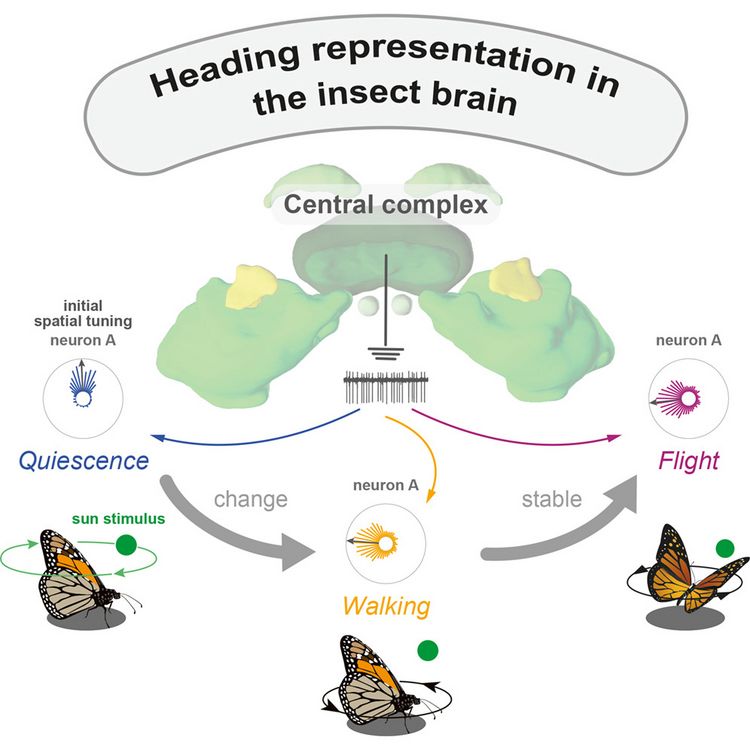
To establish a robust representation of heading, animals rely on multimodal integration of visual cues and self-motion information produced during locomotion. How animals capable of multiple modes of locomotion, such as walking and flying, maintain a heading representation across these different modes remains unexplored. Here, we demonstrate that the representation of heading coding in monarch butterflies (Danaus plexippus) remains remarkably consistent across locomotor modes, allowing heading information acquired during walking to also be used in flight. Tetrode recordings from the central complex, the brain region encoding heading in insects, allowed us to monitor the neural activity of individual butterflies that transitioned from quiescence to walking and from walking to flight. Comparing azimuthal tuning across these behavioral modes, we found dramatic state-dependent shifts that transformed a frontally biased heading coding in quiescence into a continuous, full 360° heading representation during walking and flight. This 360° heading representation was established even in an ambiguous visual setting and when the animals’ eyes were occluded, showing that self-motion inputs during active movement generate a heading signal that is independent of locomotor mode. Remarkably, despite the fundamentally different proprioceptive feedback from wings versus legs, the heading network maintained a consistent azimuthal tuning across walking and flight. This demonstrates that the monarch butterfly central complex integrates locomotor-specific signals into a unified heading signal. Together with visual information, this establishes an efficient navigation system in the monarch butterfly brain, capable of transferring relevant heading information from one mode of locomotion to another.

https://doi.org/10.1016/j.cub.2026.05.063

New paper published in Current biology

New paper from Christian published called: Stable neural coding of heading across locomotory modes by the insect compass system

Stable neural coding of heading across locomotory modes by the insect compass system

To establish a robust representation of heading, animals rely on multimodal integration of visual cues and self-motion information produced during locomotion. How animals capable of multiple modes of locomotion, such as walking and flying, maintain a heading representation across these different modes remains unexplored. Here, we demonstrate that the representation of heading coding in monarch butterflies (Danaus plexippus) remains remarkably consistent across locomotor modes, allowing heading information acquired during walking to also be used in flight. Tetrode recordings from the central complex, the brain region encoding heading in insects, allowed us to monitor the neural activity of individual butterflies that transitioned from quiescence to walking and from walking to flight. Comparing azimuthal tuning across these behavioral modes, we found dramatic state-dependent shifts that transformed a frontally biased heading coding in quiescence into a continuous, full 360° heading representation during walking and flight. This 360° heading representation was established even in an ambiguous visual setting and when the animals’ eyes were occluded, showing that self-motion inputs during active movement generate a heading signal that is independent of locomotor mode. Remarkably, despite the fundamentally different proprioceptive feedback from wings versus legs, the heading network maintained a consistent azimuthal tuning across walking and flight. This demonstrates that the monarch butterfly central complex integrates locomotor-specific signals into a unified heading signal. Together with visual information, this establishes an efficient navigation system in the monarch butterfly brain, capable of transferring relevant heading information from one mode of locomotion to another.

https://doi.org/10.1016/j.cub.2026.05.063

(Changed: 25 Jun 2026)  Kurz-URL:Shortlink: https://uol.de/p119626n13640en
Zum Seitananfang scrollen Scroll to the top of the page