Fundamentals
The Lower Saxony Higher Education Act stipulates that "every degree programme and every significant change to a degree programme (...) must be evaluated in terms of quality by a scientific institution that is independent of the state and the university" (§6 para. 2 NHG).
The University of Oldenburg decided to switch to the system accreditation procedure in 2018.
As with programme accreditation, the objectives, organisation and resources of individual degree programmes are to be reviewed.
However, the actual accreditation procedure itself looks at the quality assurance system of a university, whose task is to continuously evaluate the objectives, studyability and available resources of the degree programmes.
With the Guidelines for Quality Management in Teaching and Learning and with the Handbook for Quality in Teaching and Learning the formal requirements for the independent accreditation of degree programmes at the Carl von Ossietzky University of Oldenburg have been created.
You can find information on system accreditation and quality management in teaching and learning at the central level of the Department for Study Affairs here.
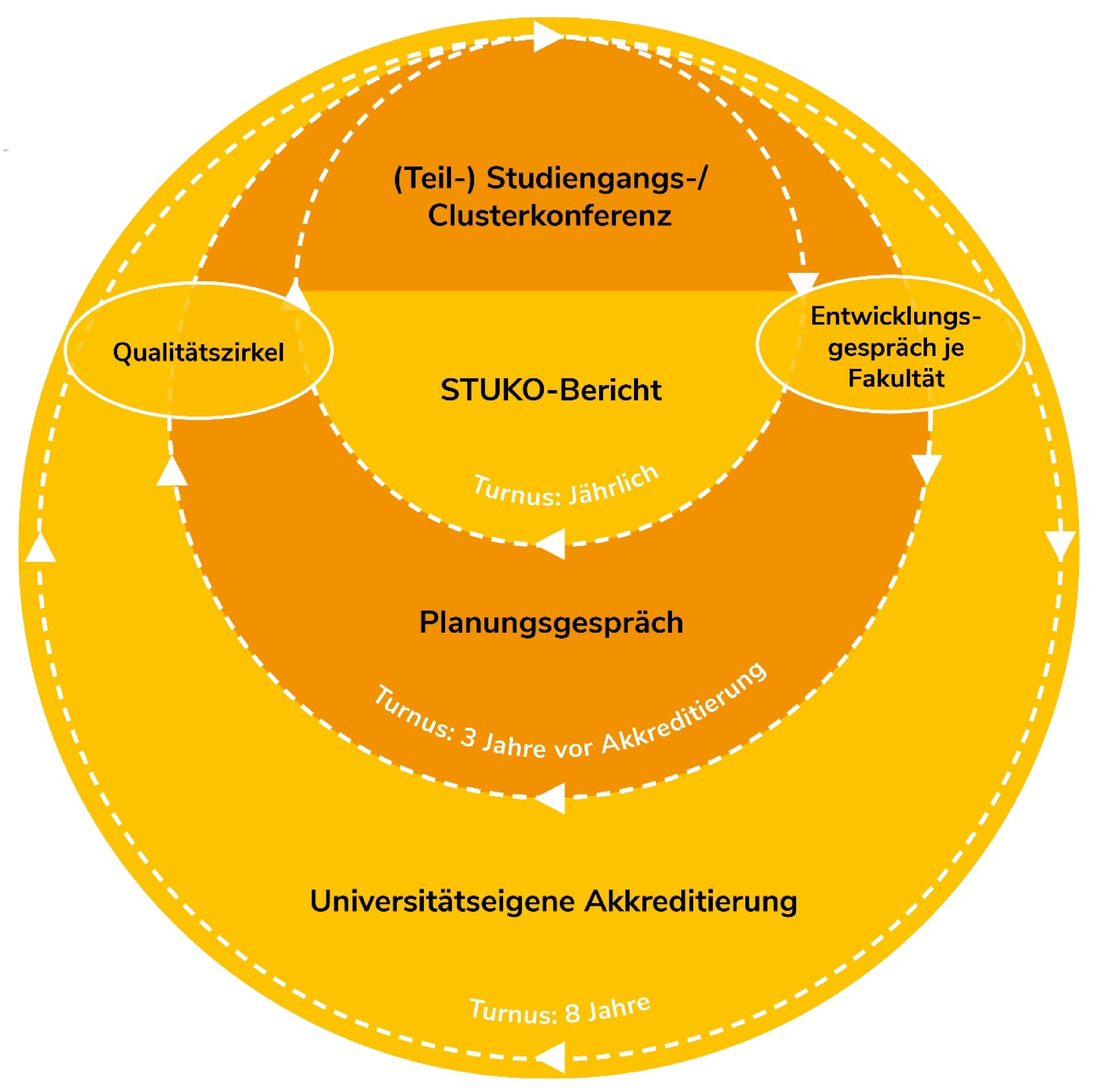
"The UOL quality cycle consists of six elements and extends over a period of eight years. The elements are designed to be dialogue-oriented and participatory. In terms of content, they are based on the Nds. StudAkkVO and the mission statement for teaching as well as on its concretisation at School level.
The quality criteria of the UOL are very closely aligned with the Nds. StudAkkVO, especially for the annual degree programme conference and the university's own accreditation. The quantitative teaching standards in accordance with the recommendations of the HRK apply to course planning.
Elements of quality management at faculty level
The quality assurance and further development of ongoing degree programmes is a constant and automated process. Modules or programme content are constantly being modified due to changes in framework conditions, such as state requirements or capacity or structural changes.
With the quality management system at the level of School I - School of Educational and Social Sciences, a process has been established that ensures that these adjustments are systematically scrutinised annually from different categorical perspectives and reviewed by colleagues.
Study programme conference(s)
The initial starting point of the quality cycle is the annual degree programme conference:
The aim of the degree programme conference(s) is to look at a degree programme (or several degree programmes) in terms of subject-specific, higher education didactic, curricular and study structure criteria. Ultimately, the aim is to identify development needs and agree on appropriate recommendations for action. In the QM system of the C.v.O. University of Oldenburg, the degree programme conferences form the basis for all faculty and inter-faculty elements that build on them and serve the continuous further development of studies and teaching.
Working basis
All those involved in the degree programme conferences are provided with the following as a working basis:
- a programme-specific data set from Academic Controlling,
- the results of the last student and graduate surveys of the respective degree programme,
- if applicable, the report sheets from module conferences of the previous year,
- the report sheets from the previous year's degree programme conferences with the measures recorded therein
- if applicable, the report from the (previous) accreditation,
- as well as other documents (e.g. examination and admissions regulations, module descriptions, study programme plans)
- If applicable, further reports (e.g. from the student body or student participants).
Questions:
A standardised report sheet is used to examine the following points, among others:
- Are there any conceptual or organisational anomalies in the degree programme?
- Are there any anomalies with regard to adherence to the standard period of study?
- Are there any anomalies with regard to the drop-out rate?
- Is there a need for improvement in the range of courses offered?
- Are there any anomalies with regard to gender equality and equal opportunities in the degree programme?
- Are there any anomalies with regard to module examinations? (e.g. failure rate, distribution of grades, examination density)
- Are there common assessment standards in the degree programme?
- Are the requirements of the examination regulations / module descriptions adhered to?
Further points can be raised by the participants.
Participation in the study programme conferences
The meetings of the degree programme conferences are always "open to the public", i.e. all interested lecturers and students are expressly invited to participate.
The programme conference is chaired by the programme directors programme directors.
Other participants are
- (at least) one university lecturer,
- (at least) one member of the academic staff,
- (at least) one student and
- if applicable, the QM representative and, if applicable, other persons.
- For teaching degree programmes, a member of the Didactic Centre (DiZ) and
- for continuing education programmes, a member of the Centre for Lifelong Learning (C3L) and, if applicable, the C3L QM officer.
The connection to the committee structure and thus to the regular decision-making processes of the School is ensured in particular by the report in the Study Commission (StuKo).
Module conferences can be initiated by the StuKo or the degree programme conference if appropriate topics or problems arise.