Narratives of female resistance in German literature of the Middle Ages
Dr. Britta Bußmann
- Übertragen und Übersetzen im Mittelalter, Übersetzungstheorien
- Ekphrasis und Text-Bild-Relationen
- Genese und Tradierung religiöser Wissensbestände in der Vormoderne
- Schweigemotive in der mittelalterlichen Epik
- Artusromane
- Wolfram von Eschenbach, ‚Parzival‛ und ‚Titurel‛
- Albrecht, ‚Jüngerer Titurel‛
- Mönch von Salzburg, geistliche Lieder
- hoch- und spätmittelalterliche Marienlieder
Institute of German Studies (» Postal address)
Narratives of female resistance in German literature of the Middle Ages
Dr Britta Bußmann in co-operation with Prof. Dr Anja Becker (University of Bremen, applicant and 1st spokesperson)
Co-operation project between the University of Bremen and the University of Oldenburg; funded by the University of Bremen’s Central Research Funding Office, Funding Line 06 A: Exploratory projects on new topics; project period: 1 November 2025–31 October 2027. Participants: Prof. Dr Anja Becker (University of Bremen) (principal investigator and lead coordinator), Dr Britta Bußmann (co-coordinator), Prof. Dr Albrecht Hausmann (University of Oldenburg), PD Dr Sonja Kerth-Wittrock (University of Bremen)
The project examines Middle High German literary narratives of female acts of resistance, both in terms of their narrative content and form, and in terms of their intra-literary functions as well as their cultural-historical significance as narratives.
The contemporary theme of resistance has many facets that remain hidden if resistance is reduced to the realm of politics and active action. Women have resisted at all times, as literary texts bear witness to, including in the Middle Ages. However, this topic has so far been overlooked in literary research, which is why the first step is to make female resistance visible in medieval literary texts and to map out its dimensions. In what contexts, by what means and with what outcomes do female characters in Middle High German literature offer resistance? As these are literary narratives of acts of resistance, the techniques and methods of storytelling must also be examined. Who narrates, how, and through which patterns of female resistance? These narratives are usually part of a larger narrative context, which is why we must examine their functions in relation to the overarching framework of meaning within the literary work: do they offer exemplary, alternative or even subversive interpretations of meaning? Do they, moreover, offer meaning-making interpretations and patterns of thought to medieval (and contemporary) culture? If so, do these reinforce existing beliefs, or do they open up new ways of understanding, or even new cultural narratives?
The project not only explores an innovative field of research at the intersection of medieval studies and literary studies, but also constitutes a central element of an interdisciplinary research initiative by Department 10 at the University of Bremen on ‘Constellations of Refusal’. A collaborative research project is currently being prepared in this regard. Within this framework, the collaborative project plays a key role. The exploratory project on female resistance therefore aims to secure external funding (planned through the DFG).
Upcoming activities:
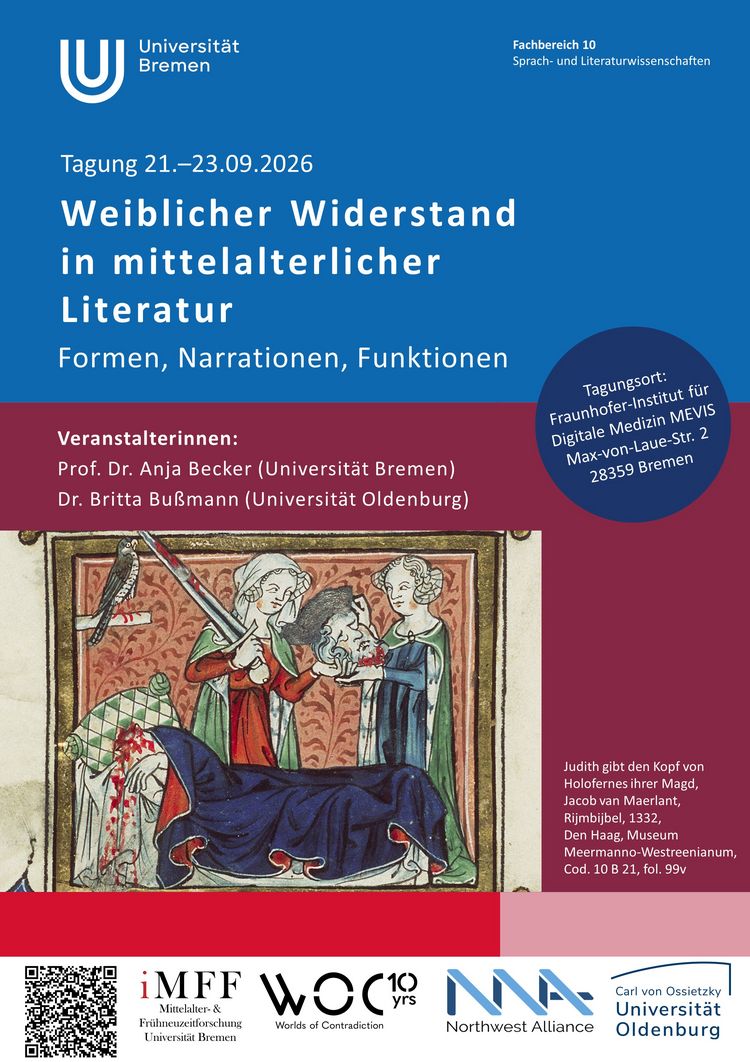
21–23 September 2026, in collaboration with Prof. Dr Anja Becker: Interdisciplinary and international conference: ‘Female Resistance in Medieval Literature: Forms, Narratives, Functions’ (University of Bremen)
Winter semester 2026/2027 : Dr Britta Bußmann (University of Bremen) to act aslocum for the full professorship in ‘Medieval and Early Modern German Studies up to the end of the 16th century’