Verona
Verona
Verona - by Manuela Janssen and Merle Wißmann
On the fourth day of the excursion, we travelled by bus from Brescia to Verona in the afternoon. We were to spend the next two nights in a hotel there. All the rumours that had come true about this city steeped in history awaited us. It is said that there is culture and history to discover on every corner in Verona and that you can even touch it! And it's true, even without a great interest in history, it has to be admitted that this city is brimming with facts from days gone by. They seem to be perfectly integrated into modern everyday life, as there are exhibitions, guided tours and buildings for those interested on every corner. So there was plenty for us to discover on the fifth day. First on our list for the day was a visit to the Museo Maffeiano. For the next three hours, we were overwhelmed by an enormous mass of tomb tablets, reliefs and inscriptions of Greek and Roman origin. We gained an insight into the life of Titus Ursinius Castor, a soldier who served the Roman Empire for 26 years. The surviving part of his tomb slab from the 2nd century AD told us that he came from Sardinia and lived to be 56 years old. Furthermore, the inscription tells us that he was no ordinary soldier, but was deployed together with Titus Arenius Cordus as a naval soldier on the "Victoria" (name of a warship).
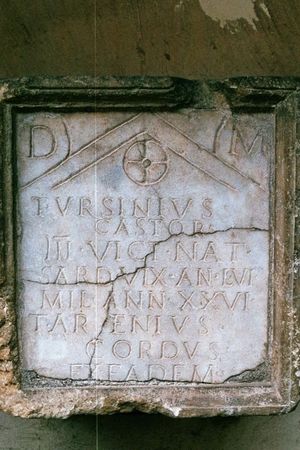 | T = Titus VRSINIVS = Ursinius CASTOR = Castor III VICT = Warship "Victoria" NAT SARD = Born in Sardinia VIX AN LVI = Lived 56 years MIL ANN XXVI = 26 years Roman soldier T = Titus AR = Arenius CORDUS = Cordus EX EADEM = Likewise |
|---|
On our journey through the lives of individual Greeks and Romans, we repeatedly came across tomb plaques and stelae that contained references to the cult of Mithras. On one of the reliefs we were able to recognise the origin of the Mithras cult and all its characteristic features. Mithras is depicted here killing the cosmic bull. The result, according to legend, was the creation of living organisms on earth. These are typically symbolised by ears of grain visible on the bull's tail.

In addition to tomb plaques, there were also some stone coffins or parts of coffins to marvel at. On the sides of the coffins we found, among other things, depictions of everyday life. It was interesting to note that the deceased person was usually depicted centred. However, there were also coffins where the face of the figure in the centre had not yet been completed. It is therefore assumed that these coffins were never used. The reasons for this will probably always remain a mystery.
Not only was the exhibition impressive with a wealth of information about the lives of Romans and Greeks, but the museum's 300-year-old building is also steeped in history. It was opened as a museum in the middle of the 18th century. The associated vestibule and inner courtyard were even built in the 17th century. The vestibule was originally built as part of a theatre. Here we came into contact for the first time that day with a phenomenon typical of Verona: finding historical artefacts from very different eras in the same place. Although the large number of funerary inscriptions and reliefs presented were actively collected there, we were to find out in the afternoon that a large number of remains of ancient and medieval Verona can be found below today's Verona. On closer inspection, they are recognisable on the surface. Strengthened by a short lunch break, we set off in search of the Roman traces on site. First of all, we marvelled at the roads underground, which the Romans built 100 - 200 years ago and which are so solid that they are still extremely well preserved today. As these are roads, they can hardly be displayed in a museum, but the Italians are very proud of their history and have found an unusual solution to the problem of accessibility: In addition to a few access points that lead under the buildings via narrow staircases, there is an active restaurant (pictured left) that offers guided tours during opening hours. Next to the wine cellar of the house there is another cellar room. There is a large table with a map of the area to explain clearly what this part of Verona looked like in Roman times, around 200 BC.

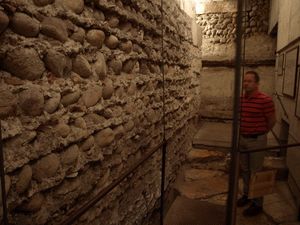
After this explanation, we were taken a little deeper underground and were able to see the foundations of a medieval tower next to the Roman roads. The base was almost square and its masonry was well preserved. However, the tower was no longer impressive in terms of completeness, as a large proportion of the stones had been reused by previous generations for houses or roads. It was fascinating to see how the Roman road and the medieval tower differed in their construction methods. While the Romans had used large stone blocks for their buildings, the foundations of the tower from the Middle Ages were more like a collection of stones from a river bed, with occasional stone blocks from the Roman road worked in.
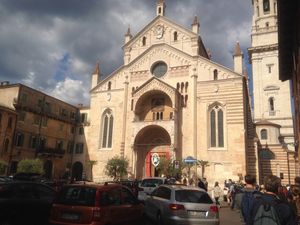
After this experience, the guide led us back to the surface. Here we continued along the Roman road, as many streets in the original part of today's Verona still run the same way as the Romans laid them out around 2000 years ago. On the trail of further Roman remains on Verona's surface, we again found isolated stone blocks that were used in the façades of the houses. To round off the day, the city guide showed us some particularly awe-inspiring buildings, such as the town hall and Verona Cathedral. The cathedral was consecrated in the 12th century after over 100 years of construction, with Romanesque and Gothic elements characterising its appearance. There is also an ancient library next to the cathedral, which can be visited on request. It is considered to be one of the oldest libraries in the world. This day full of exciting impressions could be rounded off with either a cup of Italian coffee or another tour of the city.