
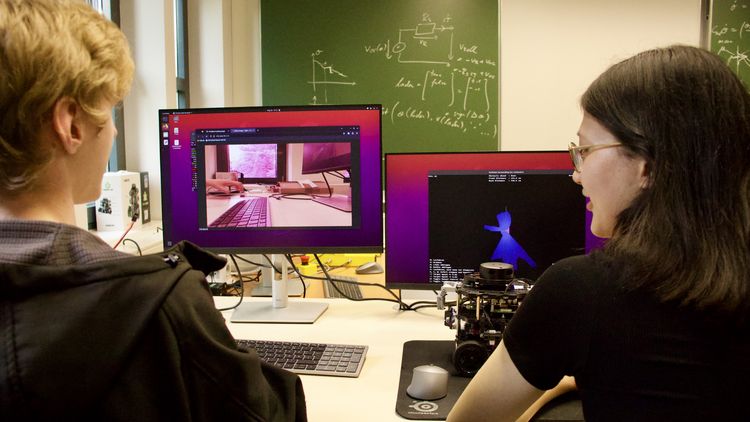
Thanks to funding from forschen@studium, the research seminar "Mobile multi-agent robot system" offers students the opportunity to carry out research in a practical context.
In the latest round of this module, students worked in two groups to investigate and practically implement method-oriented topics in the field of mobile robotic systems. One group asked the question "How can realistic driving behaviour be simulated?" and the other dealt with the question "How can an autonomous system be developed that follows a given path, e.g. a wall?". Both questions were worked out with a theoretical background and the students' results were validated using the TurtleBots made available by forschen@studium. The limited number of TurtleBots available prevented all students from testing their implementations at the same time. The students therefore familiarised themselves with simulation options and used these to validate initial prototypes in simulation before transferring them to the real hardware. The differences between reality and simulation turned out to be greater than expected. Initially, the students' TurtleBot only turned in circles instead of travelling straight towards a wall. While analysing this phenomenon in more detail, the students discovered measurement errors and uncertainties as the cause. They learnt how to model and compensate for these.
This project, which is continuously supported by the department of Distributed Control in Networked Systems and a new module on Hardware-in-the-Loop Simulation in Energy Informatics (from winter semester 2023/24) will enable students to combine lecture content directly with real-world challenges.
In conclusion, the students of the current semester are quoted: "Such projects allow a deeper understanding of what can actually be hidden behind research questions. It's worth a visit for anyone who wants to try out research and apply research results in practice!"
 |  |  |
Some more impressions in video format:
Contact and further information: