
Publications
Publications

“Scenes of Anger, Disruptions in the Visual Space. Protest Practices of the New Women’s Movement”, Marie Sophie Beckmann in: Caroline Schöbi/Linda Waack/Seraina Winzeler (eds.), *Frauen und Film*, Issue 74: ANGER (October 2026).
Issue 74 of *Women and Film* is devoted to the politically significant aspect of anger and explores how this experience can be channelled into strength, energy and resistance. What does anger mean in film and theory? What are the aesthetic indicators of anger? Where does anger drive us, and into which historical traditions does it fit? Can it be channelled, or is it better to turn away from it after all?
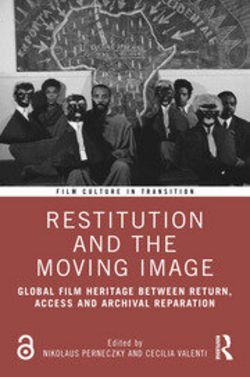
"Reactivating Ethnographic Image Collections: Towards a Decolonial Archivology", Petra Löffler in: Nikolaus Perneczky and Cecilia Valenti (eds.), *Restitution and the Moving Image: Global Film Heritage Between Return, Access and Archival Reparation*. London : Routledge, 2026, pp. 135–155.
This chapter takes as its starting point a historical photographic collection now held by the ethnographic museum MARKK in Hamburg, Germany, to reflect on the role of ethnographic photography and filmmaking in the colonisation of peoples, cultures and territories. Issues of access and remediation are discussed, using the image collection of the so-called Hamburg South Seas Expedition as an example. By re-analysing selected photographs from this collection, the author first asks how Western modes of knowledge production, circulation and archiving can be challenged and decolonised, and then examines how such sensitive ethnographic image collections might be reactivated and opened up to different curatorial practices and artistic interventions. In conclusion, the chapter argues for a ‘decolonial archivology’ that takes into account the decolonial potential of other knowledge practices as well as digital media.

From Debris to Sediment: Unearthing Imperial Geologiesedited by Felix Hasebrink and Petra Löffler. Lüneburg: meson press, 2026.
In geology, the term sediment refers to organic or mineral particles that were set in motion and transported to a new location by air, water, or ice. Today, new sediments are emerging that challenge traditional concepts of geological processes: the global spread of microplastics, the contamination of soil and water with toxins, infrastructural remainders of industrial manufacturing, or the material legacies of imperial and/or colonial resource extraction.
From Debris to Sediment addresses the rising relevance of these residues. From the perspective of media studies, geography, sociology, environmental sciences, and artistic research, the contributions to this volume deal with key sites and issues related to the mounting layers of anthropogenic refuse and explore sediments as a geo-philosophical figure of thought. What media, politics, and ecologies are implicated in accumulating "future fossils"? And how do they envision the new material cycles emerging from these growing deposits?
“Sticky Screens: Between Protest and Cooperation”, Marie Sophie Beckmann in: Kerim Doğruel/Fadekemi Olawoye/Clara Podlesnigg (eds.), Sticky Films: Material and Conceptual Explorations. Lüneburg: meson press, 2025, pp. 37–54.
Sticky Films brings the material and conceptual dimensions of stickiness into dialogue, seeking out intentional and sometimes unwanted sticky residues in film and media cultures. The chapters explore the sensations of stickiness, sticky modes of being, as well as representations or traces of stickiness in audiovisual media.
Marie Sophie Beckmann’s “Sticky Screens: Between Protest and Cooperation” takes us through events that unfolded at screenings of underground films by the US filmmaker Richard Kern in Germany in the early 1990s. Beckmann focuses on a particular screen at Johannes Gutenberg University Mainz, onto which student protesters threw red paint in protest against the “dirty” films that were about to be projected onto it. She interprets this interaction between the audience and the screen as a form of “meaningful contact” and collaboration that disrupts the social protocols of the cinematic experience, yet simultaneously enriches them by staining the screen and vandalising the cinema space in acts of resistance against the films being screened. (p. 29)
Sub(e)merging: Experiences, Practices and Politics from Belowedited by Marie Sophie Beckmann and Petra Löffler, Zurich: Diaphanes, 2025.
Whether it is the ocean, the ground or soil, a metaphorical or symbolic underworld or a political figure of thought, the subsurface intervenes in recent debates about ecological, social and postcolonial conflicts and power inequalities in the humanities and beyond. However, turning to the unstable grounds of the subterranean always involves a conceptual or methodological movement and a practice of submersion, and thus a critical reflection on the conditions, technologies, aesthetics and politics of knowledge production.
Review in: Sehepunkte (issue 26, no. 3, 2026).
Films That Spill: Beyond the Cinema of TransgressionMarie Sophie Beckmann. New Brunswick, NJ: Rutgers University Press, 2025.
Films That Spill is a comprehensive study of the Cinema of Transgression, a hitherto underexamined moment in US underground film culture. Reconsidering the concept of transgressive cinema not only as a description of the intentionally provocative content of the films but also as a feature of a cross-disciplinary practice, Marie Sophie Beckmann explores how filmmaking in the context of the vibrant and intermingling art, music, performance, and film scenes in 1980s Lower Manhattan spilled over the boundaries of artistic disciplines, media formats, and content concepts.
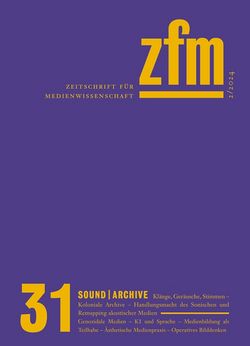
"Listening to voices. Knowledge practices and restitutive options of colonial sound documents", Jakob Claus in: Journal for Media Studies. Vol. 16, Issue 31 (2/2024): Sound Archive, pp. 20-32.
The article examines media practices of phonographic knowledge production in the context of German colonial ethnography. Two recordings from Micronesia made in the course of ethnographic expeditions are analysed in a "close listening". The historical sound documents are understood as circulating and complex archival objects and analysed in terms of their recording context and contemporary mediality.
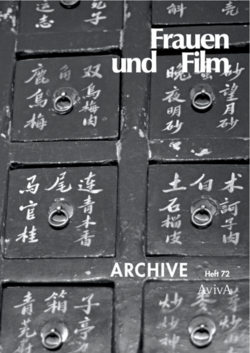
"Archive que(e)ren: Black Feminst Futurity in Whilst You Archive Me", Petra Löffler in: Dagmar Brunow/Katharina Müller (eds.): Women and Film, Issue72: Archives (2024) S. 42-51.
In the anniversary year, the issue is dedicated to archiving and thus to the practices of collecting, cataloguing and curating.
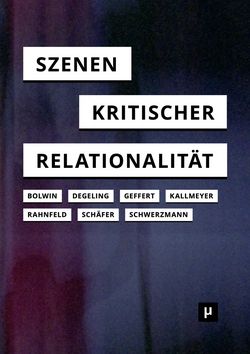
"Not the First Time: Asymmetrical Knowledge between Media Circulation and Colonial Archive", Jakob Claus in: Charlotte Bolwin/Jasmin Degeling/Gabriel Geffer et al. (eds.): Scenes of Critical Relationality. Lüneburg: meson press, 2024, pp. 55-76.
Critical relationality intervenes in orders of thought that have designed critique as an operation of separating and keeping apart and thus shaped the modern dualisms of human and non-human, subjects and objects, organic and technical, nature and culture. Based on multiple, entangled crises, the contributions in this volume seek out concrete scenes in which the critical potential of connections and entanglements becomes clear.
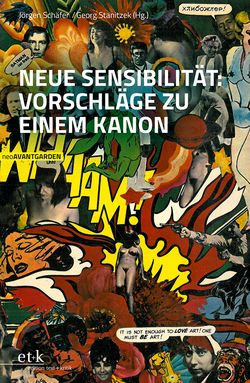
"Leafing through the underground: A review of the Cologne underground film initiative XSCREEN (1968-1971)", Marie Sophie Beckmann in: Jörgen Schäfer/Georg Stanitzek (eds.), Neue Sensibilität: Vorschläge zu einem Kanon. Munich: edition text+kritik, 2024, pp.101-124.
The literature of the "New Sensibility" (circa 1965-1975) has remained largely terra incognita in German-language literary history to this day. It is supported by an only loosely integrated intellectual formation that draws partly explicitly, partly implicitly on the conceptual stakes imported from the USA by Susan Sontag, Tom Wolfe, Leslie A. Fiedler, Herbert Marcuse and others. In the works of young authors of the time such as Elfriede Jelinek, Rolf Dieter Brinkmann, Renate Matthaei, Peter Handke, Renate Rasp, Hubert Fichte, Barbara Frischmuth, Gerhard Zwerenz and Helga M. Novak, the agenda of the New Sensibility becomes tangible: provocative drasticness, references to mass media and consumption, depictions of sex and violence and, last but not least, the experimental straining of the book medium aim at nothing less than a "revolution of perception".
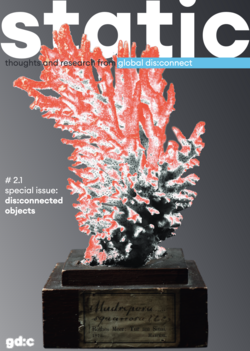
"Haeckel's Corals: On the Extraction, Collection and Circulation of Scientific Objects", Petra Löffler in: static 2/1: disconnected objects (2023), pp. 9-19.
Imperial and colonial power structures that allowed scientists to extract objects and living beings from colonised countries, their landscapes, habitats and seas were a prerequisite for globalisation. Petra Löffler presents a case study on the journey of Ernst Haeckel's corals and shows how Haeckel extracted a vast amount of corals from their original habitats with the help of colonial infrastructure, transporting them to German museums, where they are now archived and have been objects of research and display.
"Ecologies of Film in the Anthropocene", Petra Löffler and Charlotte Bolwin in: Bernhard Groß/Thomas Morsch (eds.): Handbuch Filmtheorie. Wiesbaden: Springer VS, 2023, pp. 1-20.
As a mass medium, technology and material infrastructure, film is part of the current earth epoch known as the Anthropocene. The production, distribution and reception of films consumes large amounts of resources and energy and leaves a significant ecological footprint. At the same time, from the perspective of media theory and philosophy, films represent an aesthetically privileged form of access to the world, which is said to have a high affinity to ecological issues. The article examines the diverse relationships and interactions within the media milieu and the film ecosystem and looks at film and media studies concepts such as 'ecocinema', 'eco media' or 'green cinema' in order to uncover the entanglement of film theory and practice with material production conditions, modern consumption practices and ethical imperatives in the context of global warming and the climate crisis. The term 'ecology' serves as a concept that encompasses the various relationships of cinema to its material environment as well as the epistemologies of thinking and describing film and the aesthetic form of perception of audiovisual media as a whole. Using relevant texts on film theory from the early days and present day of cinema, it will be explained which dimensions of film touch on ecological thinking and how ontological considerations are linked to ethical and political questions.
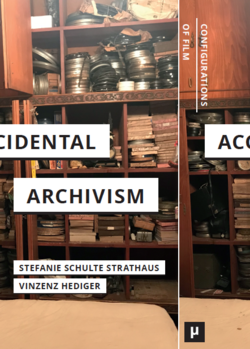
"Forgetting the Cinema of Transgression by Looking for its Traces", Marie Sophie Beckmann in: Vinzenz Hediger/Stefanie Schulte Strathaus (eds.), Accidental Archivism: Shaping Cinema's Futures with Remnants of the Past. Lüneburg: meson press, 2023, pp.167-173.
Accidental Archivism brings together programmatic statements and proposals to explore an artistic space between archiving and activism, a space where remnants of the past become the building blocks of new ways of making, showing, teaching and thinking cinema.
In "Forgetting the Cinema of Transgression by Looking for Its Traces" Marie Sophie Beckmann recounts the challenge of mapping 1980s marginal film cultures in New York's East Village and Lower East Side. Focusing on the work of Nick Zedd, Beckmann emphasises the resistance to reconstruction of what she calls fluid practices and unruly objects. (S. 21)
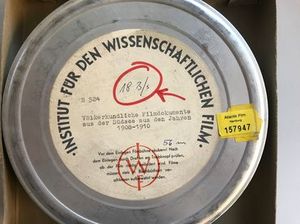
"Double Vision: Encountering Early Ethnographic Films in the Digital Archive", Petra Löffler in: Frames Cinema Journal 19 (2022), pp. 277-291.
This featurette raises questions about the significance of film recordings for ethnographic research, the role of archives and museums in their preservation or digitisation, and, not least, their entanglement in German colonial politics.
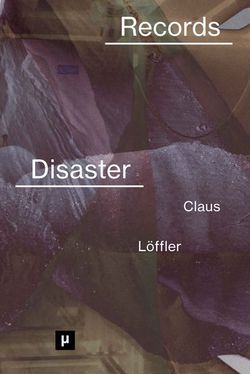
Records of Disaster. Media Infrastructures and Climate Change, edited by Jakob Claus and Petra Löffler. Lüneburg: meson press, 2022.
What connects melting glaciers and the knowledge from ice cores to the mapping of the ocean floor and the extraction of resources in the deep-sea? Records of Disaster proposes an analytical perspective on infrastructures as multi-layered witnesses to climate change.
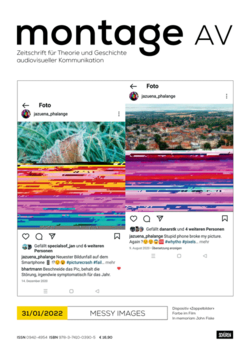
"Overflow/Containment: The Messiness of the Cinema of Transgression", Marie Sophie Beckmann in: Montage AV: Messy Images 31, 1 (2022), pp. 77-100.
Messy images are images that disturb. Messy images can have technical reasons - such as visual blurring and glitches, acoustic noise, lossy compression, faltering images due to buffering. They can be deliberately created by human actors - for example in the form of confusing image compilations, collages or text-image-sound arrangements - or exist by chance. Nevertheless, the impression of messiness can also arise in the transitions between technical and human actors, between networks, institutions, archives and algorithms.
Marie Sophie Beckmann's text approaches the heterogeneous movement of the Cinema of Transgression via the metaphor of overflow and containment. In addition to the exuberant, excessive aesthetics of the films, the author also questions their overflowing arrangement in the exhibition "You Killed Me First" (KW Institute for Contemporary Art, Berlin 2012) and in the New York context of the 1980s. Paratexts such as exhibition brochures, VHS tapes and manifestos become carriers of an ontological destabilisation as well as of formlessness and indiscipline, which are intended to give space to messy methods, disorderly approaches to collaborative film practices. (S. 14)

Earth and Beyond in Tumultuous Times. A Critical Atlas of the Anthropocene, Edited by Petra Löffler and Réka Patrícia Gál. Lüneburg: meson press, 2021.
This volume addresses the urgent geopolitical and environmental questions raised by the new geological epoch called the Anthropocene.
"Ecologies of medial practices", Petra Löffler in: Sebastian Gießmann/Tobias Röhl/Ronja Trischler (eds.): Materialität der Kooperation. Berlin: De Gryuter, 2019, pp. 373-398.
The concept of an 'ecology of practices' was coined by feminist science theorist Isabelle Stengers and has been continuously developed for more than twenty years. She already used it in her seven-volume study Cosmopolitiques, published in 1997, to outline the emergence and coexistence of acting entities in scientific experimental cultures. For her, these heterogeneous actors only achieve identity and stability in a network of relations that gives rise to heterogeneous modes of existence and practices.
"Archives of the future? A conversation about collection policies, colonial archives and the decolonisation of knowledge", Petra Löffler, Brigitta Kuster and Britta Lange, in: ZfM 20 (2019), pp. 96-111.
Brigitta Kuster and Britta Lange have long been researching and publishing on sensitive collections, colonial heritage, archiving processes and exhibition practices. They talk to Petra Löffler about the possibilities and risks of a different archive policy in the future and about the relationship between the materiality and mediality of archives.

Distributing images. Photographic Practices in Digital Culture, edited by Winfried Gerling, Susanne Holschbach and Petra Löffler. Bielefeld: transcript, 2018.
Digital photographs are omnipresent: they are created, distributed, commented on and stored billions of times a day. In conjunction with digital technologies and social networks, practices have emerged that have radically changed the production and reception, distribution and archiving of photographic images. They are distributed, organised and evaluated by their prosumers as well as by machines, software and algorithms.
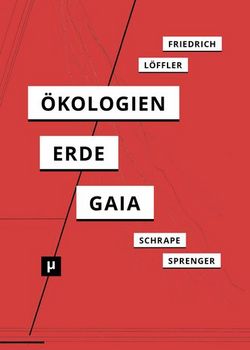
Ecologies of the Earth - History and Topicality of the Gaia Hypothesis, edited by Alexander Friedrich, Petra Löffler, Niklas Schrape and Florian Sprenger. Lüneburg: meson press, 2018.
Ecologies of the earth determine the present. The Gaia theory developed by James Lovelock together with Lynn Margulis in the 1970s is now gaining new explanatory power. If Gaia even becomes Bruno Latour's general model for explaining the world in the 21st century, it is important to ask about the plausibility that the talk of Gaia is currently developing.
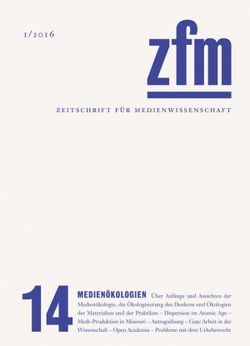
Media Ecology. Issue of the Journal of Media Studies, Petra Löffler and Florian Sprenger (eds.), 14 (2016).
The relationship between technology, culture and nature is up for debate, and with it a number of basic concepts of media studies. Based on this realisation, approaches are emerging that ask about the systematic use and historical role of media ecologies. However, what is meant by this, how the relationship between media and ecology could be conceptualised, what plausibilities ecology has for media studies and what objects media studies is able to grasp ecologically is rarely looked at more closely. The 14th issue of the Journal of Media Studies, focussing on "Media Ecology", sets out to map areas of possible media ecologies from a historical and systematic perspective.