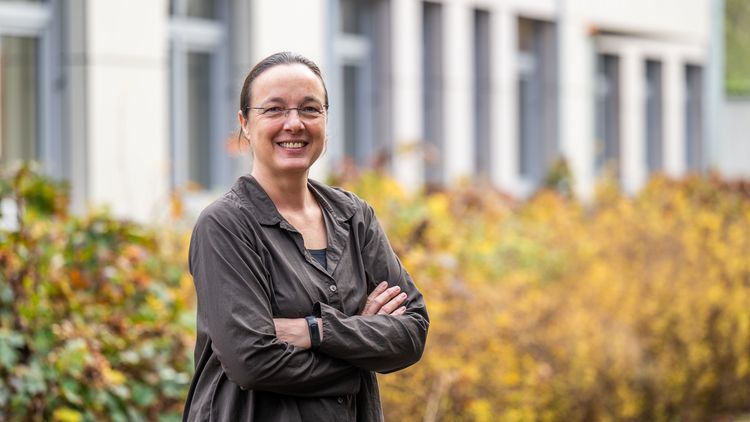

For three decades, the University has been offering language courses for students, researchers and staff. In this interview, Maike Engelhardt, head of the Language Centre, explains its important role in campus life.
In today’s world, people often learn new languages on their own using apps or AI-based translation software. How can a traditional language course compete with that?
Dr. Maike Engelhardt: No AI or app can replace interaction with a language teacher or meeting other people to learn together in a group. Anyone who wants to be able to communicate confidently in a foreign language will benefit immensely from having someone by their side to correct mistakes and teach them grammar. A special feature of our courses, in particular, is that they are clearly geared towards studying and research. People who really need to learn the language for their studies, research or work come together here. The participants in our courses are highly motivated, and their language skills advance rapidly as a result.
Why is the Language Centre important for the University?
In the times we live in, it is more important than ever to maintain a direct dialogue – across all cultures. The Language Centre is one of the places where the internationality of our campus is particularly in evidence. Important encounters take place in our courses, and above all at events such as our language café and in our language tandems. They provide a great opportunity to communicate authentically in a foreign language outside the seminar room and to gain direct insights into a learning partner’s culture.
The University has become increasingly diverse in recent years and attracts students from all over the world. What do you offer international students?
Engelhardt: Many of them come to the Language Centre to learn German or to improve the German language skills they already have. We offer a wide range of courses and services to meet different requirements – from intensive courses during lecture-free periods and preparatory courses spanning two semesters to language assistants who help international students with everyday life at the University.
Which languages are most in demand?
Engelhardt: The University of Oldenburg is among a number of universities that expressly adopted a language policy and a corresponding catalogue of measures in 2019. With this step it actively committed to promoting multilingualism on campus and focusing not only on English as the primary international language of science, but also on German as a scientific language. All members of the University, including students, researchers and staff, are therefore offered opportunities to develop and consolidate their English and German language skills. Spanish, Dutch and Swedish are also in high demand. We currently offer courses in 16 languages, including Japanese, Croatian and Danish. That we offer such a wide range of languages also has to do with the University's increased focus on international student exchange. According to the International Office, we currently have 288 active partners in 65 countries.
How has the Language Centre evolved over the years?
Engelhardt: We now have twelve permanently employed language teachers and 25 part-time teachers. This alone shows that the Language Centre has become one of the strategic levers for internationalisation. When the Common European Framework of Reference for Languages was published in 2001, it was an important step towards being able to assess and compare learning progress and competence levels in foreign languages on a Europe-wide basis. Since then, our language courses have been divided into six proficiency levels: A1 to A2 for basic use, B1 to B2 for independent use, and C1 to C2 for proficient language use. German for internationals has become an extremely important area, because due to a growing number of international degree programmes the University has become increasingly attractive to international students and academics. The integration of these people into university life and the labour market will continue to be one of our main focuses.
What are your goals for the future?
Engelhardt: I hope that we can maintain our strong position and continue to expand the diversity of our language courses in order to foster the international environment at our university. I look forward to many more students from abroad learning German with us, and to seeing many students and researchers from the region continuing to be motivated to learn languages and gain experience abroad. There is so much to learn about the world, other cultures – and ultimately about ourselves. Research is international by nature, so it’s important to gain international experience and be proficient in the languages of science.
And if you don't go abroad?
Engelhardt: Taking a language course is still worthwhile: not only are you immersed in foreign words and structures, but you also learn something about other countries and cultures. Internationalisation at home – that’s also an option, of course.
Interview: Saskia Heinze