
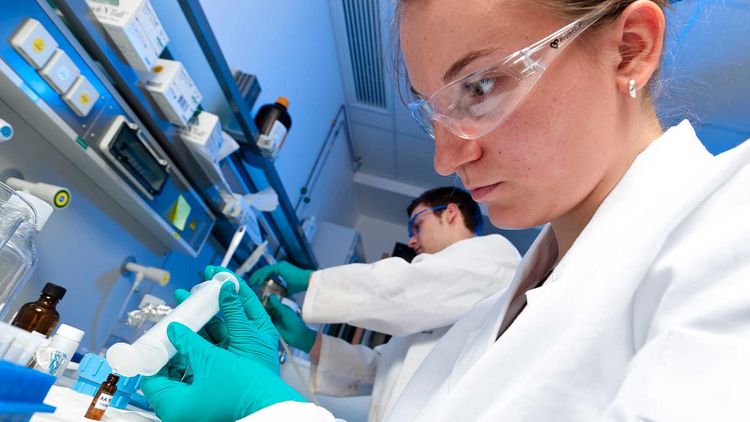

How is it that organic material dissolved in the sea can store carbon over thousands of years and thus keep our climate relatively stable? To get a little closer to the answer to this question, marine researchers at the university have conducted a laboratory experiment lasting several years.
The five-person team led by Dr Helena Osterholz and Prof Dr Thorsten Dittmar from the Institute of Chemistry and Biology of the Marine Environment (ICBM) has published its findings in the current issue of the renowned journal "Nature Communications".
The ocean stores a similar amount of carbon in dissolved organic matter (DOM) as the Earth's atmosphere does in carbon dioxide (CO2). This highly complex mixture of different carbon-containing substances consists of metabolic and decomposition products of marine organisms such as algae. It forms the basis of life for marine bacteria, which release the carbon it contains into the atmosphere in the form of CO2 when it is broken down.
However, a large proportion of the DOM remains in the seawater for several thousand years, in some cases even up to 40,000 years. This so-called refractory DOM - or RDOM - therefore acts as a large long-term carbon store.
The question of whether RDOM is formed solely by biological processes and how it can subsequently resist bacterial degradation for so long is the basis of the recently published article. To this end, the researchers mixed pure, initially DOM-free salt water with a small amount of North Sea water along with its natural algae and bacteria content. Using water samples taken over a period of 1011 days, algae growth, DOM release and degradation processes were observed and analysed in detail using ultra-high-resolution chemical methods.
The researchers investigated whether the molecules produced in the laboratory were the same as those in the deep sea and were present in similar concentrations as in the deep water of the world's oceans. The result: the molecules are largely the same as in the marine RDOM - but mostly in completely different concentrations. The mixing ratio of the DOM components in the laboratory did not match the RDOM.
In a complicated calculation, the scientists determined the proportion of RDOM in the total organic material in the experiment; this was 0.2 to 0.4 per cent of the total bound carbon. "This is in the same order of magnitude as theoretical estimates, which assume around 0.6 per cent. We have now been able to prove experimentally what had long been suspected: Biological processes are sufficient to keep the amount of carbon stored in the sea stable," says Osterholz.
A delicate balance that is highly relevant for our climate: "In the Earth's history, even small fluctuations in the concentration of dissolved organic material have presumably led to ice ages or warm periods that spanned the entire Earth."
After a total of four years of the laboratory experiment, the scientists will soon take the last water samples from the large vessels. The rest will be used for a follow-up experiment: The scientists will next use UV light to simulate processes on the light-flooded sea surface.