
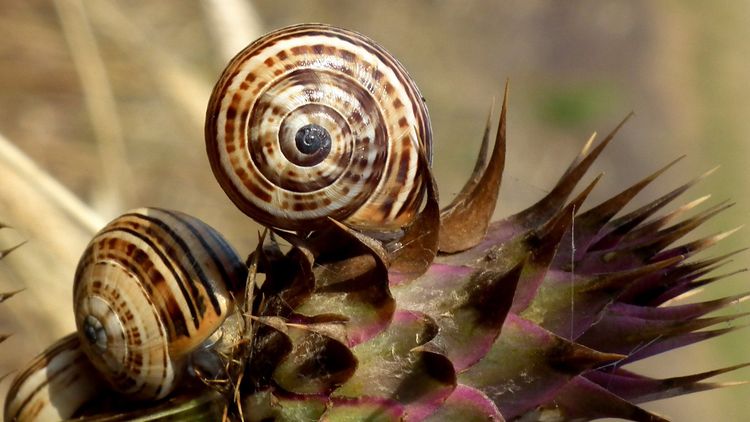

The European Mediterranean snail can now also be found in South Africa and Australia. How this came about and what snails have to do with the homogenisation of ecosystems was the subject of research by ecologist Hanno Seebens in an international team and the results were published in the journal "Science".
More and more plant and animal species are being introduced into new areas by humans. An international team of researchers led by Prof. Dr Henrique Miguel Pereira from the German Centre for Integrative Biodiversity Research in Leipzig has now been able to prove for the first time that the global introduction of species leads to the collapse of independent distribution patterns of species that have evolved over many millions of years - and thus to the increasing homogenisation of ecosystems.
One of the members of the research team and authors of the study is ecologist Dr Hanno Seebens from the Institute of Chemistry and Biology of the Marine Environment at the University of Oldenburg. Together with scientists from Portugal, Austria and Germany, he analysed 175 snail species in 56 countries and was able to prove that species communities are rapidly changing in their composition worldwide and are becoming increasingly similar. The results of the large-scale study have been published in the current issue of the renowned journal "Science". The study provides one of the first analyses of the global homogenisation of ecosystems.
Continents, countries, islands - by nature, they have their own unique flora and fauna. Well-known examples are the eucalyptus and marsupials in Australia or the nocturnal and flightless kiwi in New Zealand. On a smaller scale, this uniqueness also applies to many species of the East Frisian Islands and the Wadden Sea. Oceans and mountains have prevented the natural spread of species over millions of years, thus limiting their range. Global trade has enabled humans to remove these ancient barriers to the spread of species within a very short space of time. Plant and animal species are transported across continents, while other species are deliberately released. This development has increased massively in recent decades.
For their study, the scientists investigated how the similarity of species compositions in snails changes as a result of human species introduction. To do this, they recorded both the natural distribution of land snail species and their introduction by humans.
Their result: The natural distribution of snail species reflects the known dispersal limits and corresponds to the classic biogeographical regions. In contrast, the distribution of species introduced by humans follows completely new distribution patterns and is almost exclusively determined by the climate. The composition of the introduced species is based on two biogeographical regions: the tropics and the temperate zones.
For example, the European Mediterranean snail (Theba pisana) was spread worldwide by humans. It can now be found in many warm-temperate regions such as California, South Africa, Argentina and Australia - in other words, in regions with a similar climate to the Mediterranean region. "We were able to prove that regions that are far apart but have similar climates, such as Austria and New Zealand, have a very similar community of snail species. As a result, the species communities are becoming increasingly similar," says Seebens. Whereas distance used to be the determining factor for the development of similarity patterns, climate in combination with global trade is now the decisive factor. The more intensive the trade between countries with similar climatic conditions, the more similar their species communities develop.
"Biological homogenisation can have far-reaching consequences," warns Seebens. The fact that humans are carrying some species around the world means that many native species come under massive pressure, are unable to assert themselves against the invaders and perish. "The study shows that the spread of species must be slowed down in order to preserve our ecosystems," says the ecologist.