

The German Research Foundation (DFG) has accepted Oldenburg neuroscientist Dr Martin Bleichner into the renowned Heisenberg Programme for outstanding scientists. The funding of 560,000 euros over the next five years will enable Bleichner to deepen his research. During this time, he plans to realise the project "The Everyday Brain: Towards Capturing Temporal Dynamics Beyond the Lab" (German: "Das Gehirn im Alltag - Hin zur Erfassung zeitlicher Dynamiken außerhalb des Labors"). Bleichner's aim is to find out how the human brain functions in everyday situations. One focus is on the perception of sounds and speech.
Martin Bleichner is a dedicated researcher at the Department of Psychology at the interface between hearing research, psychology and neuroscience and is driven by the desire to understand how the human brain works using real everyday data, says University President Prof Dr Ralph Bruder. "With him, the DFG is not only accepting an excellent researcher into the Heisenberg Programme, but also an outstanding university lecturer and proven supporter of future scientists."
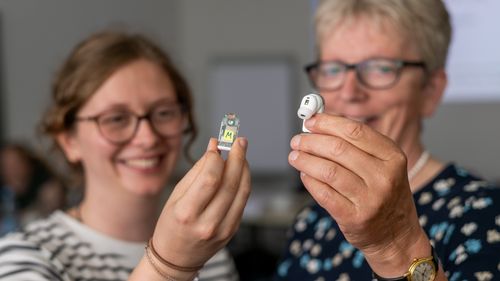
A central focus of Bleichner's future research is the further development of wearable electroencephalography (EEG) devices that can be used to measure brain waves in everyday life. He wants to make them as inconspicuous as a piece of clothing so that wearers ideally forget they are wearing them. In this way, the neuroscientist wants to collect measurement data and investigate how people perceive their world and what roles concentration, mood and attention play in this. One focus is on the soundscapes of everyday life and the question of how the brain processes background noise, speech or music, for example. A better understanding of all these relationships could also help, for example, to better assess acoustic workloads and provide starting points for improving them. Bleichner is already working with the research group led by Prof Dr Dirk Weyhe, Director of the University Clinic for Visceral Surgery at Pius Hospital in Oldenburg, to investigate the noise pollution that employees are exposed to in operating theatres. The neuroscientist also wants to work with people with mental disorders such as depression or anxiety disorders in the future. Better understanding their brain activity in everyday situations could offer approaches for new forms of diagnosis and therapy.
Bleichner studied Cognitive Science at the Universities of Osnabrück and Utrecht (Netherlands). He completed his doctorate at the University Medical Centre Utrecht and moved to Oldenburg in 2013. Here, together with Prof Dr Stefan Debener and others, he developed special electrodes that can be attached to the skin under the name cEEGrid, which make it possible to measure brain waves on the move and at the ear. From 2016 to 2018, the neuroscientist was an Associate Junior Fellow at the Hanse-Wissenschaftskolleg. Since 2019, Bleichner has headed the DFG-funded Emmy Noether Group "Neurophysiology of Everyday Life".
Together with Prof. Dr Stefan Debener and Dr Cornelia Kranczioch, Bleichner has just been awarded the university's "Teaching Prize" in the "Best Event" category for a seminar on the "Neurocognitive Psychology" Master's programme. In 2021 and 2022, the Universitätsgesellschaft Oldenburg e.V. (UGO) awarded him both the prize for excellent research and the prize for outstanding doctoral supervisor.