
The Oldenburg University Association (UGO) was founded 50 years ago – two years before the university itself. A look back at the association’s history reveals the close ties between the university and its supporters.
The Oldenburg City Council had already passed a resolution to establish a university in 1959. It took almost 15 years for this to be implemented: On 5 December 1973, the University of Oldenburg was officially founded, and it began teaching in the summer semester of 1974.
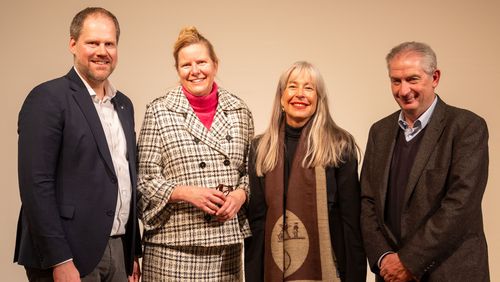
As early as 1964, a ‘Support Group for a University of Oldenburg’ had been formed, supported primarily by leading figures from the business community, the judiciary and the city’s academic and cultural institutions. ‘It can certainly be regarded as the forerunner of the University Society of Oldenburg,’ said Honorary Professor Dr Werner Brinker, the current chairman of the UGO. At the ‘Oldenburg Climate Symposium’ on 23 June, he looked back in his lecture on the 50-year history of the University Society.
It was officially founded on 26 April 1972. On that day, the inaugural meeting of the non-profit association took place, and those present elected the physician Dr Hans-Arnold Simon as its first chair. Its mission: to foster relations between the university – which was yet to be established – and the local community, and to support research and teaching. By the end of that same year, the UGO’s membership had risen to 170. “The founding and development of the University of Oldenburg are very closely linked to the commitment of the University Society of Oldenburg and its prominent representatives,” emphasised Brinker.
The UGO as a mediator
The UGO played a particularly important role as a mediator during the university’s early years. For this period was not without its conflicts: whilst the new academic institution was warmly welcomed in the city as the successor to the College of Education, there was initially a certain degree of scepticism amongst the local population towards the young academics who were striving for far-reaching social change. The UGO helped to bridge the gap between a section of Oldenburg’s middle classes and the so-called ‘reform university’, and to integrate the latter into the region. ‘The University Society created a forum for dialogue between local institutions, interested individuals and university representatives,’ said Brinker.
However, the UGO itself was also characterised by two distinct currents in its early days. “On the one hand, there were the advocates of a traditional full-scale university from the more conservative middle classes and the business community; and on the other, members of the trade unions, large sections of the Social Democratic Party, and members of the University of Education, who were pushing for a ‘reform university’ with greater co-determination,” reported Brinker. However, the representatives of both factions presented a united front to the political authorities.
Gerhard Wachsmann, then President of the Oldenburg Chamber of Industry and Commerce, played a key role in this. He served as UGO Chair from 1976. “Gerhard Wachsmann supported the development of the university on numerous occasions, using the weight of his voice and the backing of the institutions he represented,” summarised Brinker. For example, he had called for construction work on the library and sports facilities, driven forward the establishment of the energy laboratory and prevented the diploma programme in physics from being discontinued in 1980.
Strong cohesion amongst all those involved
A new phase began in 1994 when Peter Waskönig took over as UGO Chair. Under the leadership of this dedicated entrepreneur from Saterland, the University Society expanded its activities, launched new event formats and strengthened its contacts with member companies.
Over the years, the UGO has repeatedly supported the university in its disputes with various state governments over funding – not least since 2012, during the establishment and expansion of University Medicine Oldenburg. Brinker sees the strong cohesion between the University Society, the University, the city and the region as a key reason why the University developed successfully following its difficult early years.
This is evident, for example, in the establishment of several non-university research institutes, as well as in the close co-operation between the university, its affiliated institutes and the regional business community. “The members of the UGO and its board were aware from the very beginning that a university, with its fields of research, lecturers and students, would bring new impetus to society and the regional economy,” said Brinker.
With donations from its now nearly 1,000 members and the proceeds from its charitable foundation, the UGO today supports events such as the New Year’s Reception or ‘Auftakt’, the ceremonial opening of the academic year, and awards various prizes annually, such as the UGO Prizes for outstanding doctoral theses, excellent research and outstanding doctoral supervision.
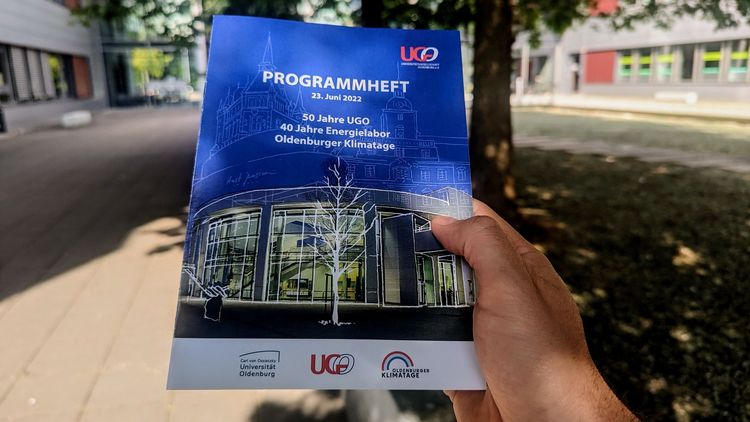
With the new ‘Oldenburg Climate Symposium’ initiative, which took place for the first time in 2022 at the Alte Fleiwa to mark the 50th anniversary of the UGO’s founding, the University Society aims to raise public awareness of issues such as sustainability, biodiversity, climate change and renewable energy more firmly into the public consciousness. It is important to “inspire the city and region to embrace the issue of sustainability”, emphasised Brinker. For businesses, sustainability should not be seen as a risk, but as a genuine opportunity. “At this point,” summarised the UGO chair, “the University Society can once again fulfil its role as a bridge between academia, business and society.”