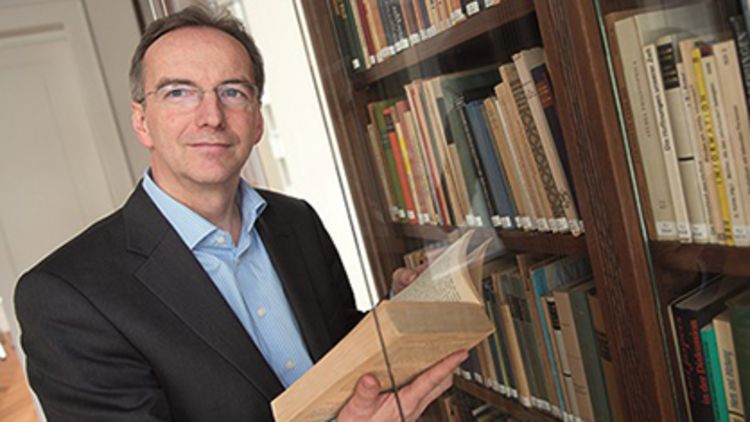

An exhibition that is causing a stir: the Kunsthalle Rostock is showing "Werner Tübke and Michael Triegel - two masters from Leipzig" until 14 September. The Oldenburg philosopher Prof Dr Matthias Bormuth has known Triegel personally for years. In the Jaspers Year 2008, he succeeded in bringing the artist and some of his paintings to the University of Oldenburg. Bormuth has now written an essay about Triegel for the Rostock exhibition catalogue.
QUESTION: Mr Bormuth, both painters - Tübke as one of the founding fathers of the Leipzig School and Triegel as a leading representative of the New Leipzig School - fascinate you. What in their works particularly appeals to you as a philosopher?
BORMUTH: I first encountered Triegel's works in January 2008, when the small Giersch Museum in Frankfurt exhibited him together with the Leipzig greats Werner Tübke and Wolfgang Mattheuer, who had died a few years earlier. I still remember very well how I was fascinated by the dazzling realism of an elongated allegorical still life. Its Dutch illusionism tempted me to take a bite of the fresh bread and the colourful fruit bulging out of the picture. And then there was the great Passion, with the beautiful, naked Christ, Italianate in style, as perfect in craftsmanship as the still lifes and portraits, which were orientated towards old Flemish perfection.
Werner Tübke, on the other hand, whom I had already seen a few years earlier in Berlin, I perceived in Frankfurt above all in the large landscapes and portraits inspired by journeys to the Soviet Union and Italy. I was very impressed, but the unknown Triegel amazed me with his perfect, seemingly epigonal, old-masterly style of painting, which was quite unique and challenged me as a viewer.
QUESTION: How did you get to know Triegel?
BORMUTH: I met him a short time later in his Leipzig studio after Eduard Beaucamp, art critic for the FAZ and intimate connoisseur of the Leipzig School, encouraged me to meet the philosophically adept painter in person. The visit to the "Alte Spinnerei" artists' campus was quickly followed by Triegel's participation in the Oldenburg art exhibition organised by Monica Meyer-Bohlen to mark the Jaspers year. In conversation with Beaucamp, Triegel explained his art on site. When we moved to Leipzig for private reasons, the loose bond of sympathy strengthened into one of family friendship.
QUESTION: Michael Triegel, whose work you honour in the exhibition catalogue, is considered "old masterly". He is probably best known to a wider public for his portrait of Pope Benedict XVI.
BORMUTH: Yes, the stormy rush in the press, triggered by the sensationally perceived portrait of the German Pope Benedict XVI, initiated the broader impact and deeper perception of Michael Triegel's person and work. The Leipzig Museum of Fine Arts quickly decided to organise a major exhibition entitled "The Transformation of the Gods". Under the curator Richard Hüttel, a close friend of Triegel's, the Pope portrait and its preliminary stages were given a special place. With ironic self-confidence, the artist said at the crowded opening that he had always known that the deputy of Peter held the keys to the gates of heaven - but what was new to him was that the Pope also had the power to open the doors of this great museum.
QUESTION: Triegel has been painting on behalf of the church for many years, but only now has he been baptised ...
BORMUTH: In fact, Michael Triegel - who inherited the palette and brushes from Werner Tübke in a highly symbolic manner - has increasingly focussed on religious motifs in his work, often amalgamated with ancient legends and fables. In this respect, it seemed to many to be a flirtatious contradiction that Triegel, as an avowed pagan, was asked to design Christian altars and stained glass windows and portraits of dignitaries. It was hardly recognised that in his paintings he presented with great empathy the figures of seekers and doubters longing for higher redemption through a greatness.
In the 2008 Oldenburg Jaspers catalogue, Triegel described the artist as the creator of an aesthetic religion. Along the lines of Nietzsche's Zarathustra's talk of "graves and resurrections", he emphasised his elitist will to art. For the catalogue of the Rostock exhibition, he left this testimony unchanged, but supplemented it with a "postscript" from the perspective of a believer who is by no means free of doubts and uncertainties. A searching individual always speaks in the pictures, using the pictorial tradition for self-expression and giving expression to the idea of the hidden God, the "Deus absconditus", in suggestive symbolism.
QUESTION: So without knowledge of ancient Christian imagery, it's hard to understand this search ...
BORMUTH: That's right. The art historian Erwin Panofsky, who together with Aby Warburg opened up the wealth of ancient imagery for the art-historical understanding of painting, distinguished two steps in this sense when looking at images: the iconographic description of what is meant by tradition and the iconological understanding of what is meaningful for the painter in his current situation. This two-phase view is also necessary in order to fathom the historical depth of Triegel's paintings and outline their current horizon.
QUESTION: "Paintings should pose questions, not provide answers" - this is how DIE ZEIT quotes Michael Triegel. Would you subscribe to his statement - perhaps even for philosophy?
BORMUTH: Yes, the figure of Socrates was always a bone of contention in this sense, posing ultimate questions without being able to show his students a certain path beyond personal risk-taking. His questioning thinking irritated the citizens of democratic Athens, for whom their fixed rites and cults were sufficient answers for coping with daily life and who feared for their youth. We are all travelling along confusing paths of self-interpretation, understandably often worried about finding our way back into routine everyday life. Tradition can provide rigid support or serve as a challenge to join Socrates in searching for personally viable paths through the challenging reality. In this sense, Jürgen Habermas recently spoke of the "untapped semantic potentials" that can also benefit secular society in the modern age. However, this requires engaging with their content - a mental task that must also be undertaken in order to follow Michael Triegel's visual thought processes.
In other words, thoughtful Christians and pagans alike are dependent on establishing a fruitful relationship between questions and knowledge in order to gain a deeper understanding of themselves and others in the world in which they live. Because without historical knowledge, our questions today have no solid foundation. And: without current questions, our historical knowledge becomes a narrow prison or pure decoration.
QUESTION: How do you explain the renaissance of figurative painting, which Tübke and Triegel each epitomise in their own way?
BORMUTH: I see two reasons. In contrast to purely abstract art, it offers completely different possibilities to connect to traditions in order to understand one's own time through painting. A good example that we can learn from is the New York School of Abstract Expressionism. To their horror, at the end of the 1960s, Philipp Guston's comic-like figures, weighed down by his own and society's history, broke out of the strict and beautiful shapelessness.
QUESTION: And this despite the fact that Abstract Expressionist painters such as Piet Mondrian or Mark Rothko continued to inspire him ...
BORMUTH: Yes, but he was no longer satisfied with the abstraction of reality that had coagulated into a dogma. In other words, no path of art should be absolute, none should be forbidden, even if the art business naturally likes to control what happens. Its mandates are often more tyrannical than those of the churches ever were. Visual languages must remain free, including the freedom to scrutinise the consumer world's image of humanity with recourse to ancient and Christian anthropology, as Michael Triegel does. Every painter has his own destiny, which he should not allow to be determined by the fashions and dictates of the business.
QUESTION: And the second reason for the new representationalism?
BORMUTH: That seems to me to be their craftsmanship, which can be seen at a masterly level in Tübke and Triegel. Richard Hüttel, curator of the Rostock exhibition, brought this quality of artistic creation back into focus at the beginning of the catalogue. Today, under the sign of conceptual art, craftsmanship is often regarded as unnecessary ballast, which some art academies cheerfully encourage us to discard.
QUESTION: Eduard Beaucamp - a recent guest at the Karl Jaspers House - speaks of a "radical modernity" with regard to Tübke's and Triegel's pictorial content. Do you share his assessment?
BORMUTH: Yes, it is to Eduard Beaucamp's great credit that since the 1970s he has presented the seemingly politically and aesthetically conformist art of the Leipzig School to the public in terms of its underlying modernity. Despite all their differences, these painters are essentially always concerned with the precarious freedom of the historical individual, who is not absorbed in politically and aesthetically standardised concepts, be they conservative or progressive. With Nietzsche, these artists undermine the practice of superficial attributions and, with their old-masterly executed and often antique-Christian designed works, offer profound offers to the individual to understand themselves without ever being able to resolve the manifold contradictions of self-interpretation. They realistically expose the "authentic" as a fashionable illusion of our time. For both Tübke and Triegel, the play of masks is a necessary part of the human condition. In this sense, they both paint in a radically modern way, despite their recourse to the old masterly tradition. Their works bear witness to Nietzsche's insight: "Everything that is deep loves the mask."
More on the topic
Exhibition "Werner Tübke and Michael Triegel - two masters from Leipzig "
Contact
Prof Dr Matthias Bormuth
Institute of Philosophy
matthias.bormuth@uni-oldenburg.de