


What remains of Karl Jaspers? In this interview, historian of ideas Matthias Bormuth talks about the plans for the new Karl Jaspers Society in Oldenburg, Jaspers' view of science from the outside - and why such a view is still worthwhile today.
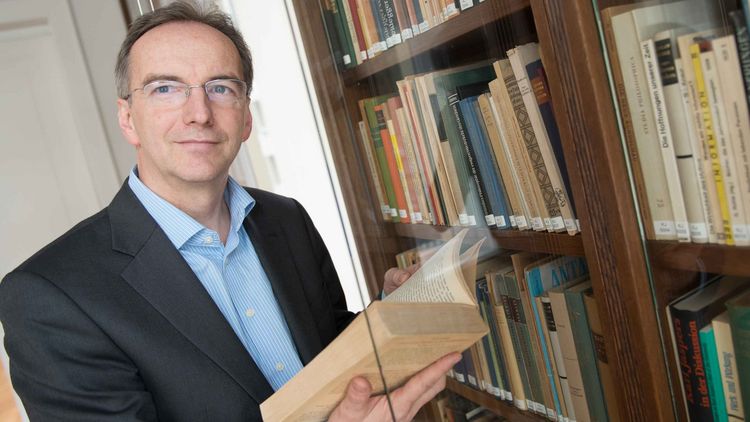
QUESTION: Mr Bormuth, Karl Jaspers' library has found a new home in the Jaspers House in Oldenburg, where you also work. What are your first impressions?
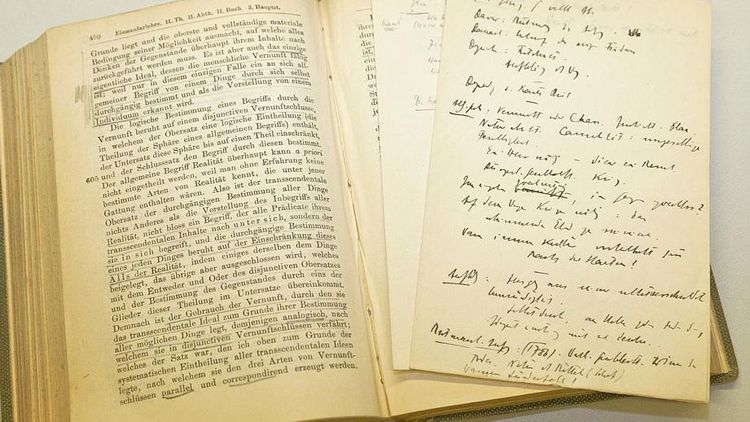
BORMUTH: It's exciting to do research with this library. I have already been able to trace Jaspers' interpretations of Hölderlin back to their origins, so to speak. His annotations and comments in the poems give an idea of how he understood the philosophising poet. Younger and more experienced researchers will now have the opportunity to research the sources of Jaspers' work in Oldenburg.
QUESTION: There are already two flats on the top floor of the house for so-called "Jaspers Fellows" - who then present their research to the public at lecture evenings, for example?
BORMUTH: That is the intention of the Jaspers Society, which has just been founded. We hope to be able to raise the necessary funds through donations. Basically, we would like to stimulate dialogue in the Jaspers House on issues that lie between the disciplines and are also of interest to the wider public. To do this, we need to develop formats that are factually understandable and exciting. Jaspers is also the inspiration here: he himself thought so clearly and stimulatingly that even radio and television approached him.
QUESTION: How do you want to achieve this?
"Inviting well-founded lateral thinkers."
BORMUTH: Well, over time we want to offer lectures, conferences and publications that bring the dialogue between the sciences and humanities to the public. Together with the German Literature Archive in Marbach, we are thinking about this: How can we introduce visitors, especially school and student groups, to Jaspers' books and biography as interactively as possible in the anteroom of the library? As far as the lecture evenings are concerned, the plan is to invite well-founded lateral thinkers, writers, academics or essayists who have something untimely, substantial and provocative to say to society - often because their view extends beyond disciplinary boundaries.
QUESTION: How did you come across Jaspers?
BORMUTH: After my first readings, the decisive factor was a visit to Jaspers' last assistant, Hans Saner, who received me in Basel surrounded by his teacher's books. At the time, I would never have dreamed that twenty years later I would be so privileged to be able to work with the library in Oldenburg on a daily basis as a researcher. It has a special significance for my own path between medicine and philosophy.
QUESTION: In what way?
"What happens when we think?"
BORMUTH: Hannah Arendt, Jaspers' philosophical student, asks in an essay what happens when we think and where we are when we think. The library can hint at this imaginary space, materialise it as it were, especially in such beautiful rooms. Jaspers saw himself in constant dialogue with the great philosophers and their ideas, from Plato and Augustine to Kant and Hegel. He saw himself as a thinker who influenced the times, but did not belong to them alone. At the same time, his library reveals how much Jaspers valued current truths, which he perceived in an enormous variety of empirical fields of knowledge. His maxims as a creative reader were to seek supra-temporal "communication" with the great philosophers and at the same time to be in dialogue with the sciences.
QUESTION: In your view, what is Jaspers' legacy?
BORMUTH: As with every thinker, there are moments in Jaspers' thought that do not stand the test of time. And theorems that constantly challenge us and keep us thinking. I am particularly fascinated by his idea of freedom, based on Kant, which must be realised as well as possible. This becomes clear in the way he dealt with his lung disease, which prevented him from engaging in practical activities. Jaspers focussed on the "inner action" of the philosopher and defied the body to live a long theoretical life. In the eighth and ninth decades of his life, he became one of the most discussed political philosophers in the Federal Republic of Germany, who also became known in the USA through Hannah Arendt. Jaspers hardly ever left his flat in Basel, but his thoughts travelled the world for him.
QUESTION: Did his physical illness have a philosophical benefit?
"Jaspers led a shielded life of thought."
BORMUTH: Exactly. His professional marginality in psychiatry began when his illness left Jaspers with few opportunities in daily hospital life, but gave him time for reflection and conversations with patients and books. His illness forced him to take on the role of a committed observer, from whose insights psychiatry has benefited ever since. In philosophy, too, he led a shielded life of thought due to his physical limitations. Jaspers described himself as an "outsider" who enjoyed "fool's freedom" among his philosophical peers. Until people realised that he had brought existential questions from psychiatry into the subject, which triggered a new way of thinking about people and their possible freedom.
QUESTION: And what fascinated you about it?
BORMUTH: The fact that Jaspers turned against factual reductionism and academic dogma in the name of possible freedom. According to Jaspers, philosophers should be uncomfortable contemporaries who, in the spirit of Socrates, show us the limits of knowledge. It was no coincidence that the young Jaspers attracted attention at the old grammar school by refusing to join a student association. He preferred to stand for himself as an individual, at a distance from the collective opinion moulds. It can still inspire us today to pause for a moment and ask ourselves what we are actually doing, what purpose our actions have and where they should lead us.
You can read the unabridged interview with Matthias Bormuth in the next issue of the research magazine EINBLICKE (to be published in May).