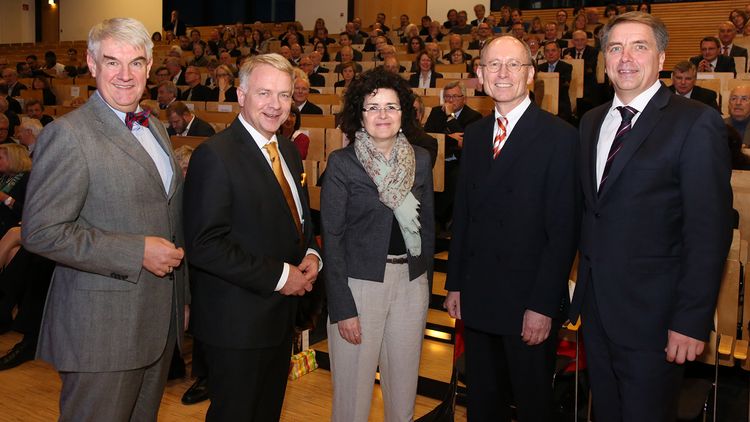
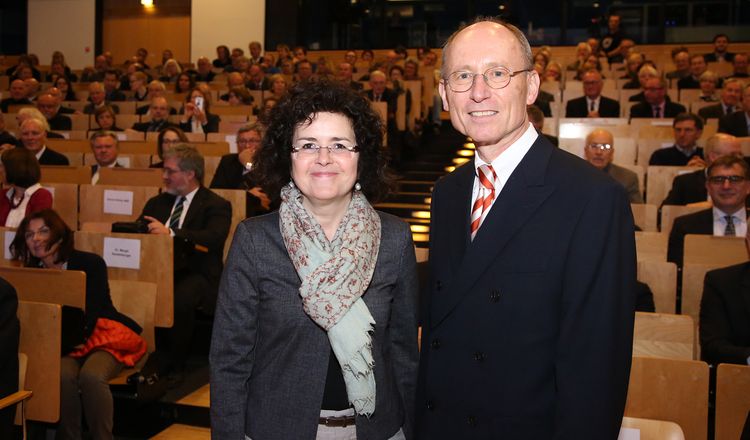


He has been the university’s new president since 1 August, and on Friday the university held a ceremony to formally install him in office: Prof. Dr Dr Hans Michael Piper, a medical scientist, will steer the course of the University of Oldenburg for the next six years.
Among the approximately 500 guests in the Audimax of the lecture theatre centre were Lower Saxony’s Minister for Science, Dr Gabriele Heinen-Kljajić, Oldenburg’s Lord Mayor Jürgen Krogmann, the Chair of the University Council Jörg Waskönig, and the Chair of the University Society of Oldenburg e.V. (UGO), Michael Wefers.
“Professor Piper’s qualifications and experience to date provide an excellent foundation for driving the university’s development forward. His task will be to gather, evaluate and strategically implement the diverse ideas that emerge at the University of Oldenburg,” said Minister Heinen-Kljajić. “I am therefore delighted that we have succeeded in appointing Professor Piper as President of the University of Oldenburg.”
In his speech, the new President began by highlighting the “special sense of community” that characterises the University of Oldenburg, even though it cannot look back on centuries of history, unlike other universities. “This university has a culture all of its own, which you probably feel much more keenly as a newcomer than if you have been here for a long time.” Piper described the University of Oldenburg as “a highly original university that is always keen to innovate”. It enjoys impressively active support from the region, including political backing, as demonstrated, for example, by the development of University Medicine Oldenburg. It is typical that Oldenburg is constantly breaking new ground in science and that – with a practical focus and a commitment to society – key research focuses such as hearing research, alternative energies, Computing Science and marine research are becoming established. The efforts to transfer practical knowledge into society – including through the Start-up and Innovation Centre – are “undoubtedly a blessing” for the region, with its many small and medium-sized enterprises.
Piper also highlighted the many pioneering concepts in Oldenburg’s educational sciences, teacher training and further education. The state government recognises this expertise, as evidenced by the establishment at the University of Oldenburg of one of the country’s largest centres for special educational needs, comprising 15 professorships. It has long been recognised that issues of social and cultural diversity play a special role in school education in Oldenburg. “In future, we will use this knowledge in particular to train teachers who can effectively manage heterogeneous classes comprising a wide variety of pupils.”
However, the new President emphasised that these achievements also present a wide range of challenges for the future. For instance, he said, it is essential to vigorously develop the university’s international profile: “We want to attract more students and researchers from abroad to Oldenburg. We also want to incorporate more opportunities into our degree programmes to gain experience at foreign universities – without causing any significant delays in students’ studies.” This will require effort, which – he is firmly convinced – will be worthwhile and make the university even more attractive internationally.
Piper also addressed the university’s shortage of space: the sharp rise in student numbers, the success in securing external funding for research, and the expansion of the medical school have “completely absorbed the available space. The infrastructure therefore urgently needs to be expanded.” The university must begin a long-term planning process for this today – in collaboration with the state.
Piper identified the promotion of early-career academics as another key task for the future. The university has established an exemplary and multi-award-winning system of doctoral supervision, but must become even more attractive to early-career researchers once they have completed their doctorates. Reliable employment conditions and active support in planning individual career paths are crucial. The President conceded that this is no easy task, given the diverse career paths both within and outside the university, as well as the varying expectations of young academics.
Piper emphasised that a university’s academic profile, with its areas of specialisation, is always a snapshot in time, and in this context called for “leaving room for the new shoots of academic originality”. The university must use its resources wisely and flexibly in this regard.
In conclusion, Piper addressed the special role of universities in processes of social change. The expansion of the higher education system, characterised by greater permeability, extensive freedom of research and institutional autonomy, formed the basis on which the University of Oldenburg had been able to develop its independent character. The fact that it consistently holds its own in competition, even against older, traditionally better-resourced universities, deserves special recognition.
With regard to refugee students and prospective students, Piper said that the shared educational experience in schools and higher education institutions had proved to be a powerful force for integration, particularly in recent German history. “This should also be possible in our country today.” The Carl von Ossietzky University will play its part in this, for example through a university integration programme. In doing so, the university is building on “the great integrative power of student life”, to which the already numerous student initiatives also make a decisive contribution.
“President’s Medal of Honour” for long-serving vice-presidents
Piper took the occasion of his inauguration to honour the long-serving members of the Executive Board – who will remain in office until the end of the year – and their services to the university with the “President’s Medal of Honour”: the Vice-President for Research and Transfer, Prof. Dr Katharina Al-Shamery, who served as acting President from April 2014 to July 2015; the Vice-President for Studies and Teaching, Prof. Dr Gunilla Budde; and the Vice-President for Early-Career Researchers and Quality Management, Prof. Dr Bernd Siebenhüner. Prof. Dr Dr h. c. H.-Jürgen Appelrath, who had repeatedly served as acting Vice-President for Research and Transfer, also received the honorary plaque.
Piper then, together with the Minister for Science, Heinen-Kljajić, presented the official letters of appointment to his future part-time vice-presidents: Prof. Dr Martin Holthaus, as Vice-President for Research and Transfer; Prof. Dr Sabine Kyora, as Vice-President for Student Affairs, Teaching and Gender Equality; and Prof. Dr Esther Ruigendijk, as Vice-President for Early-Career Researchers and International Affairs, will take up their posts at the turn of the year. Together with the full-time Vice-President for Administration and Finance, Jörg Stahlmann, they complete the university’s executive board.