
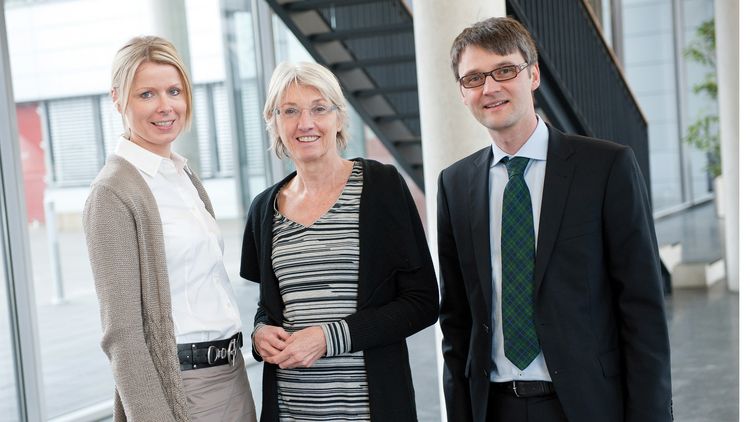



We need flexible study programmes for working people, say Oldenburg university lecturers Anke Hanft, Heinke Röbken and Olaf Zawacki-Richter. This is because German universities are not sufficiently geared towards the demands of lifelong learning.
By Anke Hanft, Heinke Röbken and Olaf Zawacki-Richter
The ‘typical student’ is still the model on which German universities base their approach. Their path is mapped out: they begin their studies after completing their Abitur. After obtaining a Master’s degree, they enter the workforce. The Organisation for Economic Co-operation and Development (OECD) has long advocated a different approach. It recommends increasing the proportion of students in higher education – by opening up the path to university to other groups as well. For example, for those eligible to study from low-income and educationally disadvantaged families, or for prospective students who already hold vocational qualifications. Working people are not part of the standard degree programme Yet working people are virtually absent from the standard degree programme that prevails nationwide. Any work undertaken by students must take a back seat to their studies and should be limited to the semester holidays. The norm is full-time study on a semester basis, with compulsory attendance spread throughout the week. Hardly any higher education institution recognises professional skills as part of a degree programme, nor does it develop study programmes specifically tailored to the needs of working adults. The German higher education system recognises only one ‘ideal path’ to successful study: the Abitur. Yet this focus on the ‘typical student’ has long since ceased to reflect reality. According to figures from a social survey published in 2010 by the German Student Union (Deutsches Studentenwerk) and the Higher Education Information System (Hochschul-Informations-System), the proportion of students with work experience in Germany stands at 64 per cent – which is above average by international standards. Just under a quarter of all students have completed vocational training prior to their degree studies. In 2009, 66 per cent of all students were in paid employment ‘on the side’. The number of students in employment rises with age and stands at 79 per cent among 30-year-olds. Number of students in employment is rising It is therefore clear that work and study are much more closely intertwined than universities are willing to acknowledge. And this is despite the fact that the number of students in employment or with professional experience is set to rise. Given the opportunity, many Bachelor’s graduates will enter the labour market and only return to higher education later – whilst working – to undertake a Master’s degree. Higher education policy-makers and universities must take significant steps to be better prepared – not only for the changing needs of their existing target group, but also for new target groups. Policy-makers have already set the course. For instance, the Standing Conference of the Ministers of Education and Cultural Affairs laid the groundwork for expanded access to higher education with a resolution in 2009. Since then, master craftsmen, technicians, business specialists and holders of equivalent qualifications have had general access to higher education; individuals with vocational qualifications who have not undertaken further training for career advancement have subject-specific access to higher education.In future, they’ll be sitting side by side in the lecture theatre: A-level graduates and interior decorators. For the German education system, this regulation is extremely far-reaching. Higher education researcher Andrä Wolter estimates that around 75 per cent of the German population could now go on to study. A school-leaver with an Abitur sits next to a gardener studying biology. Or next to an interior designer who has chosen to study Material Culture. We must be prepared for this in future. To make higher education more attractive to working adults, the Standing Conference of the Ministers of Education and Cultural Affairs, in line with the requirements of the Bologna Process, laid the groundwork as early as 2002 for a further innovation – one which, however, is as yet scarcely known within universities. The joint structural guidelines of the Standing Conference of the Ministers of Education and Cultural Affairs dated 4 February 2010 state that “proven equivalent competences and skills acquired outside the higher education sector (...) may be recognised as up to half of the credit points required for the degree programme”. In other words: working professionals can have their professional skills recognised as part of their degree programme, provided that these skills correspond to the academic requirements of the programme. In the best-case scenario, this can reduce the duration of study for those with professional experience by half. Urgently needed: flexible study structures for working adults. What sounds like a breakthrough for prospective students, however, faces significant obstacles in practice. There are quota restrictions on degree programmes with limited intake, which cap the number of students with professional experience. Even more crucial, however, is the fact that the formats of the programmes on offer are not tailored to the needs of working adults. Empirical studies have long shown that opening up universities to new target groups – as initiated by the resolutions of the Standing Conference of the Ministers of Education and Cultural Affairs – is not sufficient on its own. Rather, it requires accompanying measures. We need advisory and support services not only before students begin their studies, but also during the initial phase of their studies. Equally essential are flexible study structures, tailored to the time constraints and prior experience of working people and those with professional experience.In development: Part-time degree programmes in science and technology Rather than thinking in terms of standard periods of study, semester cycles and timetables, we must remove the spatial and temporal constraints on study. Students should be able to organise their studies flexibly and in line with their needs, working towards their qualification – which may well span multiple universities. The University of Oldenburg has already implemented much of this – as one of the few German universities to do so. It has established degree programmes that are consistently geared towards the learning needs of working professionals. Students can have their professional skills recognised for credit towards specific degree programmes. And following our successful participation in the BMBF competition ‘Advancement through Education: Open University’, we will also be developing high-quality part-time degree programmes in the natural sciences and technical fields in future. With Master’s degree programmes in the fields of renewable energy, wind energy systems, environmental sciences, building physics and acoustics, the University aims in particular to appeal to working professionals and those with family responsibilities, and to encourage them to undertake higher education.The university is taking a pioneering role with the Lifelong Learning campus Since the end of last year, the university has also had the necessary facilities, in the form of the Lifelong Learning campus, to meet the needs of working students – thereby taking a pioneering role in the German higher education landscape. The new campus brings together all the departments involved in research and teaching relating to further education and lifelong learning. The Centre for Lifelong Learning (C3L) is one of the largest institutions of its kind at German universities and provides scientifically sound, practice-oriented study programmes for working students. Through these programmes, the university aims to increase permeability between vocational education and higher education and to attract new target groups to higher education via flexible learning pathways. Lifelong learning must permeate the entire higher education system By consolidating all resources for advanced scientific training in research and teaching on the Lifelong Learning Campus, the University of Oldenburg has taken a major step towards implementing lifelong learning. However, lifelong learning is not just a matter for the University of Oldenburg, but for all higher education institutions. Lifelong learning must permeate the entire higher education system. If public universities fail to rise to these challenges, their competitiveness will suffer. Indeed, there is reason to fear that the shortcomings highlighted by the OECD will, in the long term, weaken not only public universities but Germany’s overall competitiveness. The opinion piece by Anke Hanft, Heinke Röbken and Olaf Zawacki-Richter appeared in the spring issue of the EINBLICKE research magazine.