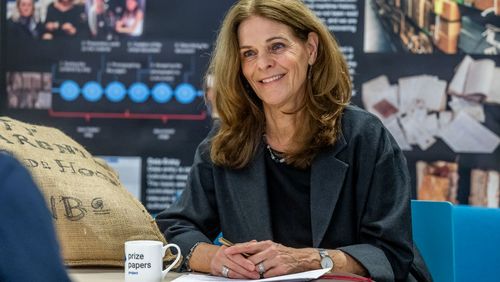


Around half of the ethnological artefacts in the State Museum of Nature and Man in Oldenburg come from former colonies. What are they - loot, gifts or purchases? Or are these terms generally inappropriate? Jennifer Tadge is investigating these questions in her doctoral thesis at the Institute of History.
They hang on a wall in the Natural History Cabinet of the Landesmuseum Natur und Mensch: six spears and five shields. How did they get here, where did they come from, who did they belong to in the past? There is currently little information on this. "Leather shields of the Maasai, East Africa" and "Spears of the Maasai, East Africa" are simply written on a plaque. From Jennifer Tadge's point of view, this is not enough. She is a doctoral student at the University's Institute of History and is also employed by the State Museum. In her research, she is investigating how objects from former colonies came to the museum. These make up around half of the ethnological collection at the Landesmuseum, most of which have been in the museum since the end of the 19th century.
For more than a hundred years, the museum hardly looked at the origins of these artefacts. This is about to change: together with five other institutions from Lower Saxony, the State Museum launched the PAESE project (Provenance Research in Non-European Collections and Ethnology in Lower Saxony) in 2018. The participating institutions, including the Landesmuseum Hannover and the Städtisches Museum Braunschweig, want to conduct basic research into their colonial heritage. This also includes working together with researchers from the societies of origin and making their findings visible to the public, for example in a digital object database.
Collecting from the military
Tadge, who studied ethnology, museology and Arabic studies in Leipzig, already completed a traineeship at the State Museum in 2014. The research at the end of project is part of her doctoral thesis: Tadge is doing her doctorate under Prof Dr Dagmar Freist, professor of early modern history at the university. Tadge's work began with her gaining an overview of the collection and the various objects. "Of the approximately 3,500 objects that come from former colonies, a large proportion - around 1,000 - come from the Langheld brothers' collection," she reports.
Wilhelm, Johannes and Friedrich Langheld were stationed as military personnel at the end of the 19th century in what was then the colony of German East Africa, most of which was located in what is now Tanzania. In addition to their military duties, they were also in contact with Berlin museums, for which they collected artefacts. "It can therefore be assumed that the brothers acquired many objects in violent contexts, for example during battles with the indigenous population," says Tadge. But how can it be determined in detail whether this was really the case?
False gifts, unfair purchases
Sometimes it's quite simple: "Captured in a hut" is written in Johannes Langheld's handwriting on unfinished grass rings. This means that it is neither a gift nor a purchase. Instead, it is reasonable to assume that the brothers took the rings with them after a battle against the indigenous population. To confirm this assumption, Tadge looks at other sources. These include, for example, reports that Wilhelm Langheld had to write in his function as captain and in which he mentions armed conflicts. From the various sources, the researcher slowly builds up a picture of the different contexts in which the brothers came into possession of today's museum artefacts - from thefts and purchases to donations.
But it is precisely these terms that divide researchers. After all, what is meant by a gift or a purchase in the context of colonialism? "Some researchers are of the opinion that in an asymmetrical power imbalance such as that between European colonisers and the indigenous population, there can be no such thing as a gift or a fair purchase," says Tadge. She also advocates researching the historical background in these cases and scrutinising terms. "On the other hand, I think it is quite conceivable that the indigenous population deliberately traded with the Europeans in order to push through their own ideas and goals," she notes. Arguing in this way, she says, gives the indigenous population the right to act independently instead of seeing them as mere pawns of the colonial powers.
Research between Oldenburg and Tanzania
Perhaps one of the reasons why experts are discussing this point so controversially is because, among other things, it determines whether museums should return objects from their collections to representatives of the societies of origin. This question was most recently raised when the Humboldt Forum opened in Berlin in December 2020. Among other things, the so-called Benin bronzes - panels and sculptures from West Africa that came to Europe as looted art - were to be exhibited in the rebuilt Berlin Palace. Since the 1970s, the Nigerian government has been trying to get some of the artefacts back. There is now movement in the debate: the first objects are due to return to Nigeria in 2022.
Representatives of the countries of origin have not yet asked for objects to be returned to the National Museum. However, Tadge is liaising with researchers from Tanzania: A member of staff from the National Museum there has already looked at the Oldenburg collection and, conversely, Tadge has researched various museums in Tanzania for her research. Time and again, she came across objects there that were very similar to those in the Oldenburg collection. "In some cases, I was able to find out which population groups they came from. Sometimes it turned out whether they had belonged to ordinary people or chieftains and kings - or whether they were even royal regalia, for example," she says.
"Simultaneously historical and highly topical"
Not only research institutions in Africa, but also political parties and interested citizens in Oldenburg keep asking how the State Museum deals with its colonial heritage. The museum has already made an initial attempt to make its research visible: In the so-called natural history cabinet, museum staff have added notes on the colonial origins of some objects. Visitors were able to express their opinions on this - and in most cases, they were favourable, says Tadge. Many had previously missed more detailed information about how the objects had come to the museum.
However, it is unclear to what extent she and her team will be able to continue researching the topic and present their findings once the project is completed this year. There is still a lack of funding to continue the work. In any case, Tadge hopes to continue researching the colonial origins of museum artefacts in the future - also because the topic is becoming increasingly present in the public eye. "My work is both historical and highly topical."
The article first appeared in the blog "Research Notes" of the Innovative University of Applied Sciences Jade-Oldenburg!