

School V - School of Medicine and Health Sciences has honoured its graduates for the first time in its short history.
Twenty-nine students on the model degree programme in Human Medicine at the ‘European Medical School Oldenburg-Groningen’ (EMS) have completed the first stage of the medical examination. This corresponds to the former ‘Physikum’, comprising course certificates in the so-called pre-clinical subjects such as anatomy, physiology, chemistry and physics. In addition, 14 students completed the international Master’s programme in ‘Neurocognitive Psychology’ this year, whilst 15 graduates were awarded doctorates in medicine or the natural sciences.
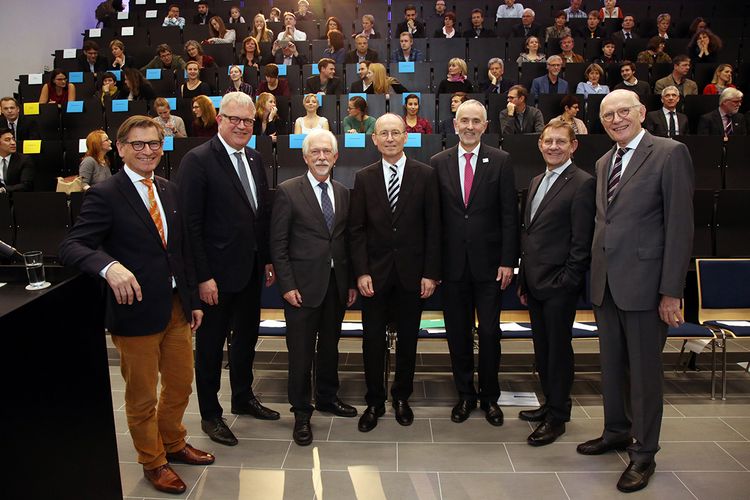
“The establishment of the School of Medicine and Health Sciences and the EMS in 2012 is one of the milestones in the history of the University of Oldenburg,” explained University President Prof. Dr Dr Hans Michael Piper. He said he was particularly pleased that the EMS’s study concept inspires students and leads to outstanding academic achievement and a broad range of skills.
Prof. Dr Sibrand Poppema, President of the Rijksuniversiteit Groningen, added: “The number of applicants, but above all the enthusiasm and academic success of EMS students, show that the model degree programme in Human Medicine, with the support of the Lower Saxony state government and many other sponsors, has enriched the medical education landscape in Germany.”
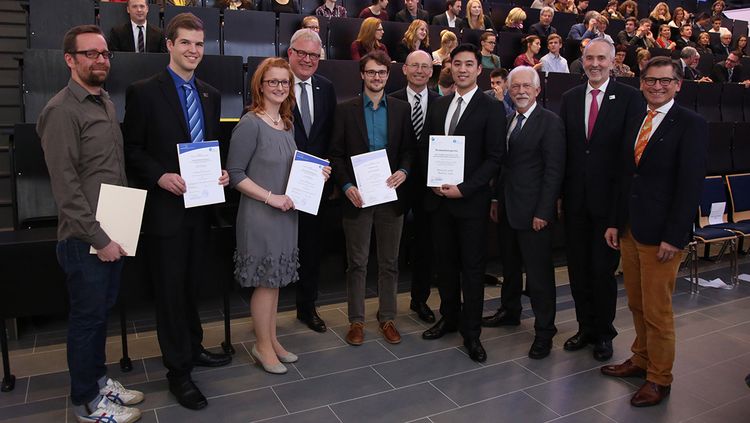
Two students and three graduates were honoured for their outstanding achievements: Friederike Lohne and Johannes Grone (equivalent to the ‘Physikum’), Felix Pascal Feuerhake (Master of Science), Dr.-Ing. Eugen Rasumow and Dr. med. Martin C. Lam. The latter was also awarded the Doctoral Prize by the Friends and Supporters of University Medicine North-West e.V.
“Honouring the first students and graduates of our School is a very special occasion for us. It is important to bear in mind that we not only successfully train medical students, but also offer excellent training opportunities to our PhD candidates and Master’s students in psychology,” explained Dean Prof. Dr Gregor Theilmeier.
School V - School of Medicine and Health Sciences at the University of Oldenburg was founded in the summer of 2012, making it the first new medical school to be established in Germany in more than 20 years. Its German-Dutch co-operation project, EMS, is unique in Europe due to its cross-border profile. Together with the Evangelical Hospital Oldenburg, Oldenburg University Hospital, the Pius Hospital Oldenburg and the Karl Jaspers Clinic in Bad Zwischenahn, the School forms the University of Oldenburg Medical Campus. In addition to healthcare research, the School’s key research focuses include neuroscience and hearing research, with the ‘Hearing4all’ cluster of excellence. Since summer 2015, the Oldenburg School has been a full member of the Association of Medical Schools of the Federal Republic of Germany (MFT).
About the European Medical School:
The model degree programme in Human Medicine is characterised by a teaching concept that is both particularly practice-oriented and research-oriented. From day one, a strong practical focus shapes everyday student life. This means that trainee doctors immediately have contact with real-world demands: each week, a patient and their condition are presented; the entire academic week is structured around this case. Twice a year, students undertake one-week placements in general practice surgeries in the region. Problem-based learning, profession-specific communication training and strong links to research – within a research curriculum that becomes increasingly intensive as the years of study progress – characterise the programme.
Interest in the new degree programme remained very high in its fourth year. Once again, more than 1,000 young people applied for the 40 places available for the winter semester.
Students from Oldenburg spend at least one year of their six-year course in Groningen. Students from Groningen are already making extensive use of the opportunity to study for a year in Oldenburg. In this way, students from both universities gain in-depth insight into a different European healthcare system. The degree programme concludes with the State Examination.