

A new teaching laboratory on the Wechloy campus will improve training in degree programmes such as Biology, Environmental Sciences, Medicine and Chemistry from March. Microbiologist Prof Dr Ralf Rabus is delighted with the new facilities, which will be used exclusively for block practicals.
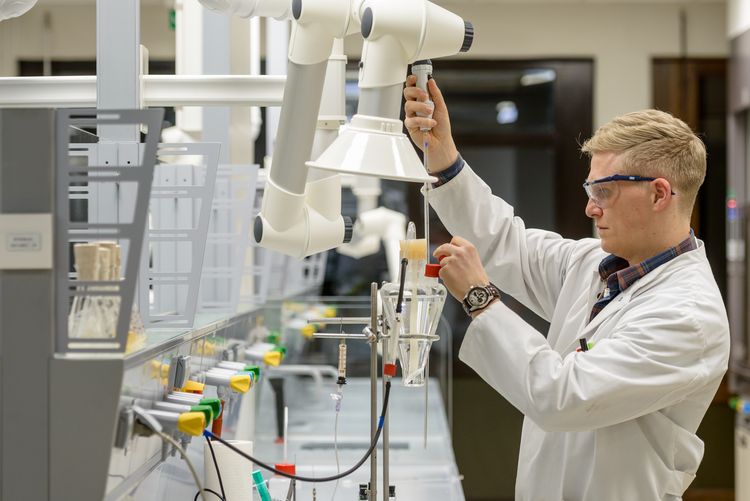
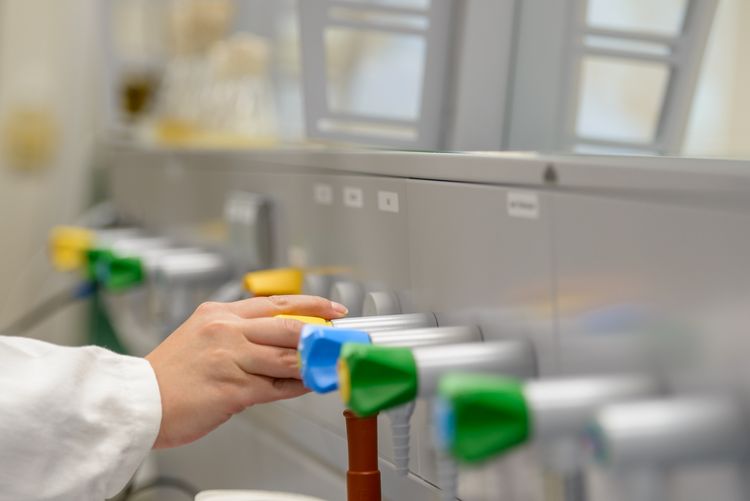
The 96 workstations in the new teaching laboratory in the basement of building W3 on the Wechloy campus are sparkling clean. The still virgin worktops made of insensitive grey ceramic are just waiting for the first chemistry students to titrate acids, fill distillation flasks or prepare solutions here from March. Later, budding microbiologists, doctors, environmental scientists and landscape ecologists will also complete the practical part of their laboratory training in the new lab.
In just ten months of construction, three older laboratories have been transformed into a modern, well-equipped teaching laboratory that enables demanding internships in various specialised fields. "During the planning phase, we placed great emphasis on flexibility, modularity and digital learning," reports Prof Dr Ralf Rabus from the Institute of Chemistry and Biology of the Marine Environment (ICBM), who initiated and supervised the renovation project in 2015. "We managed to come to a good decision quickly across all levels of the university and thus create further excellent laboratory conditions for the students," says Rabus.
Investment in the future
The university has invested around 1.4 million euros in the new laboratory, where around 500 students from School V - School of Mathematics and Health Sciences and School VI - School of Medicine and Health Sciences will be able to conduct experiments each year. On an area of around 200 square metres, four rows of 24 modern workstations are now available for laboratory training. Last Wednesday, the Deans of the two Schools, Prof Dr Christoph Lienau and Prof Dr Hans Gerd Nothwang, officially opened the new experimental room.
The bright open-plan laboratory can either be used by a group of almost one hundred students or divided by a mobile wall. The two rooms that are then created can be operated completely independently of each other, from admission to media technology. Two groups of 15 to 30 students can then experiment separately. "For example, internships in subjects as different as chemistry and microbiology could take place in parallel," says Rabus.
Modern media technology
Particular emphasis was placed on media technology during the planning phase. For example, images of the specimens that trainees are currently examining with a microscope can be projected directly onto the wall with a projector via an internet connection. Teachers have a small display in a corner of the room at their disposal to control everything from the lighting to the ventilation. Laptops or other devices can be connected via a USB socket if necessary.
The laboratory has also been fitted with a modern ventilation system with energy-efficient heat recovery. In order to save as much energy as possible during laboratory operation, ventilation and air conditioning units are only switched on when required via the building management system.
Scullery and storage rooms
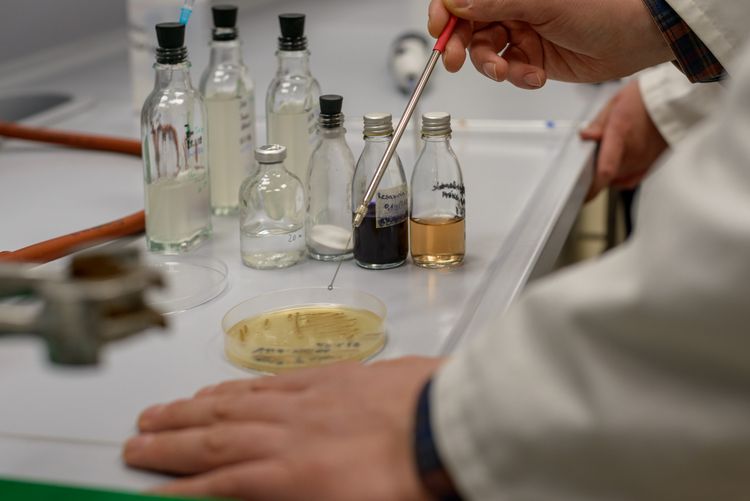
For microbiological internships, six heated cabinets are available in a separate scullery to store or incubate bacterial cultures. Students can also use two autoclaves for sterilisation, an ice machine and an ultrapure water system for their experiments. Each specialisation can store the material needed for a practical course in a storage room right next to the laboratory. A meeting room with a large screen for presentations completes the new bifaculty teaching laboratory.