
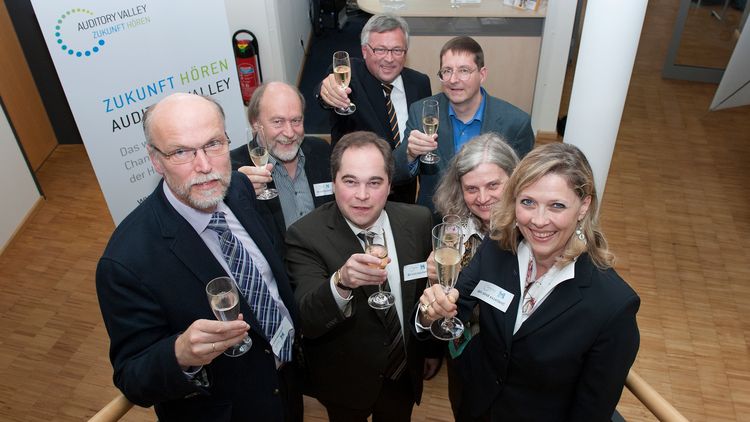

The University of Oldenburg is one of the winners of the federal and state governments’ Excellence Initiative: the ‘Hearing4all’ cluster of excellence proposal has been awarded funding for five years. The funding application was for 34 million euros.
The University of Oldenburg is leading the consortium focusing on hearing, having submitted the successful proposal jointly with Hannover Medical School and Leibniz University Hannover. Other participants include the HörTech Center of Competence, Jade University of Applied Sciences, the hearing centres in Hanover and Oldenburg, the Fraunhofer Project Group for Hearing, Speech and Audio Technology, the Laser Centre Hanover e.V. and the Hanse-Wissenschaftskolleg Delmenhorst.
“This success is first and foremost the result of outstanding scientific work at our universities. I pay tribute to this and express my sincere thanks to everyone involved,” said Lower Saxony’s Minister for Science, Prof. Dr Johanna Wanka, on the occasion of the decision. She emphasised that the funding secured would benefit Lower Saxony as a whole as a centre for research and higher education. “With sums of this magnitude, research results can be achieved that would otherwise be virtually unattainable. We have been given the opportunity to significantly boost our competitiveness in the coming years.”
University President Prof. Dr Babette Simon described today’s decision as a “magnificent success for the University of Oldenburg and its excellent hearing research”. “This success reflects positively on the entire university and contributes significantly to the further strengthening not only of the university but also of the North-West science region. “I would like to thank all those who have contributed to this result through their outstanding work and total commitment,” said Simon.
The spokesperson for the cluster of excellence, Oldenburg-based physicist and physician Prof. Dr Dr Birger Kollmeier, emphasised: “This is a magnificent day for hearing research in Lower Saxony. We are delighted that our joint work to date has been recognised; we will now continue this work under new conditions for the benefit of people with hearing loss.”
The aim of this interdisciplinary, five-year joint project is to ensure hearing for all. 18 per cent of the German population – including more than 50 per cent of those aged over 65 – have hearing loss requiring treatment. By improving personalised hearing diagnostics and the provision of personalised hearing aids tailored to these assessments, the researchers aim to significantly improve the communication experiences of those affected – whether at work, on the road or at home. To this end, innovative processing concepts for hearing aids and cochlear implants are being further developed, as is ‘assistive’ technology for everyone – in other words, the hearing aid built into every smartphone, television or car radio.
The research focuses on improving speech understanding in the presence of background noise. This is because a major problem for people with hearing loss is impaired selective hearing. People with normal hearing, on the other hand, are able, for example, to pick out the words of a single speaker at a cocktail party whilst filtering out those of others (the ‘cocktail party effect’). ‘But we also aim to make significant advances in diagnostics and treatment options in clinical audiology. Here, we are focusing on new physiological diagnostic instruments and cochlear implants at various sites in the inner ear and along the auditory pathway,” explained Prof. Dr Thomas Lenarz, Deputy Spokesperson for the Cluster of Excellence and Director of the ENT Clinic at Hannover Medical School.
Twenty-five renowned scientists from the fields of physics, medicine, psychology, biology, engineering and linguistics are responsible for the research work. They form core teams, which in turn work on current research questions in interdisciplinary ‘task groups’ and also provide a thematic framework for early-career researchers. “In addition, we are establishing a ‘Joint Research Academy’ for the targeted career development of early-career researchers – from their doctoral thesis right through to leading their own research groups or holding a professorship,” emphasised the Oldenburg-based biologist Prof. Dr Georg Klump, who is responsible for this area.
Plans also include even closer co-operation with all the world’s leading manufacturers of hearing aids and cochlear implants. “Technology from Oldenburg or Hanover is already incorporated into over 80 per cent of all hearing aids and cochlear implants,” said Kollmeier. “Within the Cluster of Excellence, we aim to further extend our lead in development – through the successful interplay of basic research, clinical research and applied research.”