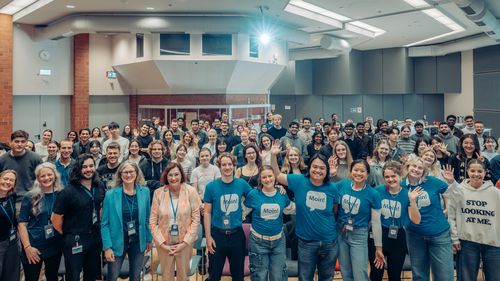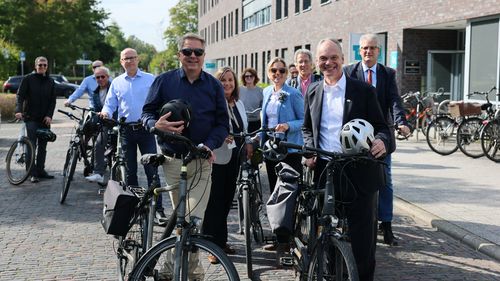
For several weeks now, the university has been home to the ‘Women Professors Forum’ – a network exclusively for female professors. In this interview, founder Katharina Al-Shamery explains how she and her fellow campaigners aim to support young female academics.
QUESTION: Professor Al-Shamery, the natural sciences are still described as a male-dominated field in which it is harder for women to reach the top. You yourself, however, made a name for yourself as a chemist years ago. Are you the exception to the rule?
AL-SHAMERY (laughs): You could interpret it that way. But I, too, had to learn the hard way: men and women really are different. Men tend to establish vertical hierarchies first, whilst women immediately form horizontal networks when they’re working on a project. This results in a whole range of specific behaviours. I didn’t realise this before and wasted a lot of energy because I simply didn’t understand why I found it so hard to assert myself. Younger female colleagues, in particular, are completely unaware of these differences. They think: ‘I’m good, so I’ll automatically make my mark. So why do we need equality measures?’ The fact is, however, that female academics remain under-represented in many disciplines, particularly in leadership roles. And not just in the natural sciences, by the way. I’m thinking, for example, of economics, philosophy, music and history. The proportion of women amongst professors at our university is just over 25 per cent – that’s a comparatively good figure, but there’s certainly room for improvement.
QUESTION: There are already various support programmes and initiatives for female academics. Why is a Women Professors Forum still needed?
AL-SHAMERY: We see ourselves as mentors to early-career female researchers, but we also want to support one another. Twelve ‘pioneers’ from the university were present at the launch in October of the <link owpf/ - external-link-new-window>Women Professors Forum</link>. But unlike, for example, the more elitist, nationwide AcademiaNet project, we provide broader local support. We’re not just targeting those at the start of their careers, but also women who have already made good progress but haven’t quite made it to the very top yet. We want to help them, for example by specifically nominating them for awards. After all, men do the same amongst themselves – they look out for one another. Our primary aim is to raise the profile of female academics and their research, so that they have the chance to build a career in the first place.
QUESTION: Making women visible? What do you mean by that – they’re not hiding away in their offices, are they?
AL-SHAMERY: Certainly not, but women are often less visible at international conferences than their male colleagues. They very rarely get the chance to deliver a keynote speech. If they have children, it’s virtually impossible to travel to Asia or the US several times a year for a week or longer. Yet attending these specialist conferences is essential for advancing one’s career in science.
QUESTION: And how do you intend to help with that?
AL-SHAMERY: By joining forces as women and making this imbalance an issue. We are working closely with ETH Zurich, the Swiss Federal Institute of Technology, and Ruhr University Bochum, where such networks of female professors have existed for some time. My colleague, Professor Dr Ursula Keller from ETH Zurich – a physicist who is very well known in professional circles – recently published an article in a specialist physics journal in which she raises some of the questions we consider crucial: How can we enable parents working in academia to attend conferences, amongst other things, by providing childcare? How can we support female postdoctoral researchers during the particularly crucial phase of their careers when they are pregnant, so that this does not lead to a career setback? She refers to a study which found that some particularly renowned and highly competitive scientific training grounds in the USA do not employ any female postdoctoral researchers at all, because they fear that pregnancies will lead to a drop in productivity within the research group. Surely it must be possible to carry forward women’s ideas even during maternity leave and parental leave – for example, a doctoral candidate could be assigned to work alongside them, who would carry on the postdoctoral researcher’s research under her supervision, even if the postdoctoral researcher is no longer able to be present full-time due to family commitments. In this way, we could avoid this intensive family phase having an immediate negative impact on publication rates and the acquisition of external funding. There are, moreover, many other factors that make it difficult for women to advance their careers.
QUESTION: Such as?
AL-SHAMERY: The burden of committee work is extremely high for them. This is linked to the Lower Saxony Higher Education Act: According to this, the proportion of women and men on committees and appointment panels must be balanced – which means that in disciplines where women are under-represented, they have to take on a disproportionately high level of committee work. To make matters worse, women often try to do everything very thoroughly: they read all the files and examine every application with particular care. This can quickly add up to several weeks’ worth of work – time that is taken away from their own research. Here, too, new approaches are needed to ease the burden on these women or, for example, to provide them with financial support.
QUESTION: How are you going about this in practical terms?
AL-SHAMREY: We want to raise awareness of this situation amongst academics. The university’s Vice-President for Gender Equality, Professor Dr Sabine Kyora, has already pledged her support. We are planning special networking events twice a semester, at which we engage in in-depth discussions – regularly supported by external female speakers. In addition, we want to draw the public’s attention to events specifically for women. For example, my colleague, Professor Dr Jutta Kunz, succeeded in bringing the 2018 Conference of Women Physicists to Oldenburg. Incidentally, we will always send out details of our events via the female professors’ mailing list, so that we can hopefully gradually expand the circle of fellow campaigners.