
Like school lessons, only harder? A university degree is more than that. In this interview, Vice-President Sabine Kyora talks about research-based learning as the university’s hallmark, as well as its pioneering role across Germany in recognising prior learning.
QUESTION: Ms Kyora, did you do any research whilst you were a student?
KYORA: I’m pretty sure I did (laughs). It wasn’t done quite as explicitly as it is today, but I focused on contemporary literature relatively early on in my degree. I also had a professor who encouraged us to develop our own research questions and to formulate our own theses about the text through research. I learnt how to conduct literary research whilst I was a student – and I can hardly imagine it any other way. If you want to enable students to engage independently with the subjects of their discipline, the only way to do so is by helping them to develop their own methodological approach. No matter where they end up – whether they become teachers or go into business – this research-based approach will be something that helps them in their day-to-day working lives.
QUESTION: Now, a key theme in the development of teaching profiles is precisely this – research-based teaching and learning. What exactly does that entail?
KYORA: It has to do with explicitness. It means taking a closer look at things we may have always done in a certain way. It means ensuring that students have actually gone through a research cycle, from formulating the research question to writing up the results. Our project ‘Focus on Research-Based Learning’ – FLiF – explores this in detail and thereby makes teaching objectives more transparent for students too.
QUESTION: A further six million euros has now been made available for FLiF until 2020. You want not only to embed research-based teaching and learning here in the long term, but also to establish it as a hallmark of the University of Oldenburg – one that is recognisable from the outside. How?
KYORA: I’d like to mention two elements of FLiF by way of example. Firstly, the student journal ‘forsch!’, which demonstrates that the work students produce in seminars must be taken more seriously. It’s simply not enough to say: ‘Ah, the seminar paper – I’ll give you a 2 for that, and that’s that.’ In other words, it offers students the chance to publish their findings and engage with the research process in a different way. Secondly, there needs to be scope for students to work independently. This is the second key aspect for sustainability and establishing a brand: ensuring that new teaching formats become established at the university. We want to enshrine this in module descriptions and in the study regulations – on this point, we are fundamentally in agreement with the stakeholders in the Schools.
QUESTION: Is this, on the whole, a topic that generates enthusiasm within the university, or one for which you have to keep rekindling enthusiasm?
KYORA: We’ve already come a long way. At the start, there were certainly sceptical voices given that this was a time-limited project for teaching. The general sentiment was: ‘What will we do after the five years?’ After all, it was impossible to predict that we would receive such extensive funding again during the second, four-year period of the Quality Pact for Teaching, running until 2020. And of course, you can’t be enthusiastic all the time (laughs), but the conference on student research, for example, was brilliant.
QUESTION: You mean ‘forschen@studium’ here at the university in June.
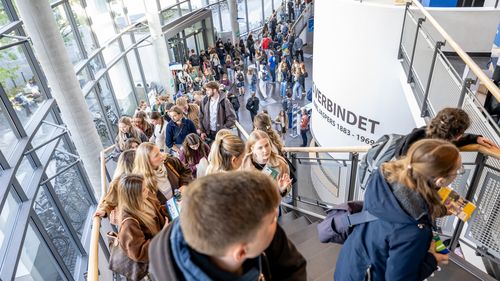
KYORA: Exactly. That gave things another boost and sparked creativity among both students and lecturers. It was an international event, with keynote speeches from Australia, the UK and the US. For the students, it was a real experience to be able to present their research to a wide audience and receive feedback from others. We at FLiF have just approved the new round of projects. There are 21 projects across the six Schools, which began in October, covering a wide range of topics from cybercrime law and mobile working to wind physics and bioethics. In that respect, it’s generating a lot of momentum.
QUESTION: You just described the enthusiasm that was palpable at ‘forschen@studium’. Oldenburg was, after all, a pioneer in Germany in this regard. What are the next steps?
QUESTION: We are networking with other universities to organise such conferences regularly across Germany. It’s already clear that the University of Oldenburg will host the 2019 conference of the global network for student research. Naturally, we hope to put the topic on an even broader footing in Germany by then. In the Anglo-Saxon world, it’s absolutely well established. There, perhaps not ‘just’ 300 people turn up as we do here, but more than 3,000, and it’s an integral part of student life. We’re not quite there yet in that respect, but things are looking good. And ‘forschen@studium’ is set to become the umbrella brand for all our research-based teaching activities.
QUESTION: The university already regards its students as researchers, yet at the same time it wants to open up this path to as many people as possible. Why an open university?
KYORA: This also has something to do with diversity, which we as a university want to develop further – that is, openness to all sections of the population. We have the orientation year for refugees, we have the Gender equality department, we’re trying to improve even further in terms of internationalisation – and we’re also concerned with social diversity. We’re also paving the way for people who could study or are already studying, but who perhaps don’t have the entirely traditional background of moving straight from school to university. Whether that’s after prior vocational training or via the Z-exam for prospective students without a general university entrance qualification.
QUESTION: How many students with prior vocational training are currently enrolled?
KYORA: More than 26 per cent – which is well over twice the figure at other universities. If someone doesn’t come to university straight after their Abitur but takes a different route, the recognition of non-university qualifications is key. We have a new project at the university that brings together advice and support: PLARnet.
QUESTION: What exactly does this involve, and what makes it special?
KYORA: The acronym stands for the recording and recognition of prior learning. This unit aims to gain an overview of the prior learning that new and prospective students have already acquired. After all, someone starting university for the first time can’t possibly know what they might be able to have recognised to shorten the duration of their degree. It’s a form of support for students – and a sign of appreciation for what they bring with them.
QUESTION: And a signal that university studies are not disconnected from professional practice?
KYORA: Yes, that’s important too. After all, in the area of specialisation, we also teach things that feed back into professional practice. It is precisely in such areas that we’re relatively well placed to say that anyone who already has that experience doesn’t need to take the module again.
QUESTION: How has that worked so far? The university already has a great many students with prior professional experience – after all, it’s around one in four.
KYORA: There is a credit transfer office within the Student Service Centre (SSC). However, it does not focus exclusively on aspects of professional practice, but also handles the recognition of credits from other degree programmes, including those from other higher education institutions. And until now, students had to take the initiative themselves. Now, right at the start of their first semester, we can direct them to the PLARnet service, which has been jointly set up by the Credit Transfer Unit, the Centre for Lifelong Learning, the Department for Study Affairs, and the Examinations Office.
QUESTION: Does this mean the university is now recording students’ prior learning more systematically?
KYORA: Yes. PLARnet has been integrated with the SSC from the outset to ensure it runs smoothly, and it also takes some of the burden off the Schools. The Schools still have the final say and ultimately decide on credit transfer, but the information is presented to them in a more organised manner. Here too, the University of Oldenburg is playing a pioneering role; this system is not found at any other German university. The project is funded by the Ministry of Science, which has stated: ‘This is a really good idea within the framework of the open university – which is, after all, a major political issue.’
Interview: Deike Stolz