

A German-Dutch co-operation project aims to raise awareness of the threat to honey bees and wild bees. Insect hotels at schools, an interactive app and other projects invite citizens to become active themselves.
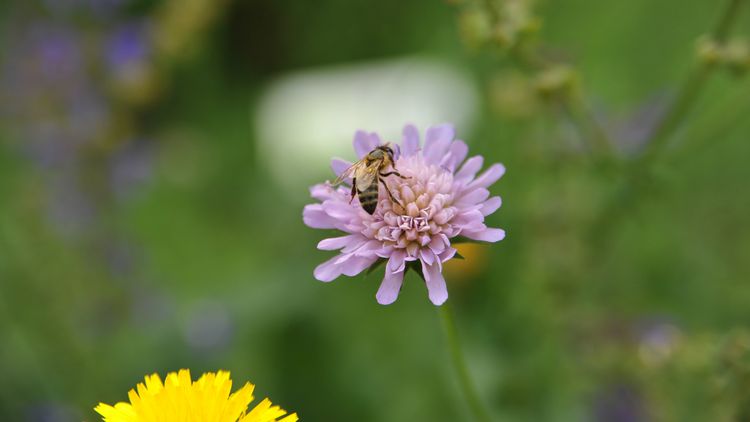
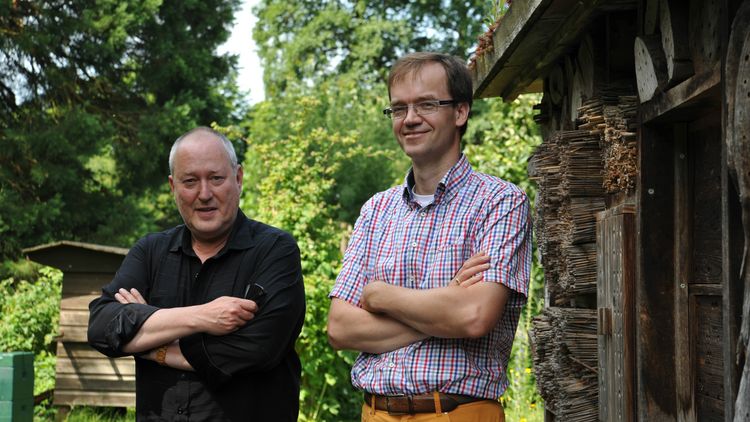
Honey bees and wild bees play an important role in our cultural landscape: by pollinating plants, they secure our supply of fruit and vegetables and make a significant contribution to biodiversity. "Around 70% of crops are pollinated by bees. Apples in particular rely on pollination, but so do other plants such as rapeseed," explains Prof Dr Dirk Albach, Head of the University's Botanical Garden. However, researchers have been observing increased bee mortality for several years. There are many reasons for this.
The German-Dutch co-operation project B-R(H)APSODIE aims to strengthen cross-border cooperation on bees and biodiversity and to raise public awareness of the threat to pollinators. In addition to the Botanical Garden, the Ökowerk Emden foundation and the Imme Bourtanger Moor e.V. association are involved in the co-operation on the German side, as are the municipality of Achtkarspelen and the Hogeschool Van Hall Larenstein in Leeuwarden from the Netherlands. The project is being funded by the European Union's INTERREG Germany-Nederland programme with around 850,000 euros until the end of 2020.
Collecting data with the help of citizens
The title B-R(H)APSODIE already reveals a lot about the project: the "B" in its English pronunciation sounds like "bee" - the English word for bee. The rhapsody as a musical genre is characterised by varied themes - just like the project, which aims to inspire people of all ages in the Ems-Dollart region (EDR) to protect bees through a wide range of activities. "We want to show what can be done to actively combat bee mortality," says Albach, describing the intention of the project. The project is the starting point for cross-border cooperation between research institutes, degree programmes and centres for nature education in the EDR. In order to get to the bottom of bee mortality, the participating institutions want to collect and exchange scientific data on bees, land use and climate in addition to the publicity activities and thus support international bee research. "Extensive data has already been collected in the Netherlands in recent years. Now we need to identify the hotspots of the phenomenon in Germany too. We are also working intensively with beekeepers to find out which factors have a particular influence on bee mortality," says Albach.
In order to make as many people as possible aware of the project, there are events in the context of the cultural programme of the European Capital of Culture 2018 Leeuwarden-Friesland - including in the Botanical Garden. One example: schools and music students on both sides of the border are to develop a composition - a B-R(h)apsody - and perform it simultaneously at several locations in June 2018 together with local musicians. Collecting the sounds for this "music of the bees" is the task of a second sub-project: with the planned "Inspector B" app, children and other interested parties can identify bees, record their sounds and upload them to the online platform Soundcloud.com.
Children as bee researchers
Citizens are also being asked to actively participate in the other Oldenburg sub-projects: Researchers will be distributing nesting aids for bumblebees at 50 schools and monitoring their success together with the pupils. "The children and young people will each have their own bumblebee colonies. The university in Leeuwarden is constructing an intelligent bumblebee box for this purpose: Infrared receptors at the entrance measure how many bumblebees fly in and out. The bumblebee colony is also bedded on a scale so that the students can determine changes in the size of the colony via the weight," explains Jan-Willem van Kruyssen, project coordinator and managing producer of Leeuwarden Capital of Culture 2018. The scientists are also creating model habitats for bees. "It's not enough to put up insect hotels, you also need appropriate habitats with the right plants so that the bees can find enough nectar and pollen," says van Kruyssen.
The participating institutions are installing touchscreens with microphones and cameras in their visitor centres. Through these "windows to the neighbour", visitors on both sides of the border can get in touch with each other and exchange observations about bees. Pupils will also be able to come into contact with each other. "Visitors should feel connected to each other," explains Dirk Albach. Because that is the main idea behind the project: to work together with as many people as possible to combat bee mortality.