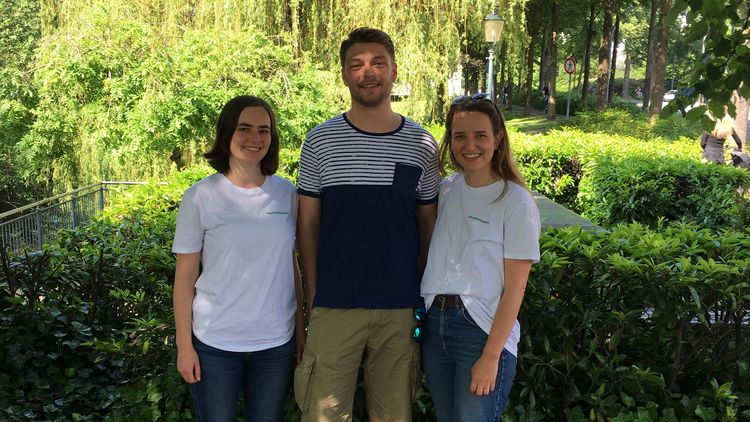


Around 90 participants are meeting this weekend for the student conference NachDenkstatt. Carla Marsland, Johanna Michel and Robbin Schiller, responsible for the overall organisation, talk about the highlights and challenges in an interview.
"Think. Act. Change", the motto of the NachDenkstatt for several years now - what does that mean to you?
Robbin Schiller: In my opinion, we need social change. We can see that there are a number of problems that society is currently facing, such as the climate crisis. In order to trigger the necessary change, we need to act as a society or as individuals and also stand up for it. The idea behind the conference is that we don't run wild, but think about what we are doing in the first place. Hence the motto "Think. Act. Change". The NachDenkstatt would therefore like to address a broad spectrum of people in order to show different perspectives from different realities of life. I believe this is how change can work.
What motivated you to take part in the project?
Carla Marsland: We see the NachDenkstatt as a great platform to make a difference as students. All three of us were keen to help organise an event that is mainly student-based, but also appeals to citizens from Oldenburg and all over Germany. For me, the NachDenkstatt lives from this transdisciplinarity. It's simply a great experience to be part of it.
The student conference is now in its tenth year. What food for thought do you want to provide this year?
Johanna Michel: We have organised a wide range of different workshops. For example, on the topic of zero waste. It's about waste management and how we can get through everyday life with as little waste as possible. We also have a contribution on the topic of fair fashion. And there is argumentation training for anyone who likes to debate or wants to learn how best to put forward their point of view in discussions. There are also two external workshops. One deals with the climate crisis and provides inspiration for taking action yourself. The other is organised by the "Energetic Neighbourhood Quarter Fliegerhorst Oldenburg" (ENaQ) project and aims to work with participants to find a sustainable neighbourhood form for the new Oldenburg Helleheide neighbourhood in the Fliegerhorst district.
Carla: Overall, it's about going from the small to the big. In other words, showing what I can do personally to make my everyday life more sustainable. But it's also about emphasising what needs to happen in society.
How has the NachDenkstatt changed since 2012?
Johanna: All three of us only joined the NachDenkstatt this year, but of course the project has grown over the last ten years. Our aim is still to continue to grow and reach as many different participants as possible. What has proved successful is the general structure. There are different teams for the various areas of responsibility, such as finance, workshops and logistics. As the overall organising team, we have an overview and are responsible for ensuring that everything comes together in the end. This has worked very well for several years now.
Carla: The largest proportion of students currently come from Sustainability Economics and Management, as the event originally emerged from this degree programme. But we're trying - and we're planning to do this next year - to appeal more to other degree programmes, because the experience will be different.
There are also many different speakers this year. What highlights can participants expect?
Carla: We have very exciting speakers in every workshop. For me, the argumentation workshop with Daniel Fuhrhop is a highlight. Fuhrhop is running for mayor as a non-party candidate, which can lead to interesting discussions. We also have speakers from all over the world. Annisa Hendrato, for example, comes from Indonesia. She has founded a small fair fashion label there and will report on her experiences at the fair fashion workshop.
Johanna: In addition to the presentations, there will also be an exciting supporting programme. Our aim is for the participants to be able to meet outside, of course in compliance with the coronavirus rules. Among other things, a rally through the city is planned, which will take participants to various sustainable places, shops and organisations in Oldenburg. We hope that this will lead to new contacts and that everyone will get to know each other better.
Carla: Another special highlight is the joint cookery evening. We have booked the "Ratatouille" restaurant for this. The staff there show us how to cook something delicious. Everyone can join in the cooking at home.
Robbin: To summarise, you can actually say that there isn't a single highlight, but that the conference as a whole is a big highlight.
Can last-minute travellers still register for remaining places - or do they have to wait until the next NachDenkstatt?
Robbin: Ticket sales are already closed. We have donated the remaining tickets we had to the Kulturtafel Oldenburg. The Kulturtafel provides free tickets for cultural events to people on low incomes. We think the concept is a great idea. It allows people who would otherwise not be able to afford it to take part in culture.
Due to the pandemic, the conference will be held online this year. What was the biggest challenge in organising a digital conference?
Carla: The biggest challenge at the beginning was making the team a team. We had a handover with the old team and then came together as a new group. We were all very motivated, but awakening this team spirit so that everyone really worked together on one thing - that was a big challenge. At first, we only met online. It was only towards the end, in May and June, that smaller groups were able to meet.
Robbin: Nevertheless, it went well overall. Everyone pulled together, so we can't complain as an overall organising team. The previous team supported us well with advice. However, we also had to work out a few things ourselves, as this year's conference is being held purely digitally for the first time.
Johanna: The biggest challenge was the online format. However, the final decision to organise the conference purely digitally was only made a few weeks ago. We tried to keep all options open for as long as we could. It's a big challenge to plan the conference twice - as an offline format and an online format. Of course, this means twice the work and twice the effort, as both formats have completely different requirements. For the online version, we had to find and set up a video conferencing tool. For the offline format, we had to book rooms and decorate them. The logistics are a considerable effort.
The aim of the conference is to help shape change. Will the results of the workshops be made publicly accessible after the NachDenkstatt so that other people can also gain added value from them?
Carla: The processing is different. For example, the results and findings from the neighbourhood planning workshop will be incorporated into the "Energy Neighbourhood Fliegerhorst Oldenburg" project.
A new team will start preparing the next NachDenkstatt in October. If you would like to take part next year, please send an email to by e-mail.
Interview: Lara Schäfer