

How can we help children and young people today to understand the horrors of the Holocaust? One answer is provided by the ‘Heimatsucher’ project, which is aimed at schools across Germany – and is now being incorporated into teacher training in Oldenburg.
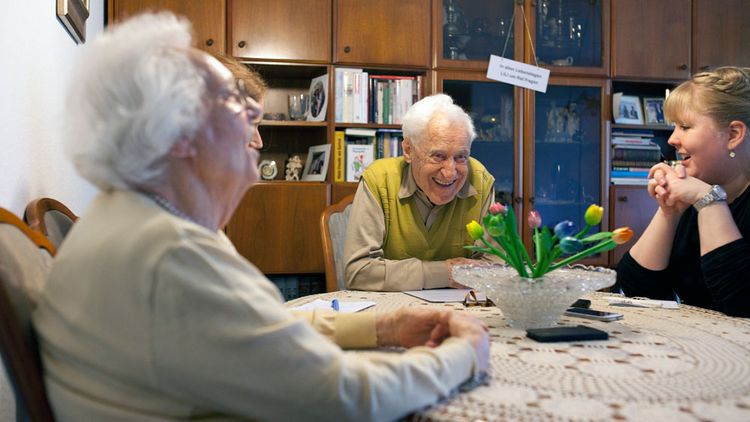
It came as a shock – and yet it was also a moment that unleashed a great deal of strength. With the sudden death of Siegmund Pluznik, Katharina Spirawski and her colleagues on the ‘Heimatsucher’ project lost not only a member of their association and a friend. It also marked the end of a Holocaust survivor’s life story, which they had made it their mission to pass on. The Oldenburg doctoral candidate was, of course, and remains, well aware that the eyewitnesses to the Shoah are now reaching an advanced age. Nevertheless, the death of the 91-year-old came as a surprise to her, especially as he had spoken to her on the phone only shortly before.
Katharina Spirawski (formerly Hermes), who has been a research assistant in religious education for a year, often reflects on the funeral. This turning point has once again brought home to her the mission of her association: “We really are the last generation who can still meet these people. If we don’t do this now, it’s over. Then no one else will do it, and the stories will eventually be lost.” Spirawski is certain: Siegmund Pluznik would want the “Heimatsucher” to carry on – and “do even more”. In a sense, it is also his legacy that she is now bringing the initiative to the University of Oldenburg and the wider region.
Listening and becoming “secondary witnesses”
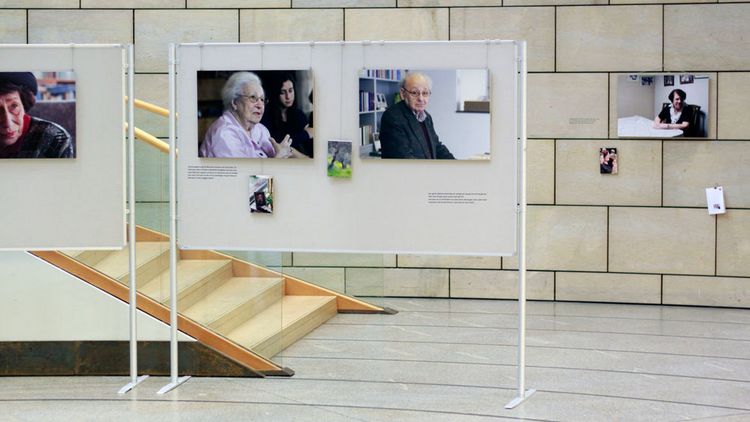
The “Heimatsucher” began as a student project. Two of Spirawski’s friends travelled from Münster to Israel in 2011 to meet Holocaust survivors. It was only afterwards that the idea arose to turn the biographies into exhibitions, on the one hand, and to offer pupils from Year 4 onwards a different kind of learning experience, on the other. The new Oldenburg resident, who was then a trainee teacher in Osnabrück, helped to develop the educational concept. The core idea is that by engaging with the eyewitnesses and their stories of survival, people become ‘secondary witnesses’. This draws on a quote from Nobel Peace Prize laureate Elie Wiesel: ‘We who listen can become witnesses.’ In this way, the ‘Heimatsucher’ aim to put a face to the history of the Holocaust, moving beyond abstract facts and figures, and thereby specifically empowering young people to stand up against racism.
To date, the ‘Heimatsucher’ have met 25 eyewitnesses, many of them in Germany, and are passing on their stories. Through 16 exhibitions across Germany to date, they have enabled 12,000 people to become ‘secondary witnesses’, with a further 3,500 reached through school visits. What began in 2014 as a handful of young people has grown into an association that now has 75 volunteers. It has already received several awards, for example from the Federal Agency for Civic Education, Chancellor Angela Merkel and, most recently, the Israel Foundation in Germany.
In Oldenburg, Spirawski is now working with a group of students on a voluntary basis to organise another exhibition, with the aim of raising awareness of the ‘Heimatsucher’ in the region. The topic of ‘Holocaust education’ is also reflected in her research for her doctoral thesis – and in her teaching: on the one hand, she is planning a student excursion to the former Auschwitz concentration camp, where links can be drawn to the biographies of survivors she knows personally. Secondly, since January, Spirawski has been running a project under the umbrella of the ‘Villa GeistReich’ teaching and learning laboratory: at the intersection of history, theology and ethics, students can develop a concept for teaching about the Holocaust in the region and later help to implement school projects.
“Whatever moves us is injustice”
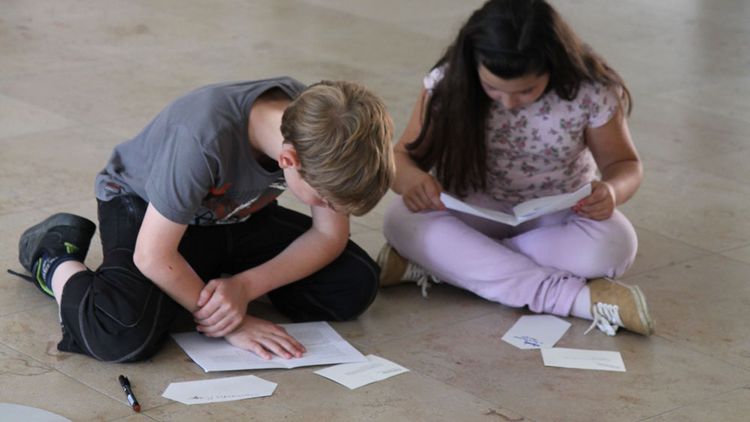
These vary depending on the year group. However, the focus is always on an emotional approach to the subject. “When I visit school classes, for example, I recount in great detail the story of a survivor. What it was like to meet him, what kind of person he was to me,” says Spirawski. She and her colleagues always approached these visits with the utmost respect, only to find themselves sitting opposite, for instance, a “nice old gentleman”, “with whom you laugh and cry, who brings out wine and biscuits, and who even cooks for you”. She would then later tell the pupils “what he had experienced before the Shoah, what it was like to be persecuted – and to carry on afterwards. Perhaps having lost everything and yet not giving up.” The fact that someone else recounts this story provides enormous emotional relief for many survivors.
For the ‘Heimatsucher’ programme, it’s not just about the 13 years of National Socialism, but about a whole life story in each case, one that offers many points of identification. “What always moves people is injustice. When we tell younger pupils about an eyewitness who was really good at school and only got top marks, and then a teacher came along who said, ‘All Jews are stupid,’ and turned those top marks into the lowest grades: the children simply cannot comprehend that – it’s so unjust from their point of view!” But she also notices that pupils who may have been through a fair bit themselves can draw hope from these life stories, says Spirawski. “To think, ‘OK, they went through some really terrible things, but somehow they managed to carry on, managed to start a family, got a job – I can do that too.’”
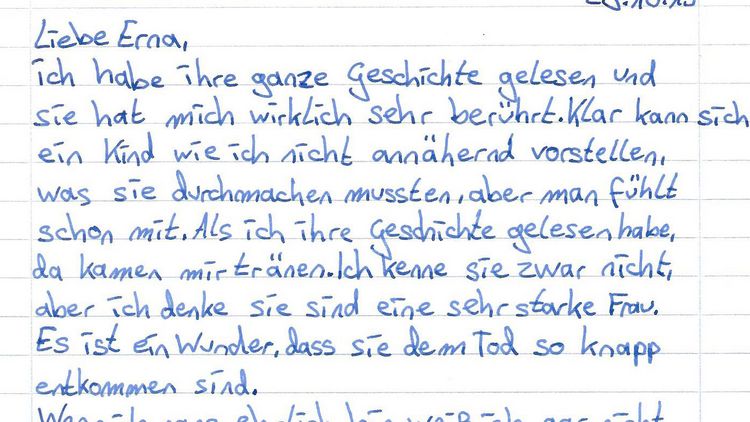
The children and young people can then express their thoughts and feelings in a letter to the eyewitness, whose ‘secondary witness’ they have become. “That brings the topic back down to a level that makes it really tangible,” explains Spirawski. Most of the letters contained the message, in simple words, “I’m glad you survived” or “how wonderful that you were able to live on”. This empathy shown by the children is something that deeply moves the survivors. Spirawski recalls the words of one eyewitness: “For so many years I didn’t feel seen as a human being; now I am seen as a human being.”