
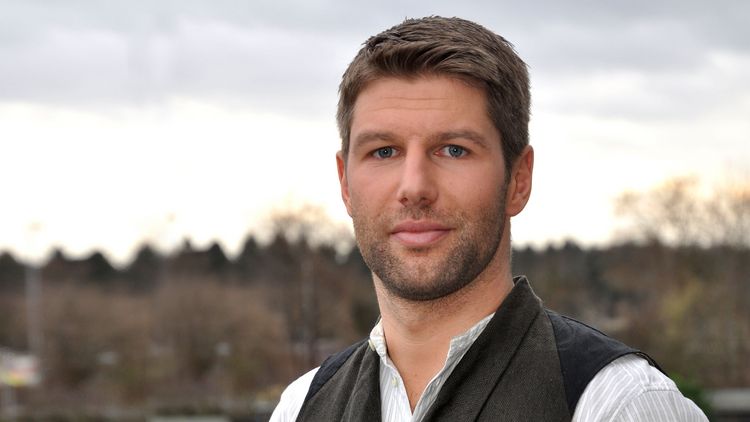

The coming out of former professional footballer Thomas Hitzlsperger is making waves. Is a cultural change underway? An interview with Oldenburg sociologist Thomas Alkemeyer about homophobia on the cinder pitches of the district leagues and in the arenas of professional football.
QUESTION: Mr Alkemeyer, will Hitzlsperger's coming out change football? ALKEMEYER: It will at least support a cultural change that had already begun to emerge even in this traditional male domain. The former international has sent out a clear signal. The still self-evident image that such a "men's sport" is exclusively for "real", i.e. heterosexual men, has been further undermined. QUESTION: Why can the private sexual orientation of a footballer trigger a social debate? ALKEMEYER: Because football is the most popular sport, at least in Germany, and is still perceived as a male bastion. The huge response to Hitzlsperger's openness is the best proof of this. An artist or musician who comes out as gay no longer upsets anyone. It is still recognised in politics, but it is no longer as big a deal as it is in football. The agitated reactions from all possible areas of society, in the old mass media as well as in the new social networks, prove the matter-of-factness with which it is assumed everywhere that football is no place for gays. Its history as an "arena of masculinity" still has an impact today. QUESTION: Why can German professional sportswomen such as national goalkeeper Nadine Angerer or former national player Steffi Jones live openly homosexual lives without the public being bothered for long, while Hitzlsperger's coming-out interview causes the Zeit.de server to crash at short notice? ALKEMEYER: Because the women are obviously not very surprised. And this is just the other side of the excitement surrounding gay footballers coming out. The lack of excitement about the confessions of lesbian athletes confirms the theory that football is still perceived as a playing field of masculinity. This is precisely why female footballers, and sportswomen in general, who make a "career" in traditionally male sports, are often - whether explicitly or behind closed doors - labelled as lesbians. When one of these athletes speaks openly about her homosexuality, hardly anyone is surprised. It fits in with classic patterns of perception. People take note of it or see it as proof of something they already knew. QUESTION: Male toughness and unconditional assertiveness have so far been the attributes in professional sport without which nothing works. A pass that is played too softly and gets stuck in the turf is a "gay pass", as Hitzlsperger describes it in his video message . But on the pitch, the aggro leader of old has had his day, and modern players have plucked eyebrows and shaved chests. How does that all fit together? ALKEMEYER: The changes in playing style are part of the emerging cultural shift. On the pitch, it manifests itself in an embodied, sensually recognisable form. Christof Kneer rightly spoke of a culture war between rival football factions in the Süddeutsche Zeitung. The stylish attacking football introduced to the German national team by Joachim Löw stands in opposition to the fighting and "Panzerknacker football" of the past. The contrast is emphasised in the images provided by both styles: on the one hand, the dancing elegance and lightness of Mesut Özil's movements, on the other, the strained, grim body language of the macho "leaders" of days gone by. A "retro faction" of coaches, officials, player counsellors and fans deride the new style as "gay" because it shakes their worldview and self-image to its very foundations. For them, the new style is proof that the world is coming apart at the seams. This uncertainty is a breeding ground for homophobia and corresponding statements. QUESTION: "Modern football is no place for yesterday's people and people with outdated prejudices," says Hitzlsperger on his website hitzlsperger.de. How realistic do you think it is that openly homosexual people will be able to stand on the pitch in the near future without being vilified? ALKEMEYER: The homophobia on the cinder pitches of the district leagues and in the arenas of professional football shows that "dusty prejudices" still find a "living space" here. In general, however, Hitzlsperger is right - or so we hope. Nevertheless, it must be recognised: There are discrepancies between the official support for Hitzlsperger's openness from politicians or professional colleagues and the everyday life of football. QUESTION: In what way? ALKEMEYER: Players who are still active and come out as gay have to fear not only being exposed to open abuse from some (opposing) fans, but also to casual innuendo or furtive glances from other players. Homophobia can also be subtle. It will take time for this to pass. It is likely that tolerance, or at least indifference, towards homosexuality will develop even faster in professional teams than on football pitches in the provinces, where relationships between players and spectators are more village-like: people know each other, they meet up after the game for a beer, they cultivate personal relationships. Relationships in professional sport are more impersonal and, in this sense, more metropolitan. This also has its good points, as we have known since Walter Benjamin: It allows freedom. You can almost be grateful to the "money economy" that Benjamin was still talking about.
Contact
Prof Dr Thomas Alkemeyer
Institute of Sport Science
Tel: 0441-798/4622
thomas.alkemeyer@uni-oldenburg.de